Kirjojen hintavertailu. Mukana 12 016 292 kirjaa ja 12 kauppaa.

Kirjahaku

Etsi kirjoja tekijän nimen, kirjan nimen tai ISBN:n perusteella.

17 kirjaa tekijältä Stuart Clark

Thinking with Demons

Thinking with Demons

Stuart Clark

Clarendon Press
1997
sidottu
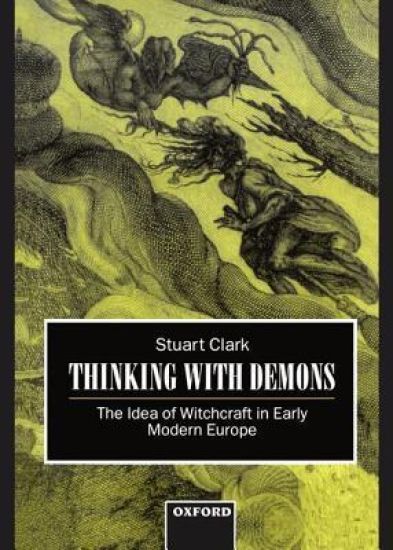
This is a work of fundamental importance for our understanding of the intellectual and cultural history of early modern Europe. Stuart Clark offers a new interpretation of the witchcraft beliefs of European intellectuals based on their publications in the field of demonology, and shows how these beliefs fitted rationally with many other views current in Europe between the fifteenth and eighteenth centuries. Professor Clark is the first to explore the appeal of demonology to early modern intellectuals by looking at the books they published on the subject during this period. After examining the linguistic foundations of their writings, the author shows how the writers' ideas about witchcraft (and about magic) complemented their other intellectual commitments--in particular, their conceptions of nature, history, religion, and politics. The result is much more than a history of demonology. It is a survey of wider intellectual and ideological purposes, and underlines just how far the nature of rationality is dependent on its historical context.
Thinking with Demons

Thinking with Demons

Stuart Clark

Oxford University Press
1999
nidottu
Aiming to illuminate the intellectual and cultural history of early modern Europe, Stuart Clark interprets witchcraft beliefs of European intellectuals based on their publications, and shows how these beliefs fitted rationally with many other views current in 15th-18th century Europe.
Vanities of the Eye

Vanities of the Eye

Stuart Clark

Oxford University Press
2007
sidottu
Vanities of the Eye investigates the cultural history of the senses in early modern Europe, a time in which the nature and reliability of human vision was the focus of much debate. In medicine, art theory, science, religion, and philosophy, sight came to be characterised as uncertain or paradoxical - mental images no longer resembled the external world. Was seeing really believing? Stuart Clark explores the controversial debates of the time - from the fantasies and hallucinations of melancholia, to the illusions of magic, art, demonic deceptions, and witchcraft. The truth and function of religious images and the authenticity of miracles and visions were also questioned with new vigour, affecting such contemporary works as Macbeth - a play deeply concerned with the dangers of visual illusion. Clark also contends that there was a close connection between these debates and the ways in which philosophers such as Descartes and Hobbes developed new theories on the relationship between the real and virtual. Original, highly accessible, and a major contribution to our understanding of European culture, Vanities of the Eye will be of great interest to a wide range of historians and anyone interested in the true nature of seeing.
Vanities of the Eye

Vanities of the Eye

Stuart Clark

Oxford University Press
2009
nidottu
Vanities of the Eye investigates the cultural history of the senses in early modern Europe, a time in which the nature and reliability of human vision was the focus of much debate. In medicine, art theory, science, religion, and philosophy, sight came to be characterised as uncertain or paradoxical - mental images no longer resembled the external world. Was seeing really believing? Stuart Clark explores the controversial debates of the time - from the fantasies and hallucinations of melancholia, to the illusions of magic, art, demonic deceptions, and witchcraft. The truth and function of religious images and the authenticity of miracles and visions were also questioned with new vigour, affecting such contemporary works as Macbeth - a play deeply concerned with the dangers of visual illusion. Clark also contends that there was a close connection between these debates and the ways in which philosophers such as Descartes and Hobbes developed new theories on the relationship between the real and virtual. Original, highly accessible, and a major contribution to our understanding of European culture, Vanities of the Eye will be of great interest to a wide range of historians and anyone interested in the true nature of seeing.
Languages of Witchcraft

Languages of Witchcraft

Stuart Clark

Red Globe Press
2000
nidottu
Different conceptions of the world and of reality have made witchcraft possible in some societies and impossible in others. How did the people of early modern Europe experience it and what was its place in their culture? The new essays in this collection illustrate the latest trends in witchcraft research and in cultural history in general. After three decades in which the social analysis of witchcraft accusations has dominated the subject, they turn instead to its significance and meaning as a cultural phenomenon - to the 'languages' of witchcraft, rather than its causes. As a result, witchcraft seems less startling than it once was, yet more revealing of the world in which it occurred.
The Sun Kings

The Sun Kings

Stuart Clark

Princeton University Press
2009
pokkari
In September of 1859, the entire Earth was engulfed in a gigantic cloud of seething gas, and a blood-red aurora erupted across the planet from the poles to the tropics. Around the world, telegraph systems crashed, machines burst into flames, and electric shocks rendered operators unconscious. Compasses and other sensitive instruments reeled as if struck by a massive magnetic fist. For the first time, people began to suspect that the Earth was not isolated from the rest of the universe. However, nobody knew what could have released such strange forces upon the Earth--nobody, that is, except the amateur English astronomer Richard Carrington. In this riveting account, Stuart Clark tells for the first time the full story behind Carrington's observations of a mysterious explosion on the surface of the Sun and how his brilliant insight--that the Sun's magnetism directly influences the Earth--helped to usher in the modern era of astronomy. Clark vividly brings to life the scientists who roundly rejected the significance of Carrington's discovery of solar flares, as well as those who took up his struggle to prove the notion that the Earth could be touched by influences from space. Clark also reveals new details about the sordid scandal that destroyed Carrington's reputation and led him from the highest echelons of science to the very lowest reaches of love, villainy, and revenge. The Sun Kings transports us back to Victorian England, into the very heart of the great nineteenth-century scientific controversy about the Sun's hidden influence over our planet.
The Unknown Universe: A New Exploration of Time, Space, and Modern Cosmology
On March 21, 2013, the European Space Agency released a map of the afterglow of the Big Bang. Taking in 440 sextillion kilometres of space and 13.8 billion years of time, it is physically impossible to make a better map: we will never see the early universe in more detail. On the one hand, such a view is the apotheosis of modern cosmology, on the other, it threatens to undermine almost everything we hold cosmologically sacrosanct.The map contains anomalies that challenge our understanding of the universe. It will force us to revisit what is known and what is unknown, to construct a new model of our universe. This is the first book to address what will be an epoch-defining scientific paradigm shift. Stuart Clark will ask if Newton's famous laws of gravity need to be rewritten; if dark matter and dark energy are just celestial phantoms? Can we ever know what happened before the Big Bang? What's at the bottom of a black hole? Are there universes beyond our own? Does time exist? Are the once immutable laws of physics changing?
Beneath the Night

Beneath the Night

Stuart Clark

Guardian Faber Publishing
2021
nidottu
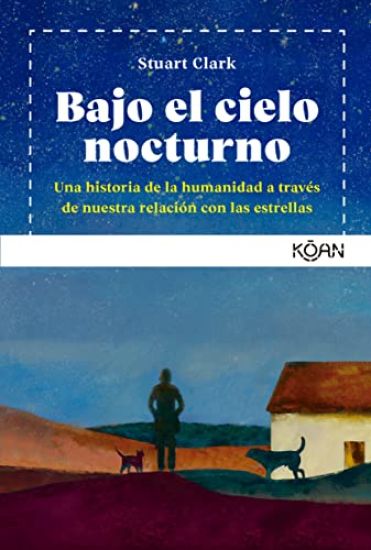
The awe-inspiring history of humanity told through our relationship with stars and the night sky.'Excellent . . . This books makes you rethink the traditional story of the history of astronomy . . . Effortlessly readable.' BBC Sky at Night'Stuart Clark's picture of the yawning gaps in our understanding of the cosmos is fuller than most.'NatureFrom the Stone Age to the Space Age, Stuart Clark explores a fascination shared across the world, one that has unequivocally shaped us as civilisations and as individuals, housing our hopes and fears. In the stars, we can see our past - and ultimately, our fate.
The Book of Mars

The Book of Mars

Stuart Clark

BLOOMSBURY PUBLISHING PLC
2022
sidottu
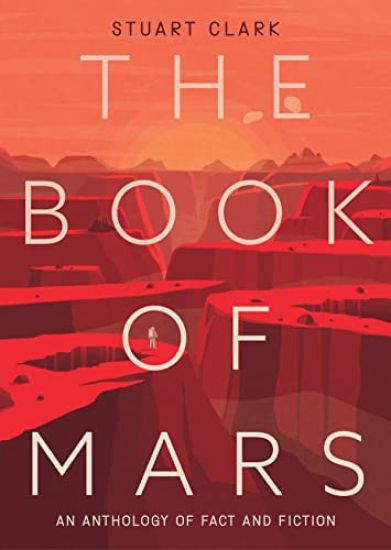
From myth to Musk, astrology to astronomy, Dr Stuark Clark selects the very best writing about the Red Planet. From its very first sighting, Mars has been a source of fascination for humanity. Named for the Roman god of war, this red planet has been explored more than any other beyond Earth and continues to occupy a distinctive place in our imagination. It's an environment that may even foster life.In The Book of Mars, Dr Stuart Clark selects one hundred pieces of writing about the planet. It is a collection that brings together fact and fiction, dreams and fears, centuries of observation and more recent feats of interstellar exploration.From classic writers of science fiction – Stanley G. Weinbaum, Arthur C. Clarke, H.G. Wells, Ray Bradbury, Pamela Sargent, Roger Zelazny – to distinguished experts in astronomy, astrobiology and aerospace engineering; from Hugo and Nebula Award-winning authors – Kim Stanley Robinson, Mary Robinette Kowal – to trail-blazing journalists and science communicators; from Andy Weir's The Martian to Elon Musk's SpaceX programme, The Book of Mars is an extraordinary overview both of the Red Planet and of the way scientific investigation diffuses into culture.
The Search For Earth's Twin

The Search For Earth's Twin

Stuart Clark

Quercus Publishing
2017
pokkari
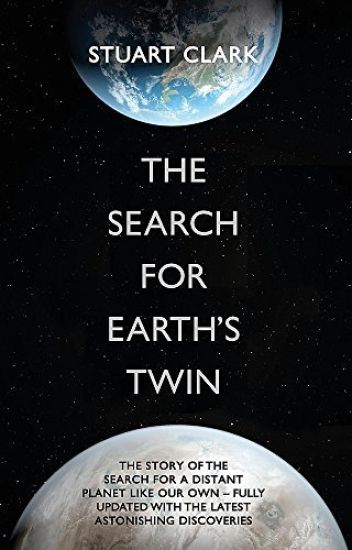
In 1995 two Swiss astronomers discovered a planet circling a star other than our Sun. This changed our perception of the Universe forever, proving that Earth and the other celestial bodies in our Solar System are not alone in outer space. Now, after a decade of exploration, more than 860 planets have been discovered, many of which are completely unlike anything else we know. Some are blacker than coal; some are bathed in molten lava; others are perpetually scoured by hurricane-force winds; some have not one sun but two that rise in the morning, and others are perpetually drowned in global oceans. But as well as strange, inhabitable lands, there is familiarity too. Some of these alien worlds are strikingly similar to planets in our Solar System. Astronomers now know of planets just like Jupiter, Neptune, Mars and Mercury orbiting stars similar to our Sun, both nearby and deep into space. Authoritatively written and fully up to date on this fast-moving area of science, The Search for the Earth's Twin will take you on a journey through the cosmos via frozen wastelands, slow-moving globes and fiery volcanic bodies, to planets that can - and just might - sustain complex life. The prospect of discovering the Earth's twin is now tantalisingly close.
Das unbekannte Universum

Das unbekannte Universum

Stuart Clark

Springer-Verlag Berlin and Heidelberg GmbH Co. KG
2017
muu
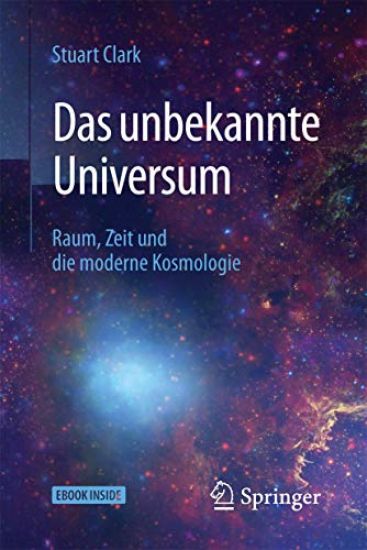
Eine Tour d'horizon bis an die Grenzen des Kosmos In zehn Kapiteln präsentiert Stuart Clark eine aktuelle Einführung in die Wissenschaft der Kosmologie: wie sie sich entwickelt hat, welche Konzepte und Personen sie maßgeblich geprägt haben, wo wir heute stehen – und wie es weitergehen könnte. Am 21. März 2013 veröffentlichte die Europäische Weltraumorganisation ESA eine neue Karte vom Echo des Urknalls. Diese – im Zuge der Planck-Mission erstellte – erste vollständige Karte der kosmischen Hintergrundstrahlung war ein wissenschaftlicher Paukenschlag. Über eine Zeit von 13,8 Milliarden Jahren hinweg und über einen Raum von 440 Trillionen Kilometern kann es physikalisch keine bessere Darstellung geben – das heißt, wir werden das frühe Universum kaum je detaillierter sehen. Einerseits erscheint eine solche Ansicht wie die Krönung der modernen Kosmologie, andererseits rüttelt sie an viele ihrer Grundfesten. Denn die Karte enthält Anomalien, die unser bisheriges Verständnis des Universums herausfordern. Sie zwingt uns, das, was bekannt ist, und das, was noch unbekannt ist, in neuem Licht zu betrachten. Wir werden ein verändertes Modell unseres Universums entwickeln müssen. Dies ist das erste Buch, das diesen epochalen wissenschaftlichen Paradigmenwechsel beleuchtet - und in einen breiteren Kontext stellt. Stuart Clark beschäftigt sich darin unter anderem mit der Frage, ob Newtons berühmte Gravitationsgesetze umgeschrieben werden müssen - oder ob die dunkle Materie und die dunkle Energie, die heute Schlagzeilen machen, etwa nur kosmische Phantome sind. Können wir jemals wissen, was vor dem Urknall passiert ist? Was befindet sich am Ende eines Schwarzen Loches? Gibt es Universen jenseits unseres eigenen? Existiert die Zeit? Wandeln sich die einst unveränderlich erscheinenden Gesetze der Physik?
Is There Life On Mars?

Is There Life On Mars?

Stuart Clark

Quercus Publishing
2014
nidottu
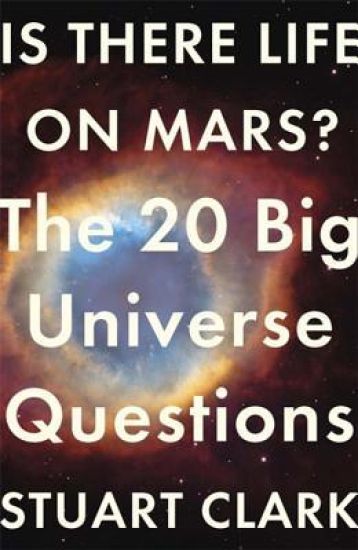
Is There Life On Mars? will help you start to answer 20 of the most perplexing and fascinating questions about the universe, such as: Why do the planets stay in orbit? Was Einstein right? What is Dark Matter? Are we made from Stardust? Is there cosmological evidence for God? Distilling the wisdom and research of scientists operating at the cutting edge of their field, Stuart Clark's book is a stimulating and challenging guide to the wonders of the universe.