Kirjojen hintavertailu. Mukana 11 224 866 kirjaa ja 12 kauppaa.

Kirjahaku

Etsi kirjoja tekijän nimen, kirjan nimen tai ISBN:n perusteella.

2 kirjaa tekijältä Subhash C. Ray

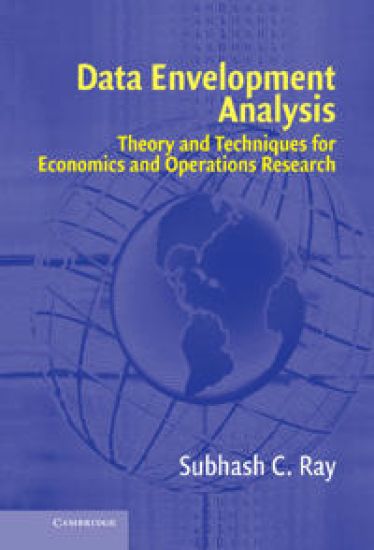
Data Envelopment Analysis

Data Envelopment Analysis

Subhash C. Ray

Cambridge University Press
2004
sidottu
Using the neo-classical theory of production economics as the analytical framework, this book, first published in 2004, provides a unified and easily comprehensible, yet fairly rigorous, exposition of the core literature on data envelopment analysis (DEA) for readers based in different disciplines. The various DEA models are developed as nonparametric alternatives to the econometric models. Apart from the standard fare consisting of the basic input- and output-oriented DEA models formulated by Charnes, Cooper, and Rhodes, and Banker, Charnes, and Cooper, the book covers developments such as the directional distance function, free disposal hull (FDH) analysis, non-radial measures of efficiency, multiplier bounds, mergers and break-up of firms, and measurement of productivity change through the Malmquist total factor productivity index. The chapter on efficiency measurement using market prices provides the critical link between DEA and the neo-classical theory of a competitive firm. The book also covers several forms of stochastic DEA in detail.
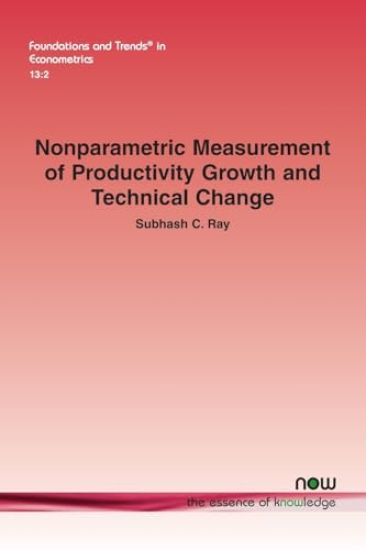
Nonparametric Measurement of Productivity Growth and Technical Change
Nonparametric Measurement of Productivity Growth and Technical Change explains how to isolate technical progress, scale effects, and efficiency changes as three distinct components of productivity change measured empirically using the nonparametric method of Data Envelopment Analysis (DEA). Section 2 provides a brief theoretical background, starting from the production possibility set, listing the basic assumptions about the reference technology, and defining the Shephard output and input distance functions, as well as technical change as shifts in the frontier of the production possibility set. Section 3 demonstrates how total factor productivity can be measured and decomposed into technical change, technical efficiency change, and scale effects using parametrically specified production, cost, profit, or distance functions. Section 4 explains the nonparametric method of DEA and formulates appropriate models for measuring input- or output-oriented technical efficiency, cost efficiency, and profit efficiency. Section 5 considers productivity change in discrete time. Section 6 explains the relationship between alternative productivity indexes and the Luenberger productivity indicator. Finally, Section 7 concludes with a summary and acknowledges several important topics related to the nonparametric measurement of productivity change not covered in this monograph, including the explicit accommodation of random noise in the DEA models, accounting for bad outputs, and the aggregation of firm-level measures of productivity change for comparison across groups.