Kirjojen hintavertailu. Mukana 11 244 527 kirjaa ja 12 kauppaa.

Kirjahaku

Etsi kirjoja tekijän nimen, kirjan nimen tai ISBN:n perusteella.

9 kirjaa tekijältä Sue Vice

Holocaust Fiction

Holocaust Fiction

Sue Vice

Routledge
2000
sidottu
Examining the controversies that have accompanied the publication of novels representing the Holocaust, this compelling book explores such literature to analyze their violently mixed receptions and what this says about the ethics and practice of millennial Holocaust literature. The novels examined, including some for the first time, are: * Time's Arrow by Martin Amis* The White Hotel by D.M. Thomas* The Painted Bird by Jerzy Kosinski* Schindler's List by Thomas Keneally* Sophie's Choice by William Styron* The Hand that Signed the Paper by Helen Darville.Taking issue with the idea that the Holocaust should only be represented factually, this compelling book argues that Holocaust fiction is not only legitimate, but an important genre that it is essential to accept. In a growing area of interest, Sue Vice adds a new, intelligent and contentious voice to the key debates within Holocaust studies.
Holocaust Fiction

Holocaust Fiction

Sue Vice

Routledge
2000
nidottu
Examining the controversies that have accompanied the publication of novels representing the Holocaust, this compelling book explores such literature to analyze their violently mixed receptions and what this says about the ethics and practice of millennial Holocaust literature. The novels examined, including some for the first time, are: * Time's Arrow by Martin Amis* The White Hotel by D.M. Thomas* The Painted Bird by Jerzy Kosinski* Schindler's List by Thomas Keneally* Sophie's Choice by William Styron* The Hand that Signed the Paper by Helen Darville.Taking issue with the idea that the Holocaust should only be represented factually, this compelling book argues that Holocaust fiction is not only legitimate, but an important genre that it is essential to accept. In a growing area of interest, Sue Vice adds a new, intelligent and contentious voice to the key debates within Holocaust studies.
Jack Rosenthal

Jack Rosenthal

Sue Vice

Manchester University Press
2012
nidottu
This is the first-ever critical work on Jack Rosenthal, the award-winning British television dramatist. His career began with Coronation Street in the 1960s and he became famous for his popular sitcoms, including The Lovers and The Dustbinmen. During what is often known as the golden age' of British television drama, Rosenthal wrote such plays as The Knowledge, The Chain, Spend, Spend, Spend and P'tang, Yang, Kipperbang, as well as the pilot for the series London's Burning. This study offers a close analysis of all Rosenthal's best-known works, drawing on archival material as well as interviews with his collaborators and cast members.It traces the events that informed his writing, ranging from his comic take on the permissive society' of the 1960s, through to recession in the 1970s and Thatcherism in the 1980s. Rosenthal's distinctive brand of humour and its everyday surrealism is contrasted throughout with the work of his contemporaries, including Dennis Potter, Alan Bleasdale and Johnny Speight, and his influence on contemporary television and film is analysed. Rosenthal is not usually placed in the canon of Anglo-Jewish writing but the book argues this case by focusing on his prize-winning Plays for Today The Evacuees and Bar Mitzvah Boy.This book will appeal to students and researchers in Television, Film and Cultural Studies, as well as those interested in contemporary drama and Jewish Studies.
Textual Deceptions

Textual Deceptions

Sue Vice

Edinburgh University Press
2014
sidottu
This book argues that literary deceptions and false memoirs have particular cultural value and significance. Sue Vice considers a wide range of 20th and 21st century literary deceptions. These include memoirs that were published as true accounts of such extreme experiences as surviving the Holocaust, life in a Los Angeles gang, and rehabilitation from drug addiction. Each of these memoirs turned out to be either wholly invented or substantially embellished. Equally, poetry by a survivor of Hiroshima, short stories by an Albanian writer, and novels by an American rent-boy and an Aboriginal woman, have been shown to have authors whose biographies are as fictive as their published works. The book explores both why such texts arise, including consideration of writers' motives as well as pressures from the publishing industry, readers' tastes and contemporary social issues, and also how such texts are constructed, concluding with an assessment of their literary merit. It analyses the background, literary construction and value of a wide range of recent false memoirs and literary deceptions. It considers whether internal detail alone is sufficient to identify the truth-value or otherwise of a text, or if other evidence must be invoked. It explores the contradiction between contemporary literary critics' adherence to Roland Barthes' notion of the 'death of the author', and the apparently supreme importance of the role and biography of authors in the scandals that accompany revelations of deception.
Claude Lanzmann’s 'Shoah' Outtakes

Claude Lanzmann’s 'Shoah' Outtakes

Sue Vice

Bloomsbury Academic
2021
sidottu
As we approach the end of the ‘era of the witness’, given the passing on of the generation of Holocaust survivors, Claude Lanzmann’s archive of 220 hours of footage excluded from his ground-breaking documentary Shoah (1985) offers a remarkable opportunity to encounter previously unseen interviews with survivors and other witnesses, recorded in the late 1970s. Although the archive is all available freely to view online and includes extra footage of those who appear in Shoah, this book focuses on the interviews from which no extracts appear in the finished film or in any subsequent release. The material analysed features interviews with such significant figures as the former partisan Abba Kovner, wartime activist Hansi Brand, Kovno Ghetto leader Leib Garfunkel, rescuer Tadeusz Pankiewicz and members of Roosevelt’s War Refugee Board, and focuses throughout on the efforts at rescue and resistance by those within and outside occupied Europe. Sue Vice contends that watching and analysing this wholly excluded footage gives us new insights into the making of Shoah through what was left out. Moreover, she reveals that the near-impossibility of rescue and often suicidal implications of resistance emerge through these excluded interviews as inextricable from the process of genocide. She concludes by arguing that the outtakes show the potential for new filmic forms envisaged on Lanzmann’s part in order to represent the crucial topics of attempted Holocaust rescue and resistance.
Claude Lanzmann’s 'Shoah' Outtakes

Claude Lanzmann’s 'Shoah' Outtakes

Sue Vice

BLOOMSBURY PUBLISHING PLC
2023
nidottu
As we approach the end of the ‘era of the witness’, given the passing on of the generation of Holocaust survivors, Claude Lanzmann’s archive of 220 hours of footage excluded from his ground-breaking documentary Shoah (1985) offers a remarkable opportunity to encounter previously unseen interviews with survivors and other witnesses, recorded in the late 1970s. Although the archive is all available freely to view online and includes extra footage of those who appear in Shoah, this book focuses on the interviews from which no extracts appear in the finished film or in any subsequent release. The material analysed features interviews with such significant figures as the former partisan Abba Kovner, wartime activist Hansi Brand, Kovno Ghetto leader Leib Garfunkel, rescuer Tadeusz Pankiewicz and members of Roosevelt’s War Refugee Board, and focuses throughout on the efforts at rescue and resistance by those within and outside occupied Europe. Sue Vice contends that watching and analysing this wholly excluded footage gives us new insights into the making of Shoah through what was left out. Moreover, she reveals that the near-impossibility of rescue and often suicidal implications of resistance emerge through these excluded interviews as inextricable from the process of genocide. She concludes by arguing that the outtakes show the potential for new filmic forms envisaged on Lanzmann’s part in order to represent the crucial topics of attempted Holocaust rescue and resistance.
Shoah

Shoah

Sue Vice

BLOOMSBURY PUBLISHING PLC
2026
nidottu
Sue Vice's study explores Claude Lanzmann's epic 1985 film Shoah both as cinema and as an example of Holocaust representation. Shoah, the distillation of more than 350 hours of footage gathered over eleven years, tells the story of the Holocaust through interviews with survivors of the extermination camps, bystanders who watched or participated in mass murder, and some of the perpetrators of genocide. Eschewing staple documentary elements of archival footage or narrating voiceover, the film is composed entirely of eyewitness interviews contrasted with footage of landscape in the present, and the chilling imagery of travelling trains. Shoah's effect is to represent the past, but only as it exists in the present - in Lanzmann's words, a "fiction of the real", and not a simple documentary.In a series of close readings of some of the film's interviews, Sue Vice follows Lanzmann's declaration that "Shoah is a fight against generalities", in emphasising the importance of detail in both dialogue and filmic technique. Through these analyses, Vice explores the background to the film, the difficulties in its financing and production, and the long process of editing that led to Lanzmann's realisation that "the subject of my film is death itself; death and not survival."In her afterword to this new edition, Sue Vice considers developments such as the online availability of the complete ‘Shoah Collection’, Lanzmann’s archive at the United States Holocaust Memorial Museum, and Shoah's continuing influence on films that witness genocides and the Holocaust, including Joshua Oppenheimer's The Look of Silence (2014), and Jonathan Glazer's The Zone of Interest (2023).
Shoah

Shoah

Sue Vice

BFI Publishing
2011
nidottu
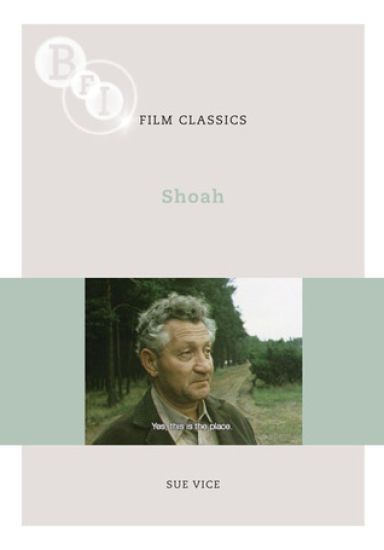
Claude Lanzmann's epic 1985 film 'Shoah' tells the story of the Holocaust through interviews with survivors of the extermination camps, bystanders who watched or participated in mass murder, and some of the perpetrators of genocide. Sue Vice addresses Lanzmann's central role in the film and the issue of representing the unrepresentable.