
Kirjahaku
Etsi kirjoja tekijän nimen, kirjan nimen tai ISBN:n perusteella.
367 kirjaa tekijältä Sun Tzu
Tzu Art of War: (Large Print Edition of Sun Tzu the Art of War Military Strategy)
Sun Tzu
Createspace Independent Publishing Platform
2010
nidottu
The Art Of War: The Art Of War: Sun Tzu
Sun Tzu
Createspace Independent Publishing Platform
2010
nidottu
L'arte della guerra un trattato di strategia militare attribuito, a seguito di una tradizione orale lunga almeno due secoli, al generale Sunzi (Sun Tzu), vissuto in Cina probabilmente fra il VI e il V secolo a.C. Importante stato il ritrovamento di un manoscritto in lingua originale scritto su un rotolo di bamb intorno al III secolo a.C.Si tratta probabilmente del pi antico testo di arte militare esistente (VI secolo a.C. circa). Sono tredici capitoli, ognuno dedicato ad un aspetto della guerra. Ebbe una grande influenza anche nella strategia militare europea. un compendio i cui consigli si possono applicare, al pari di altre opere della cultura sino-giapponese, a molti aspetti della vita, oltre che alla strategia militare. Ad esempio all'economia e alla conduzione degli affari. Il libro tuttora usato per la gestione del management di molte aziende di tutto il mondo.
The Art of War is an ancient Chinese military treatise attributed to Sun Tzu, a high-ranking military general, strategist and tactician. The text is composed of 13 chapters, each of which is devoted to one aspect of warfare. It is commonly known to be the definitive work on military strategy and tactics of its time. It has been the most famous and influential of China's Seven Military Classics, and "for the last two thousand years it remained the most important military treatise in Asia, where even the common people knew it by name." It has had an influence on Eastern and Western military thinking, business tactics, legal strategy and beyond.The book was first translated into the French language in 1772 by French Jesuit Jean Joseph Marie Amiot and a partial translation into English was attempted by British officer Everard Ferguson Calthrop in 1905. The first annotated English language translation was completed and published by Lionel Giles in 1910. Leaders as diverse as Mao Zedong, General Vo Nguyen Giap, Baron Antoine-Henri Jomini, General Douglas MacArthur and leaders of Imperial Japan have drawn inspiration from the work.Sun Tzu considered war as a necessary evil that must be avoided whenever possible. The war should be fought swiftly to avoid economic losses: "No long war ever profited any country: 100 victories in 100 battles is simply ridiculous. Anyone who excels in defeating his enemies triumphs before his enemy's threats become real". According to the book, one must avoid massacres and atrocities because this can provoke resistance and possibly allow an enemy to turn the war in his favor. For the victor, "the best policy is to capture the state intact; it should be destroyed only if no other options are available".Sun Tzu emphasized the importance of positioning in military strategy. The decision to position an army must be based on both objective conditions in the physical environment and the subjective beliefs of other, competitive actors in that environment. He thought that strategy was not planning in the sense of working through an established list, but rather that it requires quick and appropriate responses to changing conditions. Planning works in a controlled environment; but in a changing environment, competing plans collide, creating unexpected situations.
Sun Tzu - Die Kunst des Krieges: Neue deutsche Übersetzung
Sun Tzu
Createspace Independent Publishing Platform
2013
nidottu
Der chinesische General Sun Tzu beschrieb als Erster die Grunds tze milit rischer Strategie und Organisation. Sein Werk, das der Nachwelt als Die Kunst des Krieges bekannt ist, entstand wahrscheinlich im China des 5. vorchristlichen Jahrhunderts. Seine Doktrinen erwiesen sich als so erfolgreich, dass Sie viele Generationen lang, als Geheimwissen nur hohen und zuverl ssigen Offizieren zug nglich waren.Was ist so faszinieren an diesem Buch? Warum findet das Werk von Sun Tzu auch nach 2500 Jahren noch Anwendung?Warum begeistert Die Kunst des Krieges nicht nur Milit rstrategen, sondern wird auch in vielen nichtmilit rischen Bereichen aufmerksam beachtet?Es liegt daran, dass die Regeln und Doktrin, die Sun Tzu aufgestellt hat, auch heute noch die Basis vieler Unternehmensbereiche mitbestimmen. Dies gilt sowohl f r Unternehmensf hrung, Personalwesen und Projekt-Management, als auch f r Operations, Controlling oder Finanzen.Sun Tzu war ein erfolgreicher General. Seine Ausf hrungen und seine Wortwahl sind die eines Milit rs. Sie beziehen sich auf die F hrung einer Armee und nicht auf die F hrung eines Wirtschaftsunternehmens. Dennoch erkennt der Leser sofort die hnlichkeiten der Szenarien von milit rischen und wirtschaftlichen Operationen. Jeder erfasst sofort die Weisheit der Aussagen, die f r eine erfolgreiche Truppenf hrung gleicherma en gelten, wie f r die Mitarbeiterf hrung in kleinen oder gro en Unternehmen. Es wird deutlich, dass die Regeln einer milit rischen Auseinandersetzung auf vergleichbaren organisatorischen und strategischen Grunds tzen beruhen, wie die Durchf hrung einer globalen Marketingkampagne oder hnlicher Projekte.Sun Tzu ging es vor allem um Professionalit t und Effizienz. Eine Armee muss professionell ausgebildet sein und effizient gef hrt werden. Nur so k nnen die gew nschten Ziele erreicht werden, ohne dass dabei der eigene Staat leidet.Die Kunst des Krieges besteht aus 13 Kapiteln, die sich jeweils mit bestimmten Themengebieten aus theoretischer, praktischer und strategischer Sicht befassen. Dabei werden unter anderem die Grundlagen der Truppenf hrung, offensive und defensive Strategien, Gel ndekunde und die finanziellen Aspekte der Kriegsf hrung umfangreich besprochen.Die beschriebenen Regeln und Doktrin lassen sich einfach auf wirtschaftliche Bereiche wie Mitarbeiterf hrung- und F rderung, Unternehmensplanung, Sales- und Marketingkampagnen, Controlling und Finanzen anwenden.Dabei gibt es zwei Kernaussagen, die sich wie rote F den durch das Buch ziehen:1. Es ist zwingend Notwendigkeit, den Gegner, das Gel nde und die jeweils eigene Situation fortw hrend zu analysieren und zu bewerten. Nur so k nnen die f r den Sieg erforderlichen Entscheidungen getroffen werden.2. Nur eine gut gef hrte Armee kann auf Dauer erfolgreich sein. Gute F hrung ergibt vor allem aus den grunds tzlichen charakterlichen Eigenschaften des Generals und der F higkeiten seiner Offiziere.Gerade in den letzten Jahrzehnten haben sich viele Aussagen aus Die Kunst des Krieges als Schlagw rter in der ffentlichkeit etabliert.Spr che wie "Krieg basiert nur auf T uschung" oder "Kenne deinen Gegner und kenne dich selbst und in einhundert Schlachten wirst du nie in Gefahr sein.", sind allgegenw rtig.Doch wer das Buch nicht gelesen hat und nur die Schlagw rter kennt, dem ist sicher auch nicht bewusst, dass es dort hei t: Wer sowohl den Gegner als auch seine eigenen Eigenschaften ignoriert, wird sicherlich in jeder Schlacht in Gefahr sein.Die Kunst des Krieges ist viel mehr, als nur eine Sammlung von Schlagw rtern. Es die Weisheit eines der bekanntesten Gener le der Menschheitsgeschichte. Nehmen Sie seine Doktrin an, dann werden auch Sie in der Lage sein, eigene Situationen und Strategien zu erschaffen und diese zu Ihrem Vorteile zu nutzen.Sollten Sie seinen Doktrinen keine Beachtung schenken, k nnen Sie nur darauf hoffen, dass Gl ck Ihnen zum Erfolg verhilft.3. vollst ndig berarbeitete A
Sun Tzu on The Art of War: The Oldest Military Treatise in the World
Sun Tzu
Createspace Independent Publishing Platform
2015
nidottu
Sun Tzu said: The art of war is of vital importance to the State. It is a matter of life and death, a road either to safety or to ruin. Hence it is a subject of inquiry which can on no account be neglected. The art of war, then, is governed by five constant factors, to be taken into account in one's deliberations, when seeking to determine the conditions obtaining in the field. These are: (1) The Moral Law; (2) Heaven; (3) Earth; (4) The Commander; (5) Method and discipline.
The Art of War: Sun Tzu on The Art of War
Sun Tzu
Createspace Independent Publishing Platform
2018
nidottu
Sun Tzu on The Art of War. Translated from the Chinese with Introduction and Critical Notes by Lionel Giles. The Art of War is an ancient Chinese military treatise dating from the Spring and Autumn period. The work, which is attributed to the ancient Chinese military strategist Sun Tzu, is composed of 13 chapters. The Art of War is traditionally attributed to a military general from the late 6th century BC known as "Master Sun" (Sunzi or Sun Tzu), though its earliest parts probably date to at least 100 years later. Sima Qian's 1st century BC work Records of the Grand Historian (Shiji), the first of China's 24 dynastic histories, records an early Chinese tradition stating that a text on military matters was written by a "Sun Wu" from the State of Qi, and that this text had been read and studied by King Helu of Wu (r. 514-495 BC).
Sun Tzu - The Art of War - The Illustrated Edition
Sun Tzu
Archive Media Publishing Ltd
2012
pokkari
Sun Tzu - The Art of War - The Illustrated Edition
Sun Tzu
Archive Media Publishing Ltd
2012
sidottu
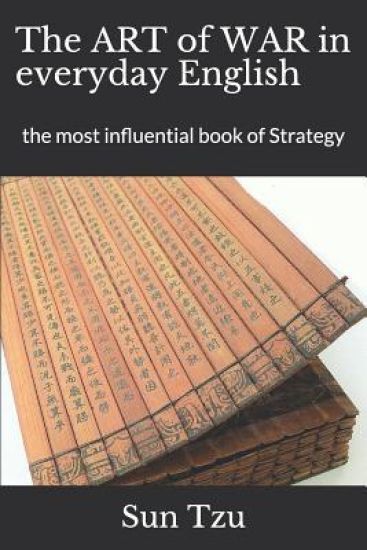
Sun Tzu's the Art of War in Everyday English: The Most Influential Book of Strategy
Sun Tzu
Independently Published
2018
nidottu
The Art of War remains the most influential strategy text in warfare. It has a great influence on East Asian and Western military thinking, business tactics, legal strategy, sports and beyond. The Art of War is an ancient Chinese military treatise dating from the Spring and Autumn period. 2500 year old this classic work is attributed to the ancient Chinese general Sun Tzu ("Master Sun," also spelled Sunzi, born in 544 BC and died in 496 BC). The Art of War is 13 chapters book on Strategy. The Art of War was first translated and published into French in 1772 by the French Jesuit Jean Joseph Marie Amiot and a partial translation into English was attempted by British officer Everard Ferguson Calthrop in 1905 under the title The Book of War. The first annotated English translation was completed and published by Lionel Giles in 1910. Numerous military and political leaders such as the Chinese communist revolutionary Mao Zedong, Japanese daimyo Takeda Shingen, and American military general Norman Schwarzkopf, Jr. have drawn inspiration from the book. The Art of War is traditionally ascribed to Sun Tzu. It presents a philosophy of war for managing conflicts and winning battles. It is accepted as a masterpiece on strategy and has been frequently cited and referred to by generals and theorists since it was first published, translated, and distributed internationally. There are numerous theories concerning when the text was completed and concerning the identity of the author or authors, but archeological recoveries show The Art of War had taken roughly its current form by at least the early Han. Because it is impossible to prove definitively when the Art of War was completed before this date, the differing theories concerning the work's author or authors and date of completion are unlikely to be completely resolved. Some modern scholars believe that it contains not only the thoughts of its original author but also commentary and clarifications from later military theorists, such as Li Quan and Du Mu. On April 10, 1972, the Yinqueshan Han Tombs were accidentally unearthed by construction workers in Shandong. Scholars uncovered a collection of ancient texts written on unusually well-preserved bamboo strips. Sun Tzu's Art of War has influenced many notable figures. The Chinese historian Sima Qian recounted that China's first historical emperor, Qin's Shi Huangdi, considered the book invaluable in ending the time of the Warring States. In the 20th century, the Chinese Communist leader Mao Zedong partially credited his 1949 victory over Chiang Kai-shek and the Kuomintang to The Art of War. The work strongly influenced Mao's writings about guerrilla warfare, which further influenced communist insurgencies around the world. In present edition of
?Sun Tzu zwingt uns dazu, genau abzuwägen, ob und wenn ja, unter welchen Bedingungen ein Krieg geführt werden soll. Zum Ideal aber erklärt er eine Strategie des Sieges ohne Kampf.?
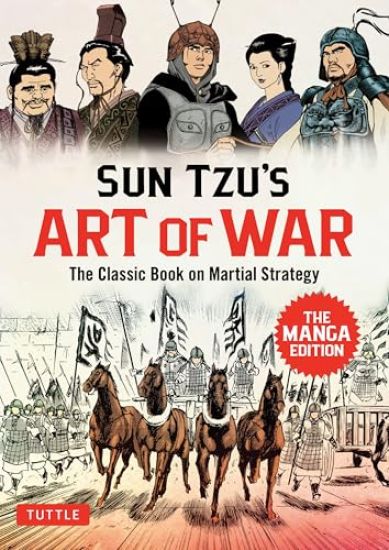
Learn the full back story behind the world's greatest book on military strategy!The Art of War is one of the world's great masterpieces—presenting timeless strategies that are as important in the boardroom as on the battlefield. Now, experience Sun Tzu's classic as never before in this riveting graphic novel brimming with battles, betrayals and political intrigues.The book recounts the conflict between the kingdom of Wu as they plot to attack the far more powerful state of Chu, with both leaders navigating internal plots and power struggles that will forever alter the fate of China. The fascinating accounts in this book include:The story of Sun Tzu, who became a trusted advisor to the powerful Wu clan and then a master military strategist, capturing the attention of Wu Zixu, the clan's most formidable generalThe creation of the military strategies in The Art of War, as Sun Tzu develops his revolutionary philosophy of asymmetrical warfareThe high-stakes Battle of Boju where Sun Tzu's teachings take center stage, shaping a battle that will become legendary in the chronicles of military historyAnd many other fascinating stories!Sun Tzu's Art of War brings to life not only the tactical brilliance of Sun Tzu's teachings but also the human drama behind them—the ambition, sacrifice and the relentless pursuit of victory.
A Arte da Guerra a b blia dos estrategistas. Sai do universo militar para conquistar o mundo pol tico e empresarial.H mais de 2.500 anos, o general chin s Sun Tzu compilou os personagens filos ficos que sintetizam estrat gias eficientes. Mist rio, dissimula o, ast cia e surpresa s o os pilares deste tratado. Um livro profundo, repleto de met foras, que encanta e intriga os estudiosos no mundo todo.