Kirjojen hintavertailu. Mukana 11 699 587 kirjaa ja 12 kauppaa.

Kirjahaku

Etsi kirjoja tekijän nimen, kirjan nimen tai ISBN:n perusteella.

5 kirjaa tekijältä Susanne Tietze

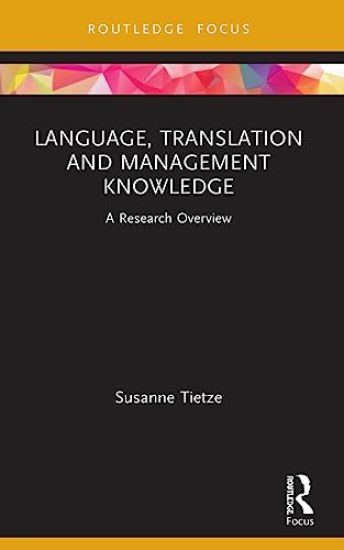
Language, Translation and Management Knowledge
The book provides insights, description and analysis over the knowledge production process within business, organization, and management research. Importantly, it does so from a language and translation perspective. It critically engages with the role of English in this process and provides theoretical argument for the need to include multilingualism in research. Translation is investigated as a concept for future inquiry.The book is expressive and formative of language-based research that is gaining momentum in business, management, and organization research. It offers conceptual innovation through a thorough treatment of multilingualism and translation, having the potentiality to guide future empirical and theoretical research, and to dispel hidden hegemonic knowledge production practices. The readers will gain insights into the current status quo of language-based inquiry, discussions of multilingualism for research design and be informed about the philosophical underpinnings of language-based research. Specifically, the benefits include the review and summary of key publications in this field, discussion and analysis of hidden assumptions of knowledge production, a critical take on knowledge production, an outline and discussion of implications of multilingual research for research design and methods, discussion of philosophical underpinnings and a vision for future research.The book is an invaluable source for all research students whose projects contain elements of multilingual research, whether empirical or theoretical. Likewise, the growing body of researchers who take a language-sensitive approach to their research may find it as a source that ‘pulls together’ the current knowledge status quo while offering discussions of future trajectories. The book is extremely useful for the teaching of research methods in undergraduate, postgraduate and also Master’s or doctoral programmes as many students are not native English speakers and are directly confronted with the subject matter of the book.

International Management and Language
Globalization processes have resulted in the emergence of business and management networks in which the sharing of knowledge is of crucial importance. Combining two contemporary and important subject areas – namely that of international management and also language and communication in multi-language contexts – the author of this book presents a wealth of ideas, examples and applications taken from international and global contexts, which show that ‘language matters’ in the pursuit of international business affairs.The book establishes the theoretical core of its main ideas by introducing two orientations (social construction and linguistic relativity) and demonstrates how they can be drawn on to frame and understand the activities of managers. Highly innovative and topical, Susanne Tietze’s book will appeal to students of international management and international human resource management as well as those studying intercultural communication. It is also useful for managers and practitioners who work internationally.
Language, Translation and Management Knowledge

Language, Translation and Management Knowledge

Susanne Tietze

TAYLOR FRANCIS LTD
2023
nidottu
The book provides insights, description and analysis over the knowledge production process within business, organization, and management research. Importantly, it does so from a language and translation perspective. It critically engages with the role of English in this process and provides theoretical argument for the need to include multilingualism in research. Translation is investigated as a concept for future inquiry.The book is expressive and formative of language-based research that is gaining momentum in business, management, and organization research. It offers conceptual innovation through a thorough treatment of multilingualism and translation, having the potentiality to guide future empirical and theoretical research, and to dispel hidden hegemonic knowledge production practices. The readers will gain insights into the current status quo of language-based inquiry, discussions of multilingualism for research design and be informed about the philosophical underpinnings of language-based research. Specifically, the benefits include the review and summary of key publications in this field, discussion and analysis of hidden assumptions of knowledge production, a critical take on knowledge production, an outline and discussion of implications of multilingual research for research design and methods, discussion of philosophical underpinnings and a vision for future research.The book is an invaluable source for all research students whose projects contain elements of multilingual research, whether empirical or theoretical. Likewise, the growing body of researchers who take a language-sensitive approach to their research may find it as a source that ‘pulls together’ the current knowledge status quo while offering discussions of future trajectories. The book is extremely useful for the teaching of research methods in undergraduate, postgraduate and also Master’s or doctoral programmes as many students are not native English speakers and are directly confronted with the subject matter of the book.
International Management and Language
Globalization processes have resulted in the emergence of business and management networks in which the sharing of knowledge is of crucial importance. Combining two contemporary and important subject areas – namely that of international management and also language and communication in multi-language contexts – the author of this book presents a wealth of ideas, examples and applications taken from international and global contexts, which show that ‘language matters’ in the pursuit of international business affairs.The book establishes the theoretical core of its main ideas by introducing two orientations (social construction and linguistic relativity) and demonstrates how they can be drawn on to frame and understand the activities of managers. Highly innovative and topical, Susanne Tietze’s book will appeal to students of international management and international human resource management as well as those studying intercultural communication. It is also useful for managers and practitioners who work internationally.