Kirjojen hintavertailu. Mukana 11 244 527 kirjaa ja 12 kauppaa.

Kirjahaku

Etsi kirjoja tekijän nimen, kirjan nimen tai ISBN:n perusteella.

7 kirjaa tekijältä T. Harry Williams

The Selected Essays of T. Harry Williams

The Selected Essays of T. Harry Williams

T. Harry Williams

Louisiana State University Press
1999
nidottu
This first collection of the essays of the late T. Harry Williams brings together some of the best shorter works of a man who was, by any standard, one of the finest historians of our time. Spanning the range of Williams' interests, this volume contains essays on the Civil War, Reconstruction, the ear of the world wars, military affairs, the craft of the historian, and the careers of Abraham Lincoln, Huey Long, and Lyndon Johnson.Williams' reputation rests on such large-scale works as Lincoln and His Generals and the Pulitzer-Prize winning biography Huey Long- exhaustively researched studies, monumental in their scope and ambition. Providing Williams with the chance to let his gaze probe beyond the fixed borders of such works, the essay was a flexible medium in which he could freely pursue some of the ideas that grew out of his daily regimen of writing and reading. He used the essay to examine large themes that spanned many areas of his interests as well as specific incidents in the course of American history, to reach both a popular audience and his fellow historians, to test ideas for books in the planning stage, and to assess the works of his colleagues.Among the essays brought together in this volume are That Strange Sad War, in which Williams examines the Civil War as the first truly, and tragically, modern war; Abraham Lincoln: Pragmatic Democrat, which sees Lincoln as the supreme example in our history of the union of principle and pragmatism in politics; and The Louisiana Unification Movement of 1873, which traces the short history of an ambitious attempt to bring about racial unity in Reconstruction Louisiana. In Interlude: 1918-1939- an essay published here for the first time- Williams analyzes the weakened state of American military preparedness before Franklin Roosevelt came into office and turned his attention to the growing threat of Hitler's Germany.In The Macs and the Ikes: America's Two Military Traditions, Williams contrasts the opposing types of military leaders in American history- those generals in the mold of Dwight Eisenhower who follow orders and submit to the power of the president and Congress, and the more fractious generals such as Douglas Macarthur, who view the military as an aristocracy of courage and genius and bridle at the reigns of civilian authority. Huey, Lyndon, and Southern Radicalism traces the common political roots of two men Williams considered among the most successful ""power artists"" of the century. And in Lyndon Johnson and the Art of Biography, Williams discusses his own plans to write a biography of Johnson and speaks of his unapologetic belief in a great-man theory of history.
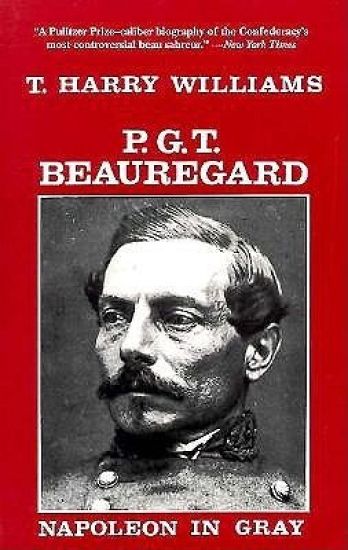
P. G. T. Beauregard

P. G. T. Beauregard

T. Harry Williams

Louisiana State University Press
1995
nidottu
First published in 1955 to wide acclaim, T. Harry Williams' P. G. T. Beauregard is universally regarded as ""the first authoritative portrait of the Confederacy's always dramatic, often perplexing"" general (Chicago Tribune). Chivalric, arrogant, and of exotic Creole Louisiana origin, Beauregard participated in every phase of the Civil War from its beginning to its end. He rigidly adhered to the principles of war derived from his studies of Jomini and Napoleon, and yet many of his battle plans were rejected by his superiors, who regarded him as excitable, unreliable, and contentious. After the war, Beauregard was almost the only prominent Confederate general who adapted successfully to the New South, running railroads and later supervising the notorious Louisiana Lottery. This paradox of a man who fought gallantly to defend the Old South and then helped industrialize it is the fascinating subject of Williams' superb biography.
P. G. T. Beauregard: Napoleon in Gray

P. G. T. Beauregard: Napoleon in Gray

T. Harry Williams

Literary Licensing, LLC
2013
sidottu
P. G. T. Beauregard: Napoleon In Gray is a biography of Pierre Gustave Toutant Beauregard, a prominent Confederate general during the American Civil War. Written by T. Harry Williams, the book delves into Beauregard's life and military career, from his early years in Louisiana to his rise to prominence as a military leader in the South.The book explores Beauregard's role in some of the most significant battles of the Civil War, including the First Battle of Bull Run and the Siege of Petersburg. It also delves into his relationships with other Confederate leaders, such as Jefferson Davis and Robert E. Lee, and his sometimes contentious interactions with his own subordinates.Throughout the book, Williams paints a vivid picture of Beauregard as a complex and sometimes contradictory figure. He portrays him as a brilliant military strategist and a charismatic leader, but also as a man prone to fits of temper and prone to political infighting.Overall, P. G. T. Beauregard: Napoleon In Gray offers a comprehensive and insightful look at one of the most important Confederate generals of the Civil War, shedding light on both his successes and his flaws.An Examination Of The Life And Tactics Of The Controversial Confederate General. Southern Biography Series.This scarce antiquarian book is a facsimile reprint of the old original and may contain some imperfections such as library marks and notations. Because we believe this work is culturally important, we have made it available as part of our commitment for protecting, preserving, and promoting the world's literature in affordable, high quality, modern editions, that are true to their original work.
Lincoln and His Generals

Lincoln and His Generals

T. Harry Williams

VINTAGE
2011
nidottu
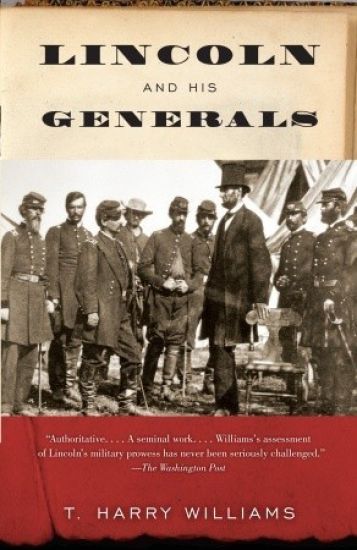
Since it was first published in 1952, Lincoln and His Generals has remained one of the definitive accounts of Lincoln's wartime leadership. In it T. Harry Williams dramatizes Lincoln's long and frustrating search for an effective leader of the Union Army and traces his transformation from a politician with little military knowledge into a master strategist of the Civil War. Explored in depth are Lincoln's often fraught relationships with generals such as McClellan, Pope, Burnside, Hooker, Fremont, and of course, Ulysses S. Grant. In this superbly written narrative, Williams demonstrates how Lincoln's persistent "meddling" into military affairs was crucial to the Northern war effort and utterly transformed the president's role as commander-in-chief.
Huey Long

Huey Long

T. Harry Williams

VINTAGE
1981
nidottu
Winner of the Pulitzer Prize and the National Book Award, this work describes the life of one of the most extraordinary figures in American political history. Huey Long was a great natural politician who looked, and often seemed to behave, like a caricature of the red-neck Southern politico, and yet had become at the time of his assassination a serious rival to Franklin D. Roosevelt for the Presidency. In this "masterpiece of American biography" New York Times Book Review], Huey Long stands wholly revealed, analyzed, and understood.
Americans at War

Americans at War

T. Harry Williams

Louisiana State University Press
1999
nidottu
In Americans at War T. Harry Williams, author of Lincoln and His Generals, offers a concise historical survey of the methods by which the United States government has sought to organize and direct our military forces from the days of the Revolutionary War to the Atomic Age.In giving his interpretative view of the development of the American command system, Dr. Williams demonstrates convincingly that the American genius- even the genius for making mistakes- has found full expression in the various systems which have been formulated.During the Revolutionary War, for instance, it was never finally determined just who had the ultimate authority in mapping strategy, Washington or the Continental Congress. The War of 1812 resulted in at least a technical defeat for the United States, Williams says, because of incompetent civilian authority over the military. In the Mexican War and the Civil War, the United States profited from strong war-time presidents, but during the Spanish-American War and World War I the civilian authority left something to be desired.Military men and the historians will welcome this first attempt to give an overall picture o the American command system through all our wars.""I know of no man,"" one prominent military authority has stated, ""who is better qualified by knowledge, insight, and writing ability to discuss the American military experience.