Kirjojen hintavertailu. Mukana 11 627 670 kirjaa ja 12 kauppaa.

Kirjahaku

Etsi kirjoja tekijän nimen, kirjan nimen tai ISBN:n perusteella.

9 kirjaa tekijältä Tal Ilan

Silencing the Queen

Silencing the Queen

Tal Ilan

Mohr Siebeck
2006
sidottu
Tal Ilan explores the way historical documents from antiquity are reworked and edited in a long process that ends in silencing the women originally mentioned in them. Many methods are used to produce this end result: elimination of women or their words, denigration of the women and their role or unification of several significant women into one. These methods and others are illuminated in this book, as it uses the example of the Jewish queen Shelamzion Alexandra (76-67 BCE) for its starting point. Queen Shelamzion was the only legitimate Jewish queen in history. Yet all the documents in which she is mentioned (Josephus, Qumran scrolls, rabbinic literature etc.) have been reworked so as to minimize her significance and distort the picture we may receive of her. Tal Ilan follows the ways this was done and in doing so she encounters similar patterns in which other Jewish women in antiquity were silenced, censored and edited out.
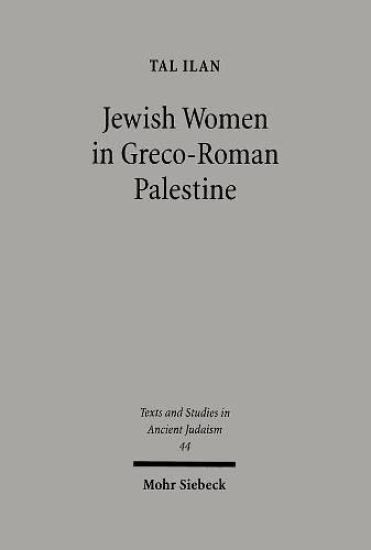
Jewish Women in Greco-Roman Palestine
Tal Ilan explores the real, as against the ideal social, political and religious status of women in Palestinian Judaism of the Hellenistic and Roman periods. The main conclusions of this investigations are that extreme religious groups in Judaism of the period influenced other groups, classes and factions to tighten their control of women and represent the ideal relationships beween men and women as requiring greater chastity, in order to prove their piety. However, the lives of real women, over and against their representation in the literature of the time, and their relationships to men as opposed to the ideals represented by legal codes, were much more varied and nuanced. This book integrates both Jewish and Early Christian sources together with a feminist critique."This book is a tour de force - a major piece of research and a 'must read' for all concerned with the recovery of women's history."Judith Romney Wegner in Journal of Biblical Literature 2 (1997), pp. 354"This fine collection of carefully analysed data will have lasting value..."Martin Goodman in Journal of Roman Studies vol. 88 (1998), p. 189"The scope of the work is impressive."Joshua Schwartz in Journal of Jewish Studies 1 (1997), pp. 156
Massekhet Ta'anit

Massekhet Ta'anit

Tal Ilan

Mohr Siebeck
2008
sidottu
Tal Ilan discusses tractate Ta'anit of the Babylonian Talmud, which deals with ritual fasting, usually in the case of rain failure. In this commentary, the author presents and discusses texts from the tractate which are relevant to women and gender. These include legal proclamations on the participation of women in public fasts, stories on pious men, whose proper conduct toward women make them ideal intermediaries for bringing rain and discussions of gendered rabbinic terms such as Bat Qol, usually translated as 'heavenly voice' but which literally translated means 'a daughter's voice'. The overall impression of this tractate is that it emphasizes the way the relationship between rainfall and the dry ground was imagined by the rabbis in a gendered metaphor of sexual relations in which rain is male and the land is female. This theme repeats itself in the tractate throughout.
Lexicon of Jewish Names in Late Antiquity
In this lexicon, Tal Ilan collects all the information on names of Jews in lands west of Palestine, in which Greek and Latin was spoken, and on the people who bore them between 330 BCE, a date which marks the Hellenistic conquest of East, and 650 CE, approximately the date when the Muslim conquest of East and the southern Mediterranean basin was completed. The corpus includes names from literary sources, but those mentioned in epigraphic and papyrological documents form the vast majority of the database. This lexicon is an onomasticon in as far as it is a collection of all the recorded names used by the Jews of the western Diaspora in the above-mentioned period. Tal Ilan discusses the provenance of the names and explains them etymologically, given the many possible sources of influence for the names at that time. In addition she shows the division between the use of biblical names and the use of Greek, Latin and other foreign names, and points out the most popular names. This book is also a prosopography since Ilan analyzes the identity of the persons mentioned therein.The lexicon is accompanied by a lengthy and comprehensive introduction that scrutinizes the main trends in name giving current at the time. A large part of it is devoted to the question of how one can identify a Jew in a mostly non-Jewish society.
Lexicon of Jewish Names in Late Antiquity
Although described as volume II, this is the last volume to appear in a series of four which documents all the named Jews whose record has come down to us from Antiquity. It lists all the Jewish people we know and those we think were Jews from Palestine after 200 CE and before the Arab conquest. Most of the information in it is derived from the Palestinian Talmud and from inscriptions from Jewish cemeteries such as Beit Shearim. Unlike the previous volumes in this series, this volume also lists all the Samaritans known by name from Palestine in this period. It includes more than 3000 entries. Together with the other books in this series, a record of more than 15,000 named Jews has been collected. From this collection it is possible to learn much about the cultural phenomenon of name-giving among Jews in Antiquity and the extent of their assimilation or separateness can be assessed. The entire series is thus a very useful resource for the study of cultural and social history and its utility to scholars will certainly be long lasting. The volume also includes a substantial addendum to volume 1, which appeared in print exactly ten years ago. It includes over 500 entries that had been overlooked in the previous volume, or that have meanwhile been published. In an appendix the results of the project team's research on inscriptions in Elijah's Cave in Haifa are presented. This cave is a venerated Jewish site to this day, although its religious character in Antiquity is the subject of debate. The team was able to read 50 inscriptions found on its wall and this added more than 70 names to the present volume.
Lexicon of Jewish Names in Late Antiquity
In this lexicon, Tal Ilan collects all the information on names of Jews in lands east of Palestine, in which Aramaic and Arabic was spoken, and on the people who bore them between 330 BCE, a date which marks the Hellenistic conquest of East, and 650 CE, approximately the date when the Muslim conquest of East and the southern Mediterranean basin was completed. The corpus includes names from literary sources, especially the Babylonian Talmud but those mentioned in epigraphic documents, especially incantation bowls in Aramaicare, are also an important factor of the database. This lexicon is an onomasticon in as far as it is a collection of all the recorded names used by the Jews of the eastern Diaspora in the above-mentioned period. Tal Ilan discusses the provenance of the names and explains them etymologically, given the many possible sources of influence for the names at that time. In addition, she shows the division between the use of biblical names and the use of foreign names, and points out the most popular ones. This book is also a prosopography, since Ilan analyzes the identity of the persons mentioned therein.The lexicon is accompanied by a lengthy and comprehensive introduction that scrutinizes the main trends in name giving current at the time. A large part of it is devoted to the question of how one can identify a Jew in a mostly non-Jewish society.
Massekhet Hullin

Massekhet Hullin

Tal Ilan

Mohr Siebeck
2017
sidottu
The Babylonian Talmud's Tractate Hullin is the longest in the Order of Qodashim with twelve chapters and over 140 pages. The Order of Qodashim ("holy things") deals with the Temple in general. The word hullin, however, means "profane things" and actually describes the kosher slaughter of beasts for human consumption outside the temple. Even though this topic is not overtly gendered, and neither does it pertain specifically to women, Tal Ilan discusses over 100 traditions that touch on women and gender in this book, She shows that "women" forever served as good "tools" with which to discuss various topics such as halakhic reliability, or the use of magic, but more specifically that while the tractate is intensely interested in beasts and beast anatomy, women most often serve as points of comparison with beasts for authors of the Talmud. In this way, the rabbinic world view of the intermediate position of women between human and beast is repeatedly demonstrated throughout the tractate.
Tractates Pe'ah, Demai and Kil'ayim
In this volume, Tal Ilan presents a feminist commentary on the first three mishnaic tractates of Seder Zera'im (Seeds) that have no Babylonian commentary. The first one, Pe'ah, is about charity. The commentary shows that, even though women in antiquity were poorer than men, and the Bible was aware of this, this tractate actually ignores them completely. Demai, the second tractate, is about doubtful tithing. Because it devotes much space to a sectarian organization known as the havurah , it is interesting to discover that this sect included women among its members. The third tractate, kil'ayim, is about forbidden mixtures - mixed breeding among animals, mixed weaving of two sorts of thread; the sowing of mixed crops in a field, or working the land with two different animals hitched together. The tractate is full of gendered metaphors that are discussed in detail.
Queen Berenice

Queen Berenice

Tal Ilan

BRILL
2022
sidottu
This is a biography of Queen Berenice, the daughter of King Agrippa I, sister of King Agrippa II, wife of two kings and lover of the emperor designate Flavius Titus. A Jew of the 1st century, she witnessed some of the foundational events of her time like the emergence of Christianity and the destruction of the Second Temple in Jerusalem, is. She met and socialized with the most important people of her day - Philo the Philosopher (who was at one time her brother-in-law), Paul the Apostle (whose trial she witnessed) and Josephus the Historian who told part of her story.