Kirjojen hintavertailu. Mukana 11 342 296 kirjaa ja 12 kauppaa.

Kirjahaku

Etsi kirjoja tekijän nimen, kirjan nimen tai ISBN:n perusteella.

3 kirjaa tekijältä Ted McCormick

William Petty

William Petty

Ted McCormick

Oxford University Press
2009
sidottu
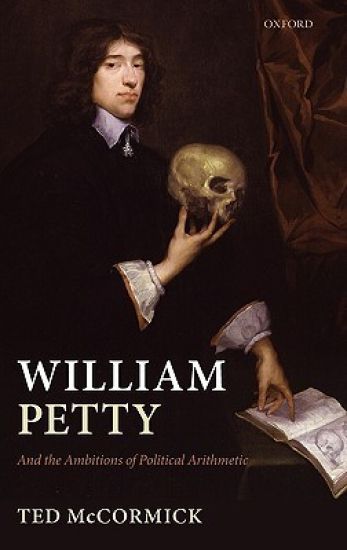
William Petty (1623-1687) was a key figure in the English colonization of Ireland, the institutionalization of experimental natural philosophy, and the creation of social science. Examining Petty's intellectual development and his invention of 'political arithmetic' against the backdrop of the European scientific revolution and the political upheavals of Interregnum and Restoration England and Ireland, this book provides the first comprehensive intellectual biography of Petty based on a thorough examination not only of printed sources but also of Petty's extensive archive and pattern of manuscript circulation. It is also the first fully contextualized study of what political arithmetic - widely seen as an ancestor of modern social and economic analysis - was originally intended to do. Ted McCormick traces Petty's education among French Jesuits and Dutch Cartesians, his early work with the 'Hartlib Circle' of Baconian natural philosophers, inventors, and reformers in England, his involvement in the Cromwellian conquest and settlement of Ireland, and his engagement with both science and the politics of religion in the Restoration. He argues that Petty's crowning achivement, political arithmetic, was less a new way of analysing economy or society than a new 'instrument of government' that applied elements of the new science - a mechanical worldview, a corpuscularian theory of matter, and a Baconian stress on empirical method and the transformative purposes of natural philosophy - to the creation of industrious and loyal populations. Finally, he examines the transformation Petty's program of social engineering, after his death, into an apparently apolitical form of statistical reasoning.
Human Empire

Human Empire

Ted McCormick

Cambridge University Press
2022
sidottu
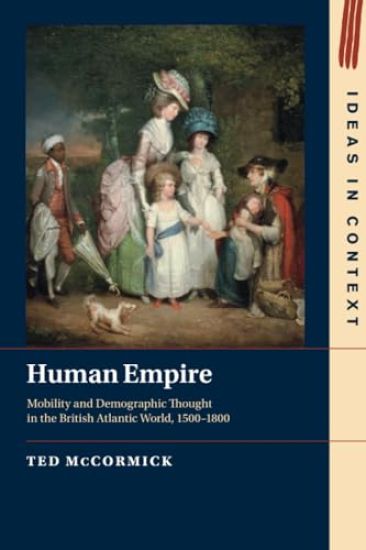
Arguing that demographic thought begins not with quantification but in attempts to control the qualities of people, Human Empire traces two transformations spanning the early modern period. First was the emergence of population as an object of governance through a series of engagements in sixteenth- and seventeenth-century England, Ireland, and colonial North America, influenced by humanist policy, reason of state, and natural philosophy, and culminating in the creation of political arithmetic. Second was the debate during the long eighteenth century over the locus and limits of demographic agency, as church, civil society, and private projects sought to mobilize and manipulate different marginalized and racialized groups – and as American colonists offered their own visions of imperial demography. This innovative, engaging study examines the emergence of population as an object of knowledge and governance and connects the history of demographic ideas with their early modern intellectual, political, and colonial contexts.
Human Empire

Human Empire

Ted McCormick

Cambridge University Press
2024
pokkari
Arguing that demographic thought begins not with quantification but in attempts to control the qualities of people, Human Empire traces two transformations spanning the early modern period. First was the emergence of population as an object of governance through a series of engagements in sixteenth- and seventeenth-century England, Ireland, and colonial North America, influenced by humanist policy, reason of state, and natural philosophy, and culminating in the creation of political arithmetic. Second was the debate during the long eighteenth century over the locus and limits of demographic agency, as church, civil society, and private projects sought to mobilize and manipulate different marginalized and racialized groups – and as American colonists offered their own visions of imperial demography. This innovative, engaging study examines the emergence of population as an object of knowledge and governance and connects the history of demographic ideas with their early modern intellectual, political, and colonial contexts.