Kirjojen hintavertailu. Mukana 12 290 406 kirjaa ja 12 kauppaa.

Kirjahaku

Etsi kirjoja tekijän nimen, kirjan nimen tai ISBN:n perusteella.

3 kirjaa tekijältä Teppo Valtonen

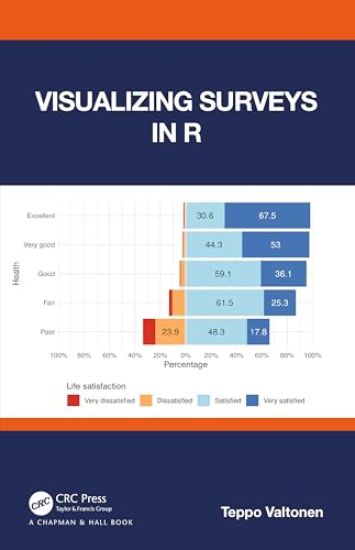
Visualizing Surveys in R

Visualizing Surveys in R

Teppo Valtonen

TAYLOR FRANCIS LTD
2025
nidottu
Visualizing Surveys in R is about creating static, print quality figures from survey data using R. The focus is not, for example, on statistical analysis of survey data, but rather on giving concrete solutions for typical problems in visualizing survey data. While there are many excellent books on data visualization, surveys and R, the aim of this book is to bring these topics together, and offer practical instructions for visualizing surveys in R. Features Introduction to survey data: variables, categories, and scales Description of a process for visualizing survey data Recommendations for reading survey data into R Advice on building a survey dataset in R to facilitate versatile plotting Step-by-step recipes in R for creating useful plots from survey data The book is intended for researchers who regularly use surveys and are interested in learning how to seize the vast possibilities and the flexibility of R in survey analysis and visualizations. The book is also valuable for psychologists, marketeers, HR personnel, managers, and other professionals who wish to standardize and automate the process for visualizing survey data. Finally, the book is suitable as a course textbook, either more widely on survey studies, or more strictly on visualizing survey data in R.
Visualizing Surveys in R

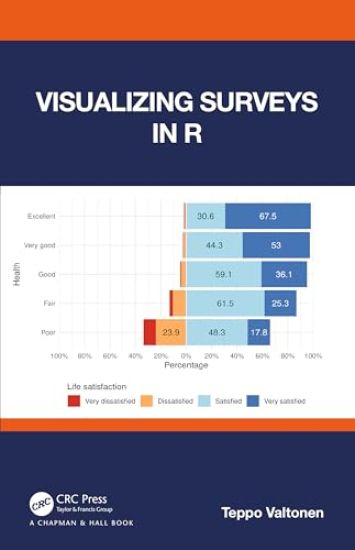
Visualizing Surveys in R

Teppo Valtonen

TAYLOR FRANCIS LTD
2023
sidottu
Visualizing Surveys in R is about creating static, print quality figures from survey data using R. The focus is not, for example, on statistical analysis of survey data, but rather on giving concrete solutions for typical problems in visualizing survey data. While there are many excellent books on data visualization, surveys and R, the aim of this book is to bring these topics together, and offer practical instructions for visualizing surveys in R.FeaturesIntroduction to survey data: variables, categories, and scalesDescription of a process for visualizing survey dataRecommendations for reading survey data into RAdvice on building a survey dataset in R to facilitate versatile plottingStep-by-step recipes in R for creating useful plots from survey dataThe book is intended for researchers who regularly use surveys and are interested in learning how to seize the vast possibilities and the flexibility of R in survey analysis and visualizations. The book is also valuable for psychologists, marketeers, HR personnel, managers, and other professionals who wish to standardize and automate the process for visualizing survey data. Finally, the book is suitable as a course textbook, either more widely on survey studies, or more strictly on visualizing survey data in R.

The Psychophysiology Primer

The Psychophysiology Primer

Benjamin Cowley; Marco Filetti; Kristian Lukander; Jari Torniainen; Andreas Henelius; Lauri Ahonen; Oswald Barral; Ilkka Kosunen; Teppo Valtonen; Minna Huotilainen; Niklas Ravaja; Giulio Jacucci

now publishers Inc
2016
nidottu
Digital monitoring of physiological signals can allow computer systems to adapt unobtrusively to users, so as to enhance personalised ‘smart’ interactions. In recent years, physiological computing has grown as a research field, and it is increasingly considered in diverse applications, ranging from specialised work contexts to consumer electronics. Working in this emerging field requires comprehension of several physiological signals, psychophysiological states or ‘indices’, and analysis techniques. The resulting literature encompasses a complex array of knowledge and techniques, presenting a clear challenge to the practitioner.The Psychophysiology Primer provides a foundational review of the field of psychophysiology to serve as a primer for the novice, enabling rapid familiarisation with the core concepts, or as a quick-reference resource for advanced readers. It places special emphasis on everyday human–computer interface applications, drawing a distinction from clinical or sports applications, which are more commonplace.This primer provides the reader with a framework of commonly understood terms associated with experiential constructs and physiological signals. Then, 12 short and precisely focused review sections describe 10 individual signals or signal sources and present two technical discussions of online data fusion and processing. A systematic review of multimodal studies is provided in the form of a reference table. It concludes with a general discussion of the application of psychophysiology to human–computer interaction, including guidelines and challenges.