Kirjojen hintavertailu. Mukana 11 342 296 kirjaa ja 12 kauppaa.

Kirjahaku

Etsi kirjoja tekijän nimen, kirjan nimen tai ISBN:n perusteella.

5 kirjaa tekijältä Terence J. Centner

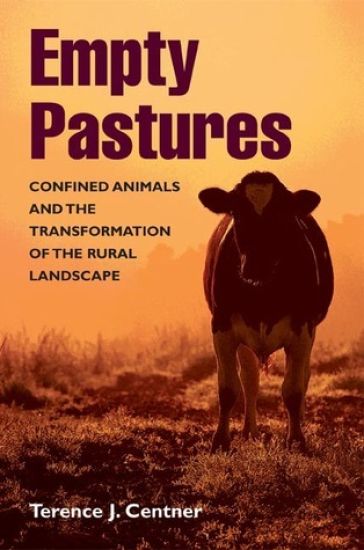
Empty Pastures

Empty Pastures

Terence J. Centner

University of Illinois Press
2004
sidottu
Over the past century American agriculture has shifted dramatically with small, commercial farms finding it increasingly difficult to compete with large-scale (mostly indoor) animal feeding operations (AFOs). In this book, Terence J. Centner investigates the environmental, social, economic, and political impact of the rise of the so-called factory farm, exposing the ramifications of the contemporary trend toward industrial-scale food production. Just as Rachel Carson's landmark Silent Spring used the disappearance of songbirds as a jumping-off point for a work that raised public awareness of pesticides' devastating environmental impact, Empty Pastures sees the dwindling numbers of livestock in the American countryside as a symptom of a broader transformation, one with serious consequences for the rural landscape and its inhabitants--animal as well as human. After outlining the rise of the AFO, Centner examines the troubling consequences of consolidation in animal farming and suggests a number of remedies. The issues he tackles include groundwater contamination, the loss of biodiversity, animal welfare, concentrated odors and other nuisances, soil erosion, and the economic effects of the disappearance of the small family farm. Inspired by largely abandoned traditional practices rather than a radical and unrealistic vision of a return to an idealized past, Centner proposes a series of pragmatic reforms for regulating factory farms to halt ecological degradation and revitalize rural communities.
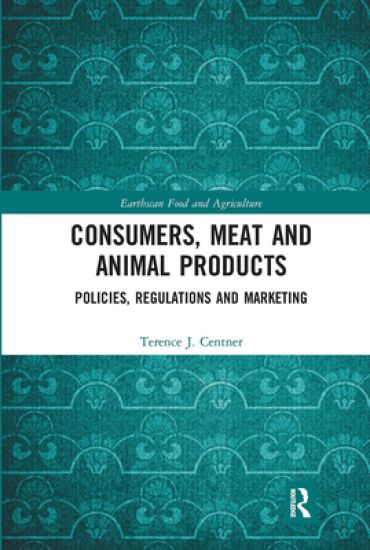
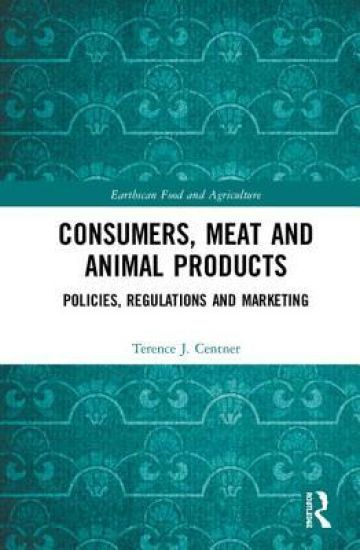
Consumers, Meat and Animal Products

Consumers, Meat and Animal Products

Terence J. Centner

Routledge
2020
nidottu
This book addresses the production practices employed in the production of food animals and animal products that enable marketers to sell a variety of products to meet consumer demand. Food animal production practices have come under increased scrutiny by consumers who object to inputs and practices. The industry has been a proponent of using technologies to reduce production costs, resulting in lower-priced meat and animal food products, and now consumers are starting to look at other objectives. This book considers the key issues of concern to consumers, including the treatment of animals, the use of antibiotics, feed additives and hormones, and how these are monitored, regulated, and communicated to consumers. It also reviews labeling and information provided to consumers, including organic, genetic engineering, welfare standards, and place of origin. While the main focus is on the United States, there are descriptions of European practices and legislation.Overall, it aims to provide an objective and balanced appraisal, which will be of interest to advanced students and researchers in agricultural, food and environmental economics, law and policy, and animal production and welfare. It will also be very useful for early career professionals in the food and agricultural sectors.
Consumers, Meat and Animal Products

Consumers, Meat and Animal Products

Terence J. Centner

Routledge
2019
sidottu
This book addresses the production practices employed in the production of food animals and animal products that enable marketers to sell a variety of products to meet consumer demand. Food animal production practices have come under increased scrutiny by consumers who object to inputs and practices. The industry has been a proponent of using technologies to reduce production costs, resulting in lower-priced meat and animal food products, and now consumers are starting to look at other objectives. This book considers the key issues of concern to consumers, including the treatment of animals, the use of antibiotics, feed additives and hormones, and how these are monitored, regulated, and communicated to consumers. It also reviews labeling and information provided to consumers, including organic, genetic engineering, welfare standards, and place of origin. While the main focus is on the United States, there are descriptions of European practices and legislation.Overall, it aims to provide an objective and balanced appraisal, which will be of interest to advanced students and researchers in agricultural, food and environmental economics, law and policy, and animal production and welfare. It will also be very useful for early career professionals in the food and agricultural sectors.
Environmental Law and Regulations to Protect People
Environmental Law and Regulations to Protect People helps students master concepts of environmental law and public well-being by combining legal concepts with actual cases to show how conflicts are handled under current laws and regulations.The learning process focuses on reading legal cases to discern regulatory approaches for safeguarding people. Through the subsequent questions about each case, students are introduced to concepts and terminology, and they learn how to analyze and resolve disputes. Students also become familiar with legislative and regulatory policies and choices for addressing particular environmental problems.The text covers constitutional proscriptions, establishing liability, precluding environmental degradation, safeguarding environmental quality, and regulations for public health. Sample topics include negligence, nuisance, water law, handling wastes, air quality, zoning and land use, energy and hydrocarbon development, and climate change.Effectively blending information on current environmental issues and the legal framework for dealing with them, Environmental Law and Regulations to Protect People is designed for undergraduate courses in environmental issues and environmental law. It is also a useful adjunct to public health law classes.
Environmental Law and Regulations to Protect People

Environmental Law and Regulations to Protect People

Terence J. Centner

Cognella Academic Publishing
2017
sidottu
Environmental Law and Regulations to Protect People helps students master concepts of environmental law and public well-being by combining legal concepts with actual cases to show how conflicts are handled under current laws and regulations. The learning process focuses on reading legal cases to discern regulatory approaches for safeguarding people. Through the subsequent questions about each case, students are introduced to concepts and terminology, and they learn how to analyze and resolve disputes. Students also become familiar with legislative and regulatory policies and choices for addressing particular environmental problems. The text covers constitutional proscriptions, establishing liability, precluding environmental degradation, safeguarding environmental quality, and regulations for public health. Sample topics include negligence, nuisance, water law, handling wastes, air quality, zoning and land use, energy and hydrocarbon development, and climate change. Effectively blending information on current environmental issues and the legal framework for dealing with them, Environmental Law and Regulations to Protect People is designed for undergraduate courses in environmental issues and environmental law. It is also a useful adjunct to public health law classes.Terence J. Centner earned his LL.M in agricultural law at the University of Arkansas, Fayetteville. He is currently a professor at the University of Georgia, Athens, where he teaches law courses and engages in research involving analyses of issues confronting the environment. Professor Centner has served as a research fellow at the University of Goettingen in Germany, a Fulbright Scholar at the University of Mannheim in Germany, and a Fulbright-Scotland visiting professor at the University of Aberdeen. He has lectured at twenty seven foreign universities, has presented his research in more than forty countries, and is the author of two books, Empty Pastures and Blame Culture.