Kirjojen hintavertailu. Mukana 11 717 486 kirjaa ja 12 kauppaa.

Kirjahaku

Etsi kirjoja tekijän nimen, kirjan nimen tai ISBN:n perusteella.

2 kirjaa tekijältä Terry L. Leap

Dishonest Dollars

Dishonest Dollars

Terry L. Leap

Cornell University Press
2007
sidottu
In an environment where corporate scandals fill the headlines and ethics courses have suddenly become standard fare in business schools, Terry Leap offers welcome insights into and useful ways of thinking about a critical problem that permeates our society. His main contribution is an integrative model of white-collar crime, which smoothly incorporates influences from sociology, psychology, public policy, and business. As he explains the process that occurs across the many different categories of crimes within organizations, he finds that there are more similarities than differences between "criminals in the suites" and "criminals in the streets."Leap's definition of crimes within organizations and the people who commit them are laid out in his first chapter. He then goes on to discuss the causes of and events surrounding white-collar crime, types of crimes and criminals, the decision-making processes of white-collar criminals, and the impact of these crimes. His concluding chapter predicts future trends in corporate crime, including an explanation of why we are likely to see more crime in health care. Throughout, Leap presents numerous specific examples and cases—from famous meltdowns such as Enron and WorldCom to less-publicized incidents including a weight-loss franchisee mislabeling doughnuts as low fat and a CEO of a South Carolina regional transportation authority misusing taxpayer money for lavish meals, personal expenses, and world travel.
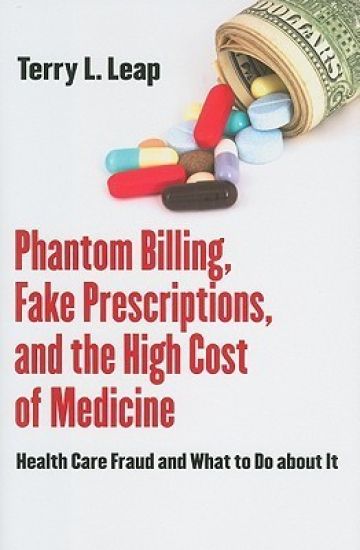
Phantom Billing, Fake Prescriptions, and the High Cost of Medicine
U.S. health care is a $2.5 trillion system that accounts for more than 17 percent of the nation's GDP. It is also highly susceptible to fraud. Estimates vary, but some observers believe that as much as 10 percent of all medical billing involves some type of fraud. In 2009, New York's Medicaid fraud office recovered $283 million and obtained 148 criminal convictions. In July 2010, the U.S. Justice Department charged nearly 100 patients, doctors, and health care executives in five states of bilking the Medicare system out of more than $251 million through false claims for services that were medically unnecessary or never provided. These cases only hint at the scope of the problem. In Phantom Billing, Fake Prescriptions, and the High Cost of Medicine, Terry L. Leap takes on medical fraud and its economic, psychological, and social costs. Illustrated throughout with dozens of specific and often fascinating cases, this book covers a wide variety of crimes: kickbacks, illicit referrals, overcharging and double billing, upcoding, unbundling, rent-a-patient and pill-mill schemes, insurance scams, short-pilling, off-label marketing of pharmaceuticals, and rebate fraud, as well as criminal acts that enable this fraud (mail and wire fraud, conspiracy, and money laundering). After assessing the effectiveness of the federal laws designed to fight health care fraud and abuse—the antikickback statute, the Stark Law, the False Claims Act, HIPAA, and the food and drug laws—Leap suggests a number of ways that health care providers, consumers, insurers, and federal and state officials can bring health care fraud and abuse under control, thereby reducing the overall cost of medical care in America.