Kirjojen hintavertailu. Mukana 11 342 296 kirjaa ja 12 kauppaa.

Kirjahaku

Etsi kirjoja tekijän nimen, kirjan nimen tai ISBN:n perusteella.

4 kirjaa tekijältä Tess Lea

Wild Policy

Wild Policy

Tess Lea

STANFORD UNIVERSITY PRESS
2020
sidottu
Can there be good social policy? This book describes what happens to Indigenous policy when it targets the supposedly 'wild people' of regional and remote Australia. Tess Lea explores naturalized policy: policy unplugged, gone live, ramifying in everyday life, to show that it is policies that are wild, not the people being targeted. Lea turns the notion of unruliness on its head to reveal a policy-driven world dominated by short term political interests and their erratic, irrational effects, and by the less obvious protection of long-term interests in resource extraction and the liberal settler lifestyles this sustains. Wild Policy argues policies are not about undoing the big causes of enduring inequality, and do not ameliorate harms terribly well either—without yielding all hope. Drawing on efforts across housing and infrastructure, resistant media-making, health, governance and land tenure battles in regional and remote Australia, Wild Policy looks at how the logics of intervention are formulated and what this reveals in answer to the question: why is it all so hard? Lea offers readers a layered, multi-relational approach called policy ecology to probe the related question, 'what is to be done?' Lea's case material will resonate with analysts across the world who deal with infrastructures, policy, technologies, mining, militarization, enduring colonial legacies, and the Anthropocene.
Wild Policy

Wild Policy

Tess Lea

Stanford University Press
2020
pokkari
Can there be good social policy? This book describes what happens to Indigenous policy when it targets the supposedly 'wild people' of regional and remote Australia. Tess Lea explores naturalized policy: policy unplugged, gone live, ramifying in everyday life, to show that it is policies that are wild, not the people being targeted. Lea turns the notion of unruliness on its head to reveal a policy-driven world dominated by short term political interests and their erratic, irrational effects, and by the less obvious protection of long-term interests in resource extraction and the liberal settler lifestyles this sustains. Wild Policy argues policies are not about undoing the big causes of enduring inequality, and do not ameliorate harms terribly well either—without yielding all hope. Drawing on efforts across housing and infrastructure, resistant media-making, health, governance and land tenure battles in regional and remote Australia, Wild Policy looks at how the logics of intervention are formulated and what this reveals in answer to the question: why is it all so hard? Lea offers readers a layered, multi-relational approach called policy ecology to probe the related question, 'what is to be done?' Lea's case material will resonate with analysts across the world who deal with infrastructures, policy, technologies, mining, militarization, enduring colonial legacies, and the Anthropocene.

Darwin

Darwin

Tess Lea

NewSouth Publishing
2020
nidottu
Darwin is a survivor, you have to give it that. Razed to the ground four times in its short history, it has picked itself up out of the debris to not only rebuild but grow. Darwin has known catastrophes and resurrections; it has endured misconceived projects and birthed visionaries. To know Darwin, to know its soul, you have to listen to it, soak in it, taste it. This is a book about the textures, colours, sounds and frontier stories of Darwin, Australia’s smallest and least-known capital city. It is a place that has to be felt to be known. Readers will sense the heat, the birds, the frogs, the mosquitoes, the architecture and the logistical infrastructure that keep the moon-base that is Darwin alive. They will learn the glory of swimming amongst pandanus fronds dipping into fresh tropical waters, take in the snaking wetland topography from a bird’s eye view, and learn about the swamps and mangroves from the perspective of ancient tidal powers and the entomologists charged with keeping the mosquito populations down. They will also meet some colourful local characters, the type that lend Darwin its vitality. It starts with the screech of a roof being peeled aloft and the sudden vista of torn sky, savage rain and missile ribbons of corrugated iron hurtling above my little girl head. It is this, the uncanny howl of shredding worlds, which most people remember about Cyclone Tracy. The main purpose of this book is to give Australian and other readers an unflinching sense of the geo-strategic significance of Darwin and what it is founded on, without losing the whimsy and beauty that so deeply attracts and binds the loyalty of its residents. If Darwin is a sentinel city, then this is a sentinel book. A new Postscript suggests how Darwin might deliver lessons for living under the climatically assaulting and culturally uncomfortable times of the Anthropocene Gives an unflinching sense of the geo-strategic significance of Darwin and what it is founded on Lea calls Darwin a ‘garrison town in sleeper guise’ and ‘a node in America’s global military arsenal’; her account of Darwin’s militarisation in some ways makes Darwin more nationally – and even internationally – relevant than any other book in the City Series
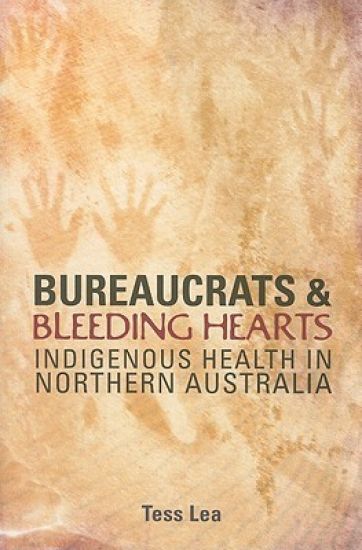
Bureaucrats and Bleeding Hearts
Bureaucrats and Bleeding Hearts takes you on an intimate journey into the lives of people armed with the task of ending Australian Aboriginal disadvantage in the frontier north of Australia. Taking a fresh look at longstanding issues, Lea examines the culture of bureaucracy, its need to create the look of action, how intelligent inhabitants uphold the apparatus of government even whilst they critique it, and how benevolent efforts to improve health have brought about unexpected co-dependencies and tragic failures. She paints a sympathetic yet discomforting portrait of those who, working on behalf of and for Aboriginal health, fiercely defend the ideas and principles that paradoxically reinstate the primary need for greater levels of government intervention.