Kirjojen hintavertailu. Mukana 11 244 527 kirjaa ja 12 kauppaa.

Kirjahaku

Etsi kirjoja tekijän nimen, kirjan nimen tai ISBN:n perusteella.

7 kirjaa tekijältä Theda Perdue

Nations Remembered

Nations Remembered

Theda Perdue

Praeger Publishers Inc
1980
sidottu
The five largest southeastern Indian groups - the Cherokees, Chickasaws, Choctaws, Creeks, and Seminoles - were forced to emigrate west to the Indian territory (now Oklahoma) in the 1830s. Here, from WPA interviews, are those Indians' own stories of the troubled years between the Civil War and Oklahoma statehood - a period of extraordinary turmoil. During this period, Oklahoma Indians functioned autonomously, holding their own elections, enforcing their own laws, and creating their own society from a mixture of old Indian customs and the new ways of the whites. The WPA informants describe the economic realities of the era: a few wealthy Indians, the rest scraping a living out of subsistence farming, hunting, and fishing. They talk about education and religion - Native American and Christian - as well as diversions of the time: horse races, fairs, ball games, cornstalk shooting, and traditional ceremonies such as the Green Corn Dance.
Cherokee Women

Cherokee Women

Theda Perdue

University of Nebraska Press
1999
pokkari
“An interesting and effective overview. . . . It is to the author’s considerable credit that she is able to re-create the values and behavior of Cherokee women through court records, myths, and observers’ accounts. By examining women’s roles in farming and community life, Perdue argues that women were coequal contributors to Cherokee culture.”-ChoiceTheda Perdue examines the roles and responsibilities of Cherokee women during the eighteenth and nineteenth centuries, a time of intense cultural change. While building on the research of earlier historians, she develops a uniquely complex view of the effects of contact on Native gender relations, arguing that Cherokee conceptions of gender persisted long after contact. Maintaining traditional gender roles actually allowed Cherokee women and men to adapt to new circumstances and adopt new industries and practices.
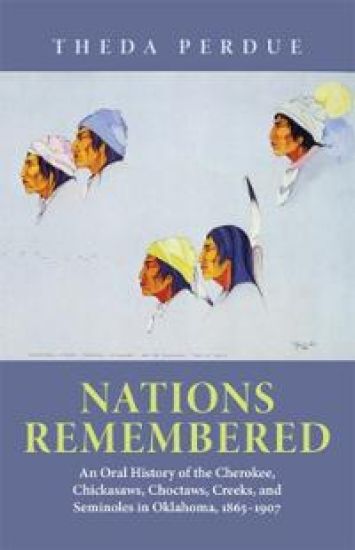
Nations Remembered

Nations Remembered

Theda Perdue

University of Oklahoma Press
1993
nidottu
The five largest southeastern Indian groups - the Cherokees, Choctaws, Chicksaws, Creeks and Seminoles - were forced to emigrate west to the Indian territory (now Oklahoma) in the 1830s. This book contains the Indians' own stories - taken from WPA interviews - of the troubled years between the Civil War and Oklahoma statehood. During this period, Oklahoma Indians functioned autonomously, holding their own elections, enforcing their own laws and creating their own society from a mixture of old Indian customs and the new ways of the whites. The WPA informants describe the economic realities of the era: a few wealthy Indians, the rest scraping a living out of subsistence farming, hunting and fishing. They talk about education and religion - Native American and Christian - as well as diversions of the time: horse races, fairs, ball games, cornstalk shooting and traditional ceremonies such as the Green Corn Dance. Theda Perdue provides an introduction to each chapter which provides the background necessary to integrate the oral accounts into a more coherent historical overview.
Mixed Blood Indians

Mixed Blood Indians

Theda Perdue

University of Georgia Press
2005
pokkari
On the southern frontier in the eighteenth and early nineteenth centuries, European men—including traders, soldiers, and government agents—sometimes married Native women. Children of these unions were known by whites as "half-breeds." The Indian societies into which they were born, however, had no corresponding concepts of race or "blood." Moreover, counter to European customs and laws, Native lineage was traced through the mother only. No familial status or rights stemmed from the father."Mixed Blood" Indians looks at a fascinating array of such birth- and kin-related issues as they were alternately misunderstood and astutely exploited by both Native and European cultures. Theda Perdue discusses the assimilation of non-Indians into Native societies, their descendants' participation in tribal life, and the white cultural assumptions conveyed in the designation "mixed blood." In addition to unions between European men and Native women, Perdue also considers the special cases arising from the presence of white women and African men and women in Indian society.From the colonial through the early national era, "mixed bloods" were often in the middle of struggles between white expansionism and Native cultural survival. That these "half-breeds" often resisted appeals to their "civilized" blood helped foster an enduring image of Natives as fickle allies of white politicians, missionaries, and entrepreneurs. "Mixed Blood" Indians rereads a number of early writings to show us the Native outlook on these misperceptions and to make clear that race is too simple a measure of their—or any peoples'—motives.
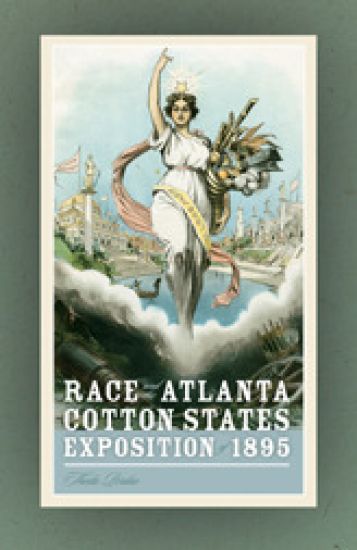
Race and the Atlanta Cotton States Exposition of 1895

Race and the Atlanta Cotton States Exposition of 1895

Theda Perdue

University of Georgia Press
2010
sidottu
The Cotton States Exposition of 1895 was a world’s fair in Atlanta held to stimulate foreign and domestic trade for a region in an economic depression. Theda Perdue uses the exposition to examine the competing agendas of white supremacist organizers and the peoples of color who participated.White organizers had to demonstrate that the South had solved its race problem in order to attract business and capital. As a result, the exposition became a venue for a performance of race that formalized the segregation of African Americans, the banishment of Native Americans, and the incorporation of other people of color into the region’s racial hierarchy.White supremacy may have been the organizing principle, but exposition organizers gave unprecedented voice to minorities. African Americans used the Negro Building to display their accomplishments, to feature prominent black intellectuals, and to assemble congresses of professionals, tradesmen, and religious bodies. American Indians became more than sideshow attractions when newspapers published accounts of the difficulties they faced. And performers of ethnographic villages on the midway pursued various agendas, including subverting Chinese exclusion and protesting violations of contracts. Close examination reveals that the Cotton States Exposition was as much about challenges to white supremacy as about its triumph.
Race and the Atlanta Cotton States Exposition of 1895

Race and the Atlanta Cotton States Exposition of 1895

Theda Perdue

University of Georgia Press
2011
pokkari
The Cotton States Exposition of 1895 was a world’s fair in Atlanta held to stimulate foreign and domestic trade for a region in an economic depression. Theda Perdue uses the exposition to examine the competing agendas of white supremacist organizers and the peoples of color who participated.White organizers had to demonstrate that the South had solved its race problem in order to attract business and capital. As a result, the exposition became a venue for a performance of race that formalized the segregation of African Americans, the banishment of Native Americans, and the incorporation of other people of color into the region’s racial hierarchy.White supremacy may have been the organizing principle, but exposition organizers gave unprecedented voice to minorities. African Americans used the Negro Building to display their accomplishments, to feature prominent black intellectuals, and to assemble congresses of professionals, tradesmen, and religious bodies. American Indians became more than sideshow attractions when newspapers published accounts of the difficulties they faced. And performers of ethnographic villages on the midway pursued various agendas, including subverting Chinese exclusion and protesting violations of contracts. Close examination reveals that the Cotton States Exposition was as much about challenges to white supremacy as about its triumph.