Kirjojen hintavertailu. Mukana 11 377 971 kirjaa ja 12 kauppaa.

Kirjahaku

Etsi kirjoja tekijän nimen, kirjan nimen tai ISBN:n perusteella.

6 kirjaa tekijältä Theodore W. Jennings

Good News to the Poor

Good News to the Poor

Theodore W. Jennings

Abingdon Press
1990
pokkari
This provocative volume illuminates a dimension of John Wesley's theology that has received insufficient attention: his deep and abiding commitment to the poor. By focusing on the radical nature of Wesley's "evangelical economics," Theodore W. Jennings, Jr., provides an important corrective to the view that Wesley was concerned with the salvation of souls only, and not also with the social conditions of human beings.
Transforming Atonement

Transforming Atonement

Theodore W. Jennings

Augsburg Fortress
2009
pokkari
Many books on the Christian doctrine of atonement have been published in recent years. Some point out the difficulties of traditional atonement theories; others attempt a revision of one of the classical three types; others attempt to combine aspects of these types. Jennings attempts something new: by approaching the question of the meaning of the cross through close attention to the biblical passages that serve as the basis of any reflection on the cross of Jesus and an engagement with patristic as well as contemporary discussion. The result is an alternative theology of the cross that grounds the message concerning the cross in the socio-political reality in which it was historically located and points to the way in which this message bears upon contemporary social and ecclesial reality. Jennings's truly fresh understanding for Christians of the meaning of Jesus' death specifically grounds the cross in the concrete political confrontation within which it occurred, relates the message about the cross to the practice of Jesus (thus keeping in relationship the gospels and the theology of Paul), and shows how the cross bears on overcoming of human division and sin, reconciliation to God, and new forms of social reality in the community of the crucified.
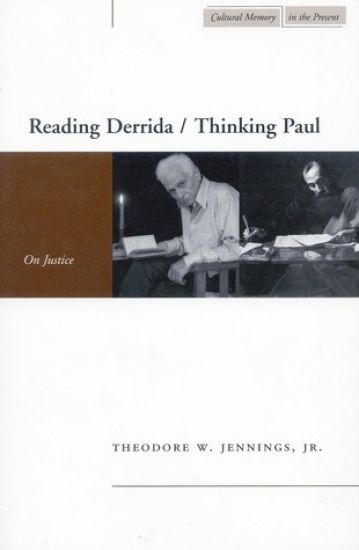
Reading Derrida / Thinking Paul

Reading Derrida / Thinking Paul

Theodore W. Jennings

Stanford University Press
2005
sidottu
This book explores the interweaving of several of Derrida's characteristic concerns with themes that Paul explores in Romans. It argues that the central concern of Romans is with the question of justice, a justice that must be thought outside of law on the basis of grace or gift. The many perplexities that arise from thus trying to think justice outside of law are clarified by reading Derrida on such themes as justice and law, gift and exchange, duty and debt, hospitality, cosmopolitanism, and pardon. This interweaving of Paul and Derrida shows that Paul may be read as a thinker who wrestles with real problems that are of concern to anyone who thinks. It also shows that Derrida, far from being the enemy of theological reflection, is himself a necessary companion to the thinking of the biblical theologian. Against the grain of what passes for common wisdom this book argues that both Derrida and Paul are indispensable guides to a new way of thinking about justice.
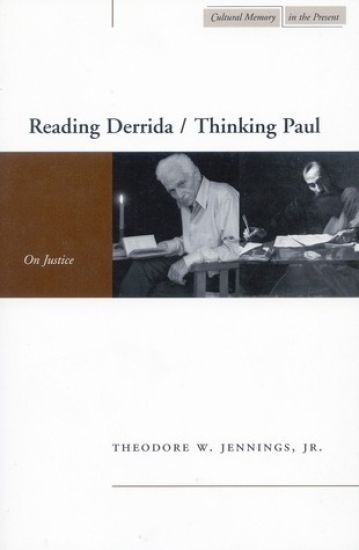
Reading Derrida / Thinking Paul

Reading Derrida / Thinking Paul

Theodore W. Jennings

Stanford University Press
2005
pokkari
This book explores the interweaving of several of Derrida's characteristic concerns with themes that Paul explores in Romans. It argues that the central concern of Romans is with the question of justice, a justice that must be thought outside of law on the basis of grace or gift. The many perplexities that arise from thus trying to think justice outside of law are clarified by reading Derrida on such themes as justice and law, gift and exchange, duty and debt, hospitality, cosmopolitanism, and pardon. This interweaving of Paul and Derrida shows that Paul may be read as a thinker who wrestles with real problems that are of concern to anyone who thinks. It also shows that Derrida, far from being the enemy of theological reflection, is himself a necessary companion to the thinking of the biblical theologian. Against the grain of what passes for common wisdom this book argues that both Derrida and Paul are indispensable guides to a new way of thinking about justice.
Outlaw Justice

Outlaw Justice

Theodore W. Jennings

Stanford University Press
2013
sidottu
This book offers a close reading of Romans that treats Paul as a radical political thinker by showing the relationship between Paul's perspective and that of secular political theorists. Turning to both ancient political philosophers (Plato, Aristotle, and Cicero) and contemporary post-Marxists (Agamben, Badiou, Derrida, and Žižek), Jennings presents Romans as a sustained argument for a new sort of political thinking concerned with the possibility and constitution of just socialities. Reading Romans as an essay on messianic politics in conversation with ancient and postmodern political theory challenges the stereotype of Paul as a reactionary theologian who "invented" Christianity and demonstrates his importance for all, regardless of religious affiliation or academic guild, who dream and work for a society based on respect, rather than domination, division, and death. In the current context of unjust global empires constituted by avarice, arrogance, and violence, Jennings finds in Paul a stunning vision for creating just societies outside the law.
Outlaw Justice

Outlaw Justice

Theodore W. Jennings

Stanford University Press
2013
pokkari
This book offers a close reading of Romans that treats Paul as a radical political thinker by showing the relationship between Paul's perspective and that of secular political theorists. Turning to both ancient political philosophers (Plato, Aristotle, and Cicero) and contemporary post-Marxists (Agamben, Badiou, Derrida, and Žižek), Jennings presents Romans as a sustained argument for a new sort of political thinking concerned with the possibility and constitution of just socialities. Reading Romans as an essay on messianic politics in conversation with ancient and postmodern political theory challenges the stereotype of Paul as a reactionary theologian who "invented" Christianity and demonstrates his importance for all, regardless of religious affiliation or academic guild, who dream and work for a society based on respect, rather than domination, division, and death. In the current context of unjust global empires constituted by avarice, arrogance, and violence, Jennings finds in Paul a stunning vision for creating just societies outside the law.