

Kirjahaku
Etsi kirjoja tekijän nimen, kirjan nimen tai ISBN:n perusteella.
8 kirjaa tekijältä Thomas Flanagan
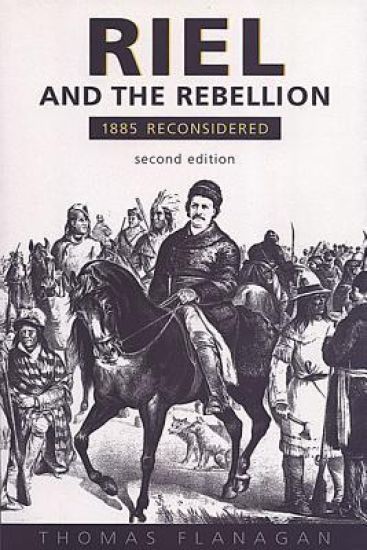
When, in 1983, the first edition of Riel and the Rebellion was published, the scholarly controversy concerning Thomas Flanagan's interpretation of the Rebellion of 1885 escalated to one of national significance. One of the few books that presents a countervailing view to the traditional interpretation of the events of 1885, Riel and the Rebellion contends that the Metis were, to some extent, responsible for the alienation of their lands, and that Riel himself was a more destructive than constructive force in the history of western Canada. After over fifteen years, issues such as land claims and native rights have in fact moved beyond the level of academic debate; Flanagan's work remains timely and the additions to the book in this new edition reflect the continued currency of its content. In the second edition, the author addresses a number of issues, including the cultural mythology surrounding Riel, the recent campaign to pardon Riel (with some discussion of a theory that contends that Riel's trial was unfair), the Manitoba lands question, and new primary research conducted by Flanagan concerning Metis land claims at Laurent. Undoubtedly, this unique work will continue to spark controversy and garner attention because of its relevance to many larger contemporary political debates concerning native rights and land claims.
Louis Riel believed that on 8 December 1875 he received a divine commission authorizing him to save the Métis and reform the Catholic Church. He was a prophet, inspired by the Holy Spirit, and the Métis were the new chosen people. A new branch of the Catholic Church would be founded in North America, with its first Holy See in Montreal, and its second in Riel's birthplace of St. Vital. When Riel expressed these views in 1876, he was committed to a lunatic asylum. After his release, he suppressed his ideas for several years, only to reveal them again to his Métis followers during the North-West Rebellion. The Rebellion thus became as much a religious as a political movement; Riel believed himself a prophet to the end of his life, and he went to his death thinking that he, like Christ, would be resurrected on the third day. Earlier writers about Louis Riel have noted his religious beliefs but have not taken them seriously. They have usually dismissed Riel's attempt to found a new religion as the symptom of a deranged mind. Thomas Flanagan takes Riel's religion seriously and analyses it using categories developed in the literature about millenarian movements. He shows that Riel's religion, far from being simply individual madness, is typical of the nativistic and millenarian movements described by one author as the 'religions of the oppressed.' This is also a biography, tracing Riel's thinking on religious subjects from his childhood to the end of his life and paying particular attention to events in his life that influenced his thinking. This developmental approach is necessary because Riel's ideas changed frequently; he never arrived at a fixed 'system.' The research is based on primary sources throughout. Much new documentation has become available over the past thirty years and in the sixteen years since this volume was initially published. In particular, new information is presented about Riel's youth in Montreal, his time in insane asylums, his years in Montana, and the North-West Rebellion. Flanagan also re-interprets well-known documents. While this revised edition does not alter the fundamentals of his interpretation, it improves the historical backdrop against which it is presented through use of a wealth of new primary sources. Flanagan has updated his citings of Riel's manuscripts to current sources.
This is the first book-length application of game theory to Canadian politics. It uses a series of case studies to illustrate fundamental concepts of game theory such as two-person and n-person games; solution in mixed strategies; ordinal games; Nash equilibrium; coordination, Assurance, Chicken and Prisoner's Dilemma models; Schelling curves; coalition theory and Riker's size principle; voting rules, cycles, and the Condorcet winner; the Banzhaf power index; structure-induced equilibrium; and spatial models of political conflict. No mathematics more complex than simple algebra is required to follow the exposition. The case studies are not just contrived illustrations of abstract models but intensively researched studies of important episodes in Canadian politics. Topics include the Lubicon Lake stalemate, metrification and vaccination; the size of winning coalitions; formulas for amending the Canadian constitution; the mechanics of choosing party leaders; Parliament's failure to legislate on abortion after the Morgentaler decision; and the entry of the Reform Party into the political system. In each case, utilization of game-theory models produces new and sometimes surprising conclusions. Game theory, and the rational-choice paradigm of which it is a part, are an increasingly important addition to the conventional modes of political analysis. This book is intended to show what game theory can add to the philosophical, institutional, and behavioural approaches that have dominated previous works on Canadian politics.
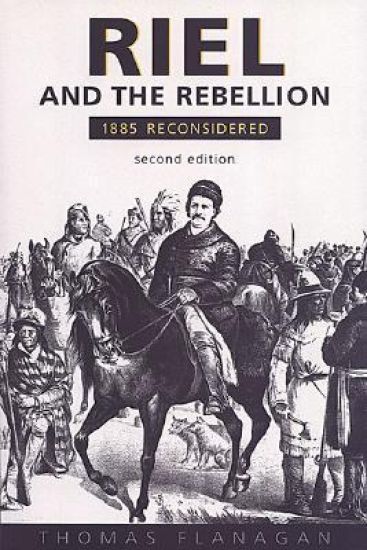
When, in 1983, the first edition of Riel and the Rebellion was published, the scholarly controversy concerning Thomas Flanagan's interpretation of the Rebellion of 1885 escalated to one of national significance. One of the few books that presents a countervailing view to the traditional interpretation of the events of 1885, Riel and the Rebellion contends that the Metis were, to some extent, responsible for the alienation of their lands, and that Riel himself was a more destructive than constructive force in the history of western Canada. After over fifteen years, issues such as land claims and native rights have in fact moved beyond the level of academic debate; Flanagan's work remains timely and the additions to the book in this new edition reflect the continued currency of its content. In the second edition, the author addresses a number of issues, including the cultural mythology surrounding Riel, the recent campaign to pardon Riel (with some discussion of a theory that contends that Riel's trial was unfair), the Manitoba lands question, and new primary research conducted by Flanagan concerning Metis land claims at Laurent. Undoubtedly, this unique work will continue to spark controversy and garner attention because of its relevance to many larger contemporary political debates concerning native rights and land claims.

A Manual of British and Irish History.
Thomas Flanagan
British Library, Historical Print Editions
2011
pokkari
Title: A Manual of British and Irish History.Publisher: British Library, Historical Print EditionsThe British Library is the national library of the United Kingdom. It is one of the world's largest research libraries holding over 150 million items in all known languages and formats: books, journals, newspapers, sound recordings, patents, maps, stamps, prints and much more. Its collections include around 14 million books, along with substantial additional collections of manuscripts and historical items dating back as far as 300 BC.The HISTORY OF BRITAIN & IRELAND collection includes books from the British Library digitised by Microsoft. As well as historical works, this collection includes geographies, travelogues, and titles covering periods of competition and cooperation among the people of Great Britain and Ireland. Works also explore the countries' relations with France, Germany, the Low Countries, Denmark, and Scandinavia. ++++The below data was compiled from various identification fields in the bibliographic record of this title. This data is provided as an additional tool in helping to insure edition identification: ++++ British Library Flanagan, Thomas; 1847. 12 . 1325.e.21.

This work has been selected by scholars as being culturally important, and is part of the knowledge base of civilization as we know it. This work was reproduced from the original artifact, and remains as true to the original work as possible. Therefore, you will see the original copyright references, library stamps (as most of these works have been housed in our most important libraries around the world), and other notations in the work.This work is in the public domain in the United States of America, and possibly other nations. Within the United States, you may freely copy and distribute this work, as no entity (individual or corporate) has a copyright on the body of the work.As a reproduction of a historical artifact, this work may contain missing or blurred pages, poor pictures, errant marks, etc. Scholars believe, and we concur, that this work is important enough to be preserved, reproduced, and made generally available to the public. We appreciate your support of the preservation process, and thank you for being an important part of keeping this knowledge alive and relevant.
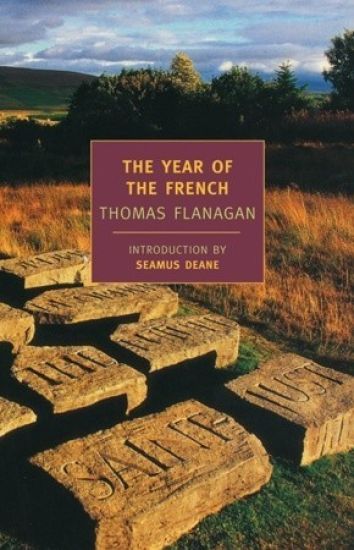
In 1798, Irish patriots, committed to freeing their country from England, landed with a company of French troops in County Mayo, in westernmost Ireland. They were supposed to be an advance guard, followed by other French ships with the leader of the rebellion, Wolfe Tone. Briefly they triumphed, raising hopes among the impoverished local peasantry and gathering a group of supporters. But before long the insurgency collapsed in the face of a brutal English counterattack.Very few books succeed in registering the sudden terrible impact of historical events; Thomas Flanagan's is one. Subtly conceived, masterfully paced, with a wide and memorable cast of characters, The Year of the French brings to life peasants and landlords, Protestants and Catholics, along with old and abiding questions of secular and religious commitments, empire, occupation, and rebellion. It is quite simply a great historical novel.Named the most distinguished work of fiction in 1979 by the National Book Critics' Circle.