Kirjojen hintavertailu. Mukana 11 342 296 kirjaa ja 12 kauppaa.

Kirjahaku

Etsi kirjoja tekijän nimen, kirjan nimen tai ISBN:n perusteella.

315 kirjaa tekijältä Thomas Jefferson

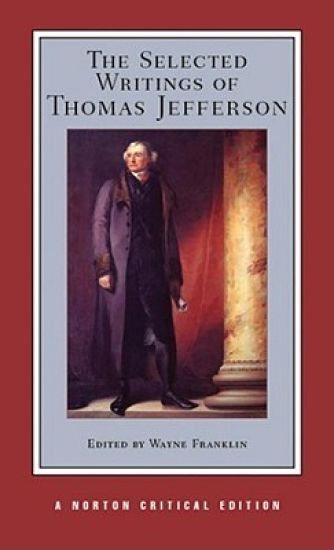
The Selected Writings of Thomas Jefferson

The Selected Writings of Thomas Jefferson

Thomas Jefferson

WW Norton Co
2010
nidottu
This Norton Critical Edition seeks to give readers a full understanding of Thomas Jefferson’s importance to the intellectual development of the United States, particularly in political theory and scientific learning; of Jefferson’s role in the expansion of the territory and sovereignty of the United States; and of Jefferson’s controversial relation to slavery and race as key issues in American history. The editor has selected Jefferson’s most important published texts—A Summary View of the Rights of British America, the Declaration of Independence, and Notes on the State of Virginia—along with An Appendix to the Notes on Virginia Relative to the Murder of Logan’s Family and his Message to Congress on the Lewis and Clark Expedition. In addition, more than one hundred of Jefferson’s letters (1760–1826) have been judiciously selected from his rich body of correspondence, allowing readers to see Jefferson as a person as well as a public figure. All texts are accompanied by detailed explanatory annotations. “Contexts” reprints contemporary documents that place Jefferson and his writings within the early American Republic, including works by Thomas Paine, John Adams, François-Jean de Beauvoir, and Luther Martin. Also included are diverse and early responses to Jefferson and his writings by, among others, John Quincy Adams, William Cullen Bryant, Washington Irving, James Fenimore Cooper, and Elizabeth Cady Stanton. "Criticism" provides representative works of modern interpretation and analysis that confirm Jefferson's continuing relevance. Included are twelve thought-provoking assessments from several disciplinary perspectives by, among others, Annette Gordon Reed, Peter Onuf, and Douglas L. Wilson. A Selected Bibliography is also included.
The Papers of Thomas Jefferson, Volume 1

The Papers of Thomas Jefferson, Volume 1

Thomas Jefferson

Princeton University Press
1950
sidottu
includes the almost incredible volume of Jefferson's writings on practically every aspect of human life-from politics and diplomacy to architecture, philosophy, agriculture, and music. The series includes 18,000 letters written by Jefferson and, in full or summary, 25,000 letters written to him by the great and humble of many nations. No previous edition has included more than fifteen per cent of the total, and only about a fifth of the documents have ever been published anywhere. Covering the years 1760-1776.
The Papers of Thomas Jefferson, Volume 11

The Papers of Thomas Jefferson, Volume 11

Thomas Jefferson

Princeton University Press
1955
sidottu
Volumes 11 and 12, cover the period from January 1787 through March 1788 and deal with Jefferson's stay in France, as American Minister there. This is a rich period of personal correspondence and important documents, revealing, particularly, Jefferson's interest in agriculture and architecture, his extended trade negotiations, his reports on the adoption of the U.S. Constitution, and his skilled efforts to establish friendly relations between Europe and his own nation.
The Papers of Thomas Jefferson, Volume 12

The Papers of Thomas Jefferson, Volume 12

Thomas Jefferson

PRINCETON UNIVERSITY PRESS
1955
sidottu
Volumes 11 and 12 cover the period from January 1787 through March 1788 and deal with Jefferson's stay in France, as American Minister there. This is a rich period of personal correspondence and important documents, revealing, particularly, Jefferson's interest in agriculture and architecture, his extended trade negotiations, his reports on the adoption of the U.S. Constitution, and his skilled efforts to establish friendly relations between Europe and his own nation.
The Papers of Thomas Jefferson, Volume 13

The Papers of Thomas Jefferson, Volume 13

Thomas Jefferson

Princeton University Press
1956
sidottu
From 1784 to 1789 Jefferson was in France, first as commissioner to negotiate peace treaties and then as American minister. Volume 13 continues the account of these years (which are covered in Volumes 7 to 14) and includes material on his travels through Holland, Germany, and northern France; on his study of wine cultivation, whale fishing, and the tobacco trade; on the consular convention with France; on the news from the United States concerning the beginnings of the Federal Government under the new Constitution.
The Papers of Thomas Jefferson, Volume 15

The Papers of Thomas Jefferson, Volume 15

Thomas Jefferson

Princeton University Press
1958
sidottu
In Volume 15 Jefferson, a veteran of the councils of his own country's revolution, becomes an eyewitness of the opening events of the great upheaval in France in 1789. The Archbishop of Bordeaux and his colleagues of the National Assembly ask Jefferson's aid and counsel in drafting a new constitution; he declines in July but gives a private dinner in August for Lafayette and the moderates who wish to form a coalition and thus avoid civil war. He is catapulted into the limelight by Mirabeau's attack on Necker for the shortage of grain and flour. He advises Lafayette about the latter's proposed draft of a Declaration of Rights and proposes a compromise charter for France in order to gain time, to consolidate the advances already made, and to allow public opinion to ripen. Jefferson dines with De Corny and learns at first hand what happened at the fall of the Bastille. Three days later he is among the crowds with Dugald Stewart, the young Scottish philosopher, as Louis XVI is "led in triumph by his people thro' the streets of the capital." He writes long dispatches to Jay and private letters to Thomas Paine and Richard Price, among others, detailing the events that he regarded as "the first chapter of the history of European liberty." Early in September Jefferson becomes ill and, treated by a philosopher-physician, is possessed by the idea that "the earth belongs in usufruct to the living." He urges Madison to develop this concept and to apply it to American legislation--but his ostensible purpose is supported by arguments addressed wholly to the situation in France, whereby he furnishes justification for the abolition of ancient debts, the public appropriation of feudal grants, the wiping out of hereditary privileges, and the eradication of monopolies. Late in September, with Polly, Patsy, Petit, and two servants, Jefferson leaves Paris for a six months' leave, unaware that the same day the United States Senate confirmed his nomination as Secretary of State. Four weeks later he lands in Norfolk, where he is greeted by the officials--and finds that politics and anti-federalism are far from inactive in Virginia.