Kirjojen hintavertailu. Mukana 12 016 292 kirjaa ja 12 kauppaa.

Kirjahaku

Etsi kirjoja tekijän nimen, kirjan nimen tai ISBN:n perusteella.

2 kirjaa tekijältä Thomas M. Greene

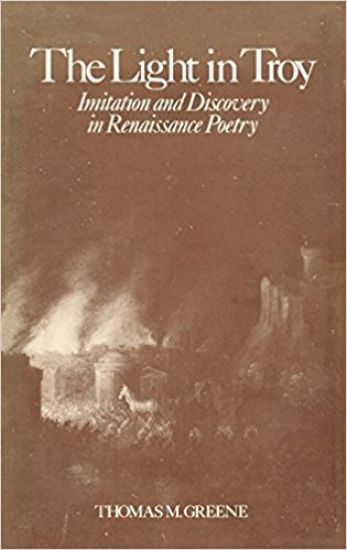
The Light in Troy

The Light in Troy

Thomas M. Greene

Yale University Press
2016
sidottu
“Extraordinarily rich and awesomely learned…. The complexity of its subject matter is here mastered in an exemplary fashion. The study offers detailed, concrete, and perceptive assessments of individual writers within a lucid and carefully balanced design…. As a work of striking originality as well as formidable yet lively scholarship,… Green’s book will become a central, even classic, text for students of Renaissance poetry and of a cardinal topos in the history of criticism and hermeneutics.” –From the citation for the award of the Harry Levin Prize of the American Comparative Literature Association, 1982 “An outstanding example of learning fully commanded and applied with uncommon perception, a lively sense of historical continuity, and, not least important, productive familiarity with modern literary theory. In its breadth of knowledge, the interplay of literary history and theory, the maturity of its judgments and the urbanity of its style, Professor Greene’s study is a most distinguished achievement of American scholarship.” –From the citation for the award of the Annual James Russell Lowell Prize, given by the Modern Language Association of America, 1983
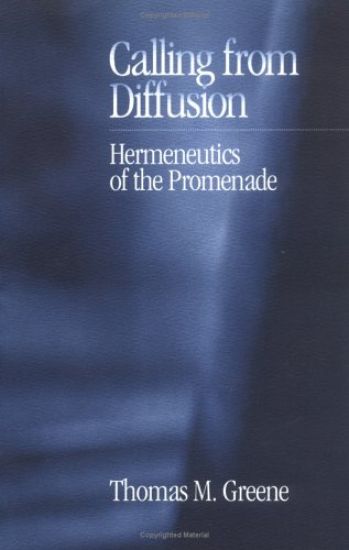
Calling from Diffusion

Calling from Diffusion

Thomas M. Greene

University of Massachusetts Press
2002
nidottu
Based on four Niclson Lectures delivered at Smith College, this book examines a series of ""promenade poems,"" lyrics that follow a poetic speaker moving through a landscape and responding to it. Thomas M. Greene invites the reader to consider a wide range of poets, beginning with Amy Clampitt and A. R. Ammons, continuing with Petrarch, Ronsard, Saint-Amant, Milton, Vaughan, and Marvell, and concluding with to two representative Romantics, Wordsworth and Whitman. Greene's discussions of this rich body of texts stimulate reflection at several levels. They can be read first of all simply as analyses of several memorable poems exhibiting a similar structure over a period of seven centuries. They can also be read as meditations on the workings of lyric poetry, which is always attempting to bring into sharper focus the sensibility of a speaker whose emergence depends on her naming and evoking the objects surrounding her. Thus Greene argues that the distinction of a poetic consciousness lies in its ""permeability,"" permitting a more intimate interplay between internal and external realms. His title is drawn from a line by Whitman: ""You objects that call from diffusion my meanings and give them shape!"" Finally, at yet another level, Greene's book presents a way of thinking about language which, recalling the Heideggerean theory of ""ereignis,"" suggests that only through the projective act of naming can human beings assimilate things through intuitive knowledge. An afterword, ""The Morality of Literary interpretation,"" surveys critically a range of hermeneutic theories and formulates a position that accords the literary text both autonomy and mystery.