Kirjojen hintavertailu. Mukana 12 390 323 kirjaa ja 12 kauppaa.

Kirjahaku

Etsi kirjoja tekijän nimen, kirjan nimen tai ISBN:n perusteella.

4 kirjaa tekijältä Thomas M. King

Jung's Four and Some Philosophers

Jung's Four and Some Philosophers

Thomas M. King

University of Notre Dame Press
1999
nidottu
Thomas M. King, S.J. uses Jungian/Myers-Briggs typology to understand the different starting points of twelve philosophers, then uses Jungian patterns of "integration" to show similarities in their development. Jung's Four and Some Philosophers provides a context in which to understand the widely differing claims of philosophers. The "four" in the title refers to the four faculties that Jung sees occurring in pairs in every psyche: thinking and its opposite, feeling; sensation and its opposite, intuition. One of these four will dominate (among philosophers it will characterize what they find self-evident), while the dominant's opposite is repressed into the mysterious unconscious. Thus, a thinker will repress one's feelings. To achieve wholeness, the philosopher must pass beyond what is known to seek the missing faculty and integrate it with the faculties of consciousness. King demonstrates this with highly documented studies of twelve philosophers: Plato, Locke, Sartre, Augustine, Descartes, Spinoza, Rousseau, Kant, Kierkegaard, Whitehead, Hume, and Teilhard, and a final reflection that considers the philosophic and religious quest.
Jung's Four and Some Philosophers: A Paradigm for Philosophy

Jung's Four and Some Philosophers: A Paradigm for Philosophy

Thomas M. King

UNIVERSITY OF NOTRE DAME PRESS
1999
sidottu
Thomas M. King, S.J. uses Jungian/Myers-Briggs typology to understand the different starting points of twelve philosophers, then uses Jungian patterns of "integration" to show similarities in their development.Jung's Four and Some Philosophers provides a context in which to understand the widely differing claims of philosophers. The "four" in the title refers to the four faculties that Jung sees occurring in pairs in every psyche: thinking and its opposite, feeling; sensation and its opposite, intuition. One of these four will dominate (among philosophers it will characterize what they find self-evident), while the dominant's opposite is repressed into the mysterious unconscious. Thus, a thinker will repress one's feelings. To achieve wholeness, the philosopher must pass beyond what is known to seek the missing faculty and integrate it with the faculties of consciousness. King demonstrates this with highly documented studies of twelve philosophers: Plato, Locke, Sartre, Augustine, Descartes, Spinoza, Rousseau, Kant, Kierkegaard, Whitehead, Hume, and Teilhard, and a final reflection that considers the philosophic and religious quest.
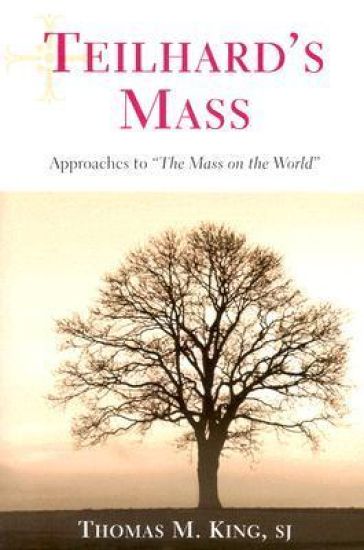
Teilhard's Mass

Teilhard's Mass

Thomas M. King

Paulist Press International,U.S.
2005
nidottu
"The Mass on the World" remains Teilhard's most popular essay. It is a fifteen-page prayer rich in imagery and passion suggesting more than it states. In exploring the careful thought behind Teilhard's images the present work reveals the heart and mind of the man as other approaches have not done. In the Offertory of his "Mass" Teilhard brought the world's hungers and disappointments into prayer; the Consecration is seen as the consummation of his work in science; while the Communion called him to a life of adventure, of success and sorrow rarely equaled. The Post-Communion tells how Teilhard transformed the simple devotions of childhood into the adoration of maturity. He ends his "Mass" with a dedication to the apostolate, and starting from this text the present work develops what it means to be an Apostle of Christ in a pluralistic world. Above all, Teilhard was a priest—and under his guidance all Christians can answer their call to priesthood. "Teilhard's Mass" shows how every Christian can transform one's life and death into an all-embracing Mass on the Altar of the World. †