Kirjojen hintavertailu. Mukana 11 627 220 kirjaa ja 12 kauppaa.

Kirjahaku

Etsi kirjoja tekijän nimen, kirjan nimen tai ISBN:n perusteella.

12 kirjaa tekijältä Thomas Mailund

Metaprogramming in R

Metaprogramming in R

Thomas Mailund

APress
2017
nidottu
Learn how to manipulate functions and expressions to modify how the R language interprets itself. This book is an introduction to metaprogramming in the R language, so you will write programs to manipulate other programs. Metaprogramming in R shows you how to treat code as data that you can generate, analyze, or modify. R is a very high-level language where all operations are functions and all functions are data that can be manipulated. This book shows you how to leverage R's natural flexibility in how function calls and expressions are evaluated, to create small domain-specific languages to extend R within the R language itself. What You'll LearnFind out about the anatomy of a function in R Look inside a function callWork with R expressions and environmentsManipulate expressions in RUse substitutions Who This Book Is ForThose with at least some experience with R and certainly for those with experience in other programming languages.
Advanced Object-Oriented Programming in R
Learn how to write object-oriented programs in R and how to construct classes and class hierarchies in the three object-oriented systems available in R. This book gives an introduction to object-oriented programming in the R programming language and shows you how to use and apply R in an object-oriented manner. You will then be able to use this powerful programming style in your own statistical programming projects to write flexible and extendable software.After reading Advanced Object-Oriented Programming in R, you'll come away with a practical project that you can reuse in your own analytics coding endeavors. You’ll then be able to visualize your data as objects that have state and then manipulate those objects with polymorphic or generic methods. Your projects will benefit from the high degree of flexibility provided by polymorphism, where the choice of concrete method to execute depends on the type of data being manipulated. What You'll LearnDefine and use classes and generic functions using R Work with the R class hierarchiesBenefit from implementation reuseHandle operator overloadingApply the S4 and R6 classes Who This Book Is ForExperienced programmers and for those with at least some prior experience with R programming language.
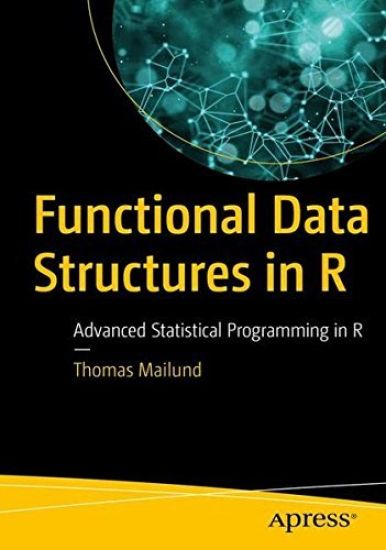
Functional Data Structures in R

Functional Data Structures in R

Thomas Mailund

APress
2017
nidottu
Get an introduction to functional data structures using R and write more effective code and gain performance for your programs. This book teaches you workarounds because data in functional languages is not mutable: for example you’ll learn how to change variable-value bindings by modifying environments, which can be exploited to emulate pointers and implement traditional data structures. You’ll also see how, by abandoning traditional data structures, you can manipulate structures by building new versions rather than modifying them. You’ll discover how these so-called functional data structures are different from the traditional data structures you might know, but are worth understanding to do serious algorithmic programming in a functional language such as R.By the end of Functional Data Structures in R, you’ll understand the choices to make in order to most effectively work with data structures when you cannot modify the data itself. These techniques are especially applicable for algorithmic development important in big data, finance, and other data science applications.What You'll LearnCarry out algorithmic programming in R Use abstract data structures Work with both immutable and persistent data Emulate pointers and implement traditional data structures in RBuild new versions of traditional data structures that are knownWho This Book Is ForExperienced or advanced programmers with at least a comfort level with R. Some experience with data structures recommended.
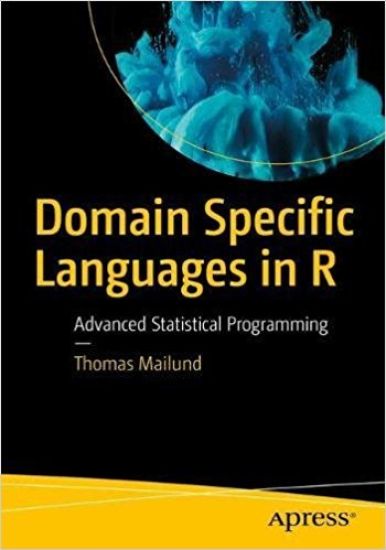
Domain-Specific Languages in R

Domain-Specific Languages in R

Thomas Mailund

APress
2018
nidottu
Gain an accelerated introduction to domain-specific languages in R, including coverage of regular expressions. This compact, in-depth book shows you how DSLs are programming languages specialized for a particular purpose, as opposed to general purpose programming languages. Along the way, you’ll learn to specify tasks you want to do in a precise way and achieve programming goals within a domain-specific context. Domain-Specific Languages in R includes examples of DSLs including large data sets or matrix multiplication; pattern matching DSLs for application in computer vision; and DSLs for continuous time Markov chains and their applications in data science. After reading and using this book, you’ll understand how to write DSLs in R and have skills you can extrapolate to other programming languages.What You'll LearnProgram with domain-specific languages using RDiscover the components of DSLsCarry out large matrix expressions and multiplications Implement metaprogramming with DSLsParse and manipulate expressions Who This Book Is ForThose with prior programming experience. R knowledge is helpful but not required.
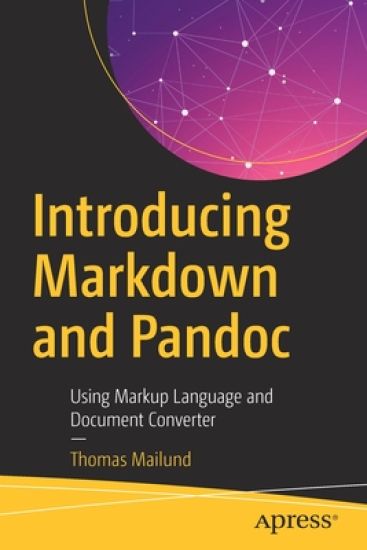
Introducing Markdown and Pandoc

Introducing Markdown and Pandoc

Thomas Mailund

APress
2019
nidottu
Discover how to write manuscripts in Markdown and translate them with Pandoc into different output formats. You’ll use Markdown to annotate text formatting information with a strong focus on semantic information: you can annotate your text with information about where chapters and sections start, but not how chapter and heading captions should be formatted. As a result, you’ll decouple the structure of a text from how it is visualized and make it easier for you to produce different kinds of output. The same text can easily be formatted as HTML, PDF, or Word documents, with various visual styles, by tools that understand the markup annotations. Finally, you’ll learn to use Pandoc, a tool for translating between different markup languages, such as LaTeX, HTML, and Markdown. This book will not describe all the functionality that Pandoc provides, but will teach you how to translate Markdown documents, how to customize your documents using templates,and how to extend Pandoc’s functionality using filters. If that is something you are interested in, Introducing Markdown and Pandoc will get you started. With this set of skills you’ll be able to write more efficiently without worrying about needless formatting and other distractions.What You Will LearnWhy and how to use Markdown and PandocWrite MarkdownUse extensions available in Pandoc and MarkdownWrite math and code blocksUse templates and produce documentsWho This Book Is ForProgrammers and problem solvers looking for technical documentation solutions.
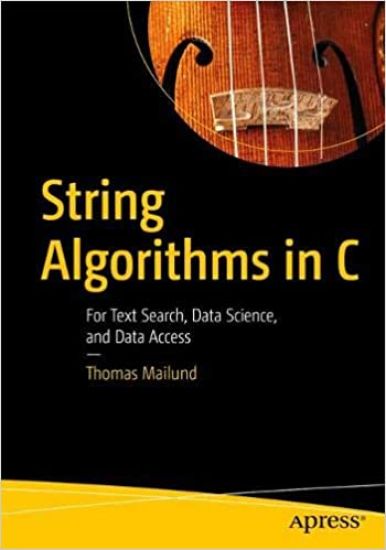
String Algorithms in C

String Algorithms in C

Thomas Mailund

APress
2020
nidottu
Implement practical data structures and algorithms for text search and discover how it is used inside other larger applications. This unique in-depth guide explains string algorithms using the C programming language. String Algorithms in C teaches you the following algorithms and how to use them: classical exact search algorithms; tries and compact tries; suffix trees and arrays; approximative pattern searches; and more. In this book, author Thomas Mailund provides a library with all the algorithms and applicable source code that you can use in your own programs. There are implementations of all the algorithms presented in this book so there are plenty of examples. You’ll understand that string algorithms are used in various applications such as image processing, computer vision, text analytics processing from data science to web applications, information retrieval from databases, network security, and much more. What You Will Learn Use classical exact search algorithms including naive search, borders/border search, Knuth-Morris-Pratt, and Boyer-Moor with or without Horspool Search in trees, use tries and compact tries, and work with the Aho-Carasick algorithm Process suffix trees including the use and development of McCreight’s algorithm Work with suffix arrays including binary searches; sorting naive constructions; suffix tree construction; skew algorithms; and the Borrows-Wheeler transform (BWT) Deal with enhanced suffix arrays including longest common prefix (LCP) Carry out approximative pattern searches among suffix trees and approximative BWT searches Who This Book Is For Those with at least some prior programming experience with C or Assembly and have at least prior experience with programming algorithms.
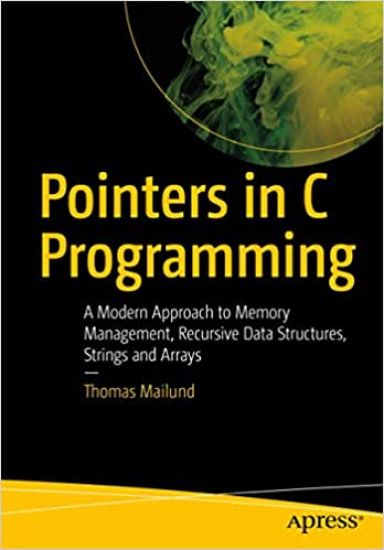
Pointers in C Programming

Pointers in C Programming

Thomas Mailund

APress
2021
nidottu
Gain a better understanding of pointers, from the basics of how pointers function at the machine level, to using them for a variety of common and advanced scenarios. This short contemporary guide book on pointers in C programming provides a resource for professionals and advanced students needing in-depth hands-on coverage of pointer basics and advanced features. It includes the latest versions of the C language, C20, C17, and C14. You’ll see how pointers are used to provide vital C features, such as strings, arrays, higher-order functions and polymorphic data structures. Along the way, you’ll cover how pointers can optimize a program to run faster or use less memory than it would otherwise.There are plenty of code examples in the book to emulate and adapt to meet your specific needs.What You Will LearnWork effectively with pointers in your C programmingLearn how to effectively manage dynamic memoryProgram with strings and arraysCreate recursive data structuresImplement function pointersWho This Book Is For Intermediate to advanced level professional programmers, software developers, and advanced students or researchers. Prior experience with C programming is expected.
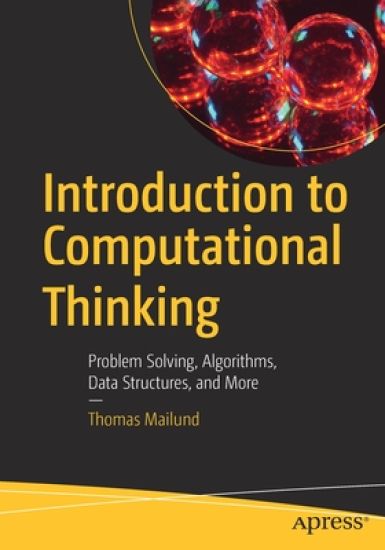
Introduction to Computational Thinking
Learn approaches of computational thinking and the art of designing algorithms. Most of the algorithms you will see in this book are used in almost all software that runs on your computer. Learning how to program can be very rewarding. It is a special feeling to seeing a computer translate your thoughts into actions and see it solve your problems for you. To get to that point, however, you must learn to think about computations in a new way—you must learn computational thinking. This book begins by discussing models of the world and how to formalize problems. This leads onto a definition of computational thinking and putting computational thinking in a broader context. The practical coding in the book is carried out in Python; you’ll get an introduction to Python programming, including how to set up your development environment. What You Will LearnThink in a computational wayAcquire general techniques for problem solvingSeegeneral and concrete algorithmic techniquesProgram solutions that are both computationally efficient and maintainable Who This Book Is For Those new to programming and computer science who are interested in learning how to program algorithms and working with other computational aspects of programming.
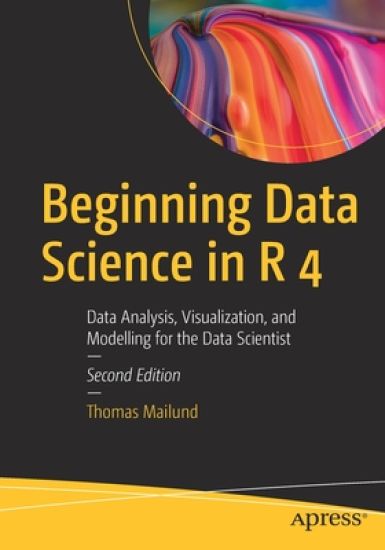
Beginning Data Science in R 4

Beginning Data Science in R 4

Thomas Mailund

APRESS
2022
nidottu
Discover best practices for data analysis and software development in R and start on the path to becoming a fully-fledged data scientist. Updated for the R 4.0 release, this book teaches you techniques for both data manipulation and visualization and shows you the best way for developing new software packages for R. Beginning Data Science in R 4, Second Edition details how data science is a combination of statistics, computational science, and machine learning. You’ll see how to efficiently structure and mine data to extract useful patterns and build mathematical models. This requires computational methods and programming, and R is an ideal programming language for this. Modern data analysis requires computational skills and usually a minimum of programming. After reading and using this book, you'll have what you need to get started with R programming with data science applications. Source code will be available to support your next projects as well.Source code is available at github.com/Apress/beg-data-science-r4.What You Will LearnPerform data science and analytics using statistics and the R programming languageVisualize and explore data, including working with large data sets found in big dataBuild an R packageTest and check your codePractice version controlProfile and optimize your codeWho This Book Is ForThose with some data science or analytics background, but not necessarily experience with the R programming language.
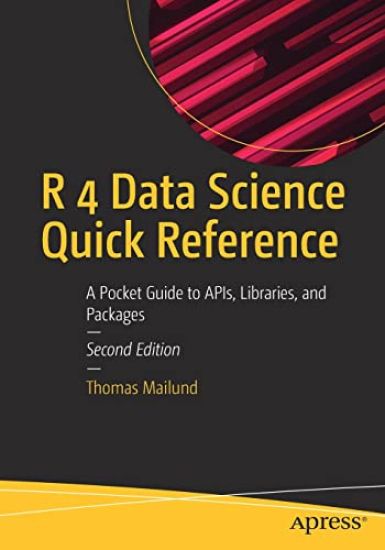
R 4 Data Science Quick Reference
In this handy, quick reference book you'll be introduced to several R data science packages, with examples of how to use each of them. All concepts will be covered concisely, with many illustrative examples using the following APIs: readr, dibble, forecasts, lubridate, stringr, tidyr, magnittr, dplyr, purrr, ggplot2, modelr, and more.With R 4 Data Science Quick Reference, you'll have the code, APIs, and insights to write data science-based applications in the R programming language. You'll also be able to carry out data analysis. All source code used in the book is freely available on GitHub.. What You'll LearnImplement applicable R 4 programming language specification featuresImport data with readrWork with categories using forcats, time and dates with lubridate, and strings with stringrFormat data using tidyr and then transform that data using magrittr and dplyrWrite functions with R for data science, data mining, and analytics-based applicationsVisualize data with ggplot2 and fit data to models using modelrWho This Book Is ForProgrammers new to R's data science, data mining, and analytics packages. Some prior coding experience with R in general is recommended.
Functional Programming in R 4

Functional Programming in R 4

Thomas Mailund

APRESS
2023
nidottu
Master functions and discover how to write functional programs in R. In this book, updated for R 4, you'll learn to make your functions pure by avoiding side effects, write functions that manipulate other functions, and construct complex functions using simpler functions as building blocks.In Functional Programming in R 4, you’ll see how to replace loops, which can have side-effects, with recursive functions that can more easily avoid them. In addition, the book covers why you shouldn't use recursion when loops are more efficient and how you can get the best of both worlds.Functional programming is a style of programming, like object-oriented programming, but one that focuses on data transformations and calculations rather than objects and state. Where in object-oriented programming you model your programs by describing which states an object can be in and how methods will reveal or modify that state, in functional programming you model programs by describing how functions translate input data to output data. Functions themselves are considered to be data you can manipulate and much of the strength of functional programming comes from manipulating functions; that is, building more complex functions by combining simpler functions.What You'll LearnWrite functions in R 4, including infix operators and replacement functions Create higher order functionsPass functions to other functions and start using functions as data you can manipulateUse Filer, Map and Reduce functions to express the intent behind code clearly and safelyBuild new functions from existing functions without necessarily writing any new functions, using point-free programmingCreate functions that carry data along with themWho This Book Is ForThose with at least some experience with programming in R.
The Beginner's Guide to GitHub

The Beginner's Guide to GitHub

Thomas Mailund

Independently Published
2019
pokkari
You have heard about git and GitHub and want to know what the buzz is about. That is what I am here to tell you. Or, at least, I am here to give you a quick overview of what you can do with git and GitHub. I won't be able, in the space here, to give you an exhaustive list of features-in all honesty, I don't know enough myself to be able to claim expertise with these tools. I am only a frequent user, but I can get you started and give you some pointers for where to learn more. That is what this booklet is for.