Kirjahaku
Etsi kirjoja tekijän nimen, kirjan nimen tai ISBN:n perusteella.
65 kirjaa tekijältä Thomas Meyer

Many modern Beowulf translations, while excellent in their own ways, suffer from what Kathleen Biddick might call "melancholy" for an oral and aural way of poetic making. By and large, they tend to preserve certain familiar features of Anglo-Saxon verse as it has been constructed by editors, philologists, and translators: the emphasis on caesura and alliteration, with diction and syntax smoothed out for readability. The problem with, and the paradox of this desired outcome, especially as it concerns Anglo-Saxon poetry, is that we are left with a document that translates an entire organizing principle based on oral transmission (and perhaps composition) into a visual, textual realm of writing and reading. The sense of loss or nostalgia for the old form seems a necessary and ever-present shadow over modern Beowulfs.What happens, however, when a contemporary poet, quite simply, doesn't bother with any such nostalgia? When the entire organizational apparatus of the poem-instead of being uneasily approximated in modern verse form-is itself translated into a modern organizing principle, i.e., the visual text? This is the approach that poet Thomas Meyer takes; as he writes, " I]nstead of the text's orality, perhaps perversely I went for the visual. Deciding to use page layout (recto/ verso) as a unit. Every translation I'd read felt impenetrable to me with its block after block of nearly uniform lines. Among other quirky decisions made in order to open up the text, the project wound up being a kind of typological specimen book for long American poems extant circa 1965. Having variously the 'look' of Pound's Cantos, Williams' Paterson, or Olson or Zukofsky, occasionally late Eliot, even David Jones."A glance anywhere in Meyer's text demonstrates the stunning results. One place he turns it to especially good effect is the fight with Grendel in Fit 11, transforming the famously hyper-condensed syntax of the scene from a discouraging challenge for the translator into a visually pleasing strength: "The eyes of Hygelac's kin watched the wicked raiderexecute his quick attack: without delay, snatching his first chance, a sleeping warrior, he tore him in two, chomped muscle, sucked veins'gushing blood, gulped down his morsel, the dead man, chunk by chunk, hands, feet & all.& thenfootstephandclawfiendreachmanbedquicktrickbeastarmpainclampnewnotknownheartrunfleshofeargetawaygonowrunrunnever before hadsinherd feared anything so."Here the reader is confronted with the words themselves running together, as if in panic, in much the same way that the original passage seems in such a rush to tell the story of the battle that bodies become confused. This is just one example of the adventurous and provocative angle on Beowulf to which Meyer introduces us. His Beowulf-completed in 1972 but never before published-is sure to stretch readers' ideas about what is possible in terms of translating Anglo-Saxon poetry, as well as provide new insights on the poem itself.With a Preface by David Hadbawnik, an Introduction by Daniel C. Remein, and an Interview with Thomas Meyer.
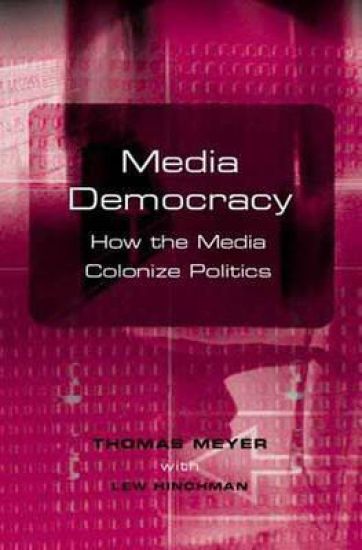
In this text Meyer argues that the media are transforming traditional party democracy into "media democracy". He argues that the culture of the media should be transformed in ways that would serve democracy, enabling citizens to deepen their understanding of political realities.
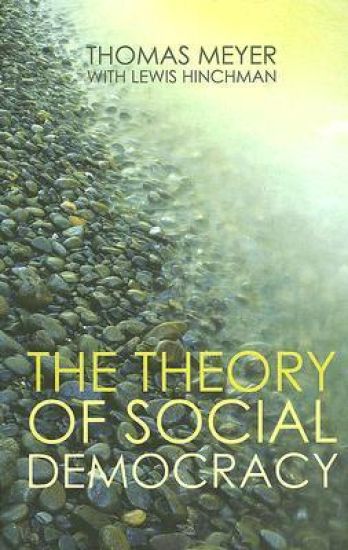
The ascendancy of neo-liberalism in different parts of the world has put social democracy on the defensive. Its adherents lack a clear rationale for their policies. Yet a justification for social democracy is implicit in the United Nations Covenants on Human Rights, ratified by most of the worlds countries. The covenants commit all nations to guarantee that their citizens shall enjoy the traditional formal rights; but they likewise pledge governments to make those rights meaningful in the real world by providing social security and cultural recognition to every person. This new book provides a systematic defence of social democracy for our contemporary global age. The authors argue that the claims to legitimation implicit in democratic theory can be honored only by social democracy; libertarian democracies are defective in failing to protect their citizens adequately against social, economic, and environmental risks that only collective action can obviate. Ultimately, social democracy provides both a fairer and more stable social order. But can social democracy survive in a world characterized by pervasive processes of globalization? This book asserts that globalization need not undermine social democracy if it is harnessed by international associations and leavened by principles of cultural respect, toleration, and enlightenment. The structures of social democracy must, in short, be adapted to the exigencies of globalization, as has already occurred in countries with the most successful social-democratic practices.

The ascendancy of neo-liberalism in different parts of the world has put social democracy on the defensive. Its adherents lack a clear rationale for their policies. Yet a justification for social democracy is implicit in the United Nations Covenants on Human Rights, ratified by most of the worlds countries. The covenants commit all nations to guarantee that their citizens shall enjoy the traditional formal rights; but they likewise pledge governments to make those rights meaningful in the real world by providing social security and cultural recognition to every person. This new book provides a systematic defence of social democracy for our contemporary global age. The authors argue that the claims to legitimation implicit in democratic theory can be honored only by social democracy; libertarian democracies are defective in failing to protect their citizens adequately against social, economic, and environmental risks that only collective action can obviate. Ultimately, social democracy provides both a fairer and more stable social order. But can social democracy survive in a world characterized by pervasive processes of globalization? This book asserts that globalization need not undermine social democracy if it is harnessed by international associations and leavened by principles of cultural respect, toleration, and enlightenment. The structures of social democracy must, in short, be adapted to the exigencies of globalization, as has already occurred in countries with the most successful social-democratic practices.
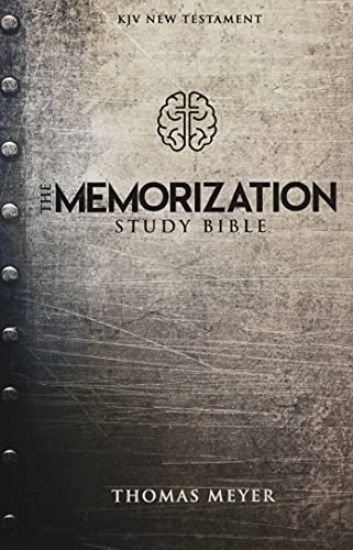
Technology has information at our fingertips. But our relationship with God needs to be one of the heart, not the smartphone. Get engaged with the Word of God in a refreshing and amazing new way Memorize verses, chapters, and even whole books of the New Testament using the "Bible Memory Man" Prof. Tom Meyer's powerful techniques that he learned while studying in Jerusalem, Israel. Having memorized 20 complete books of the Bible, Tom shares his helpful tips. Go deeper into Scripture and command a greater knowledge, insight, and understanding of God

Advanced guidance for institutional investors, academics, and researchers on how to manage a portfolio of private capital funds The Art of Commitment Pacing: Engineering Allocations to Private Capital provides a much-needed analysis of the issues that face investors as they incorporate closed ended-funds targeting illiquid private assets (such as private equity, private debt, infrastructure, real estate) into their portfolios. These private capital funds, once considered "alternative" and viewed as experimental, are becoming an increasingly standard component of institutional asset allocations. However, many investors still follow management approaches that remain anchored in the portfolio theory for liquid assets but that often lead to disappointing results when applied to portfolios of private capital funds where practically investors remain committed over nearly a decade. When planning for such commitments, investment managers and researchers are faced with practical questions such as: How to measure and control the real exposure to private assets? How to forecast cash-flows for commitments to private capital funds? What ranges for their returns and lifetime are realistic, and how can the investor’s skill be factored in? Over which dimensions should a portfolio be diversified and how much diversification is enough? How can the impact of co-investments or secondaries be modelled? How to design pacing plans that lead to resilient and efficient portfolios? What stress scenarios should be considered and how can they be applied? These are just examples of the many questions for which answers are provided. The Art of Commitment Pacing describes established and new methodologies for building up and controlling allocations to such investments. This book offers a systematic approach for building up and controlling allocations to such investments. The Art of Commitment Pacing is a valuable addition to the libraries of investment managers, as well as portfolio and risk managers involved in institutional investment. The book will also be of interest to advanced students of finance, researchers, and other practitioners who require a detailed understanding of forecasting and portfolio management methodologies.

Oral Transmission in Judaism and Christianity
Thomas Meyer
Createspace Independent Publishing Platform
2010
nidottu

Amyotrophe Lateralsklerose (Als): Ein Wegweiser - Antworten Und Hilfen
Thomas Meyer
Kohlhammer
2020
nidottu


Wolkenbruchs wunderliche Reise in die Arme einer Schickse
Thomas Meyer
DIOGENES VERLAG AG
2014
pokkari