Kirjojen hintavertailu. Mukana 11 717 486 kirjaa ja 12 kauppaa.

Kirjahaku

Etsi kirjoja tekijän nimen, kirjan nimen tai ISBN:n perusteella.

3 kirjaa tekijältä Thomas R. Dunn

The Pink Scar

The Pink Scar

Thomas R. Dunn

Pennsylvania State University Press
2025
sidottu
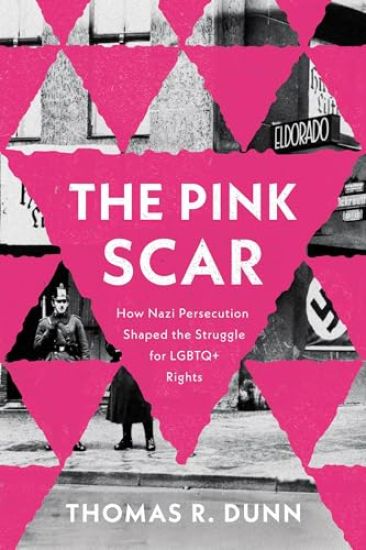
The Third Reich subjected some one hundred thousand individuals to a pernicious anti-homosexual campaign that included censorship, surveillance, medical experimentation, and death. Credible scholarship suggests that as many as fifteen thousand were interned in concentration camps, though the actual names and numbers of all those who suffered and died will never be known.Today, prevailing historical narratives hold that the persecution of homosexuals under Hitler was “discovered” in the 1970s by a post-Stonewall gay and lesbian community, who were the first to use these tragic events—emblematically symbolized by the pink triangle—to advance the struggle for LGBTQ+ rights around the world. The Pink Scar tells a different story. This book shows that Americans had ample opportunity to learn about this persecution before and during the war and explores how activists in the United States made Hitler’s anti-homosexual campaign a central, animating force in their arguments at almost every major turning point in the lesbian and gay struggle since 1934.Victims of the Nazi regime were among the most important and the most contested symbols in the history of lesbian and gay rights rhetoric—perhaps even more contested than the pink triangle itself. This book shows us how, nearly one hundred years after Hitler came to power, remembering the people persecuted by the Nazi regime is once again essential for defending LGBTQ+ rights in a new age of growing fascism and anti-queer/trans oppression.
The Pink Scar

The Pink Scar

Thomas R. Dunn

Pennsylvania State University Press
2025
pokkari
The Third Reich subjected some one hundred thousand individuals to a pernicious anti-homosexual campaign that included censorship, surveillance, medical experimentation, and death. Credible scholarship suggests that as many as fifteen thousand were interned in concentration camps, though the actual names and numbers of all those who suffered and died will never be known.Today, prevailing historical narratives hold that the persecution of homosexuals under Hitler was “discovered” in the 1970s by a post-Stonewall gay and lesbian community, who were the first to use these tragic events—emblematically symbolized by the pink triangle—to advance the struggle for LGBTQ+ rights around the world. The Pink Scar tells a different story. This book shows that Americans had ample opportunity to learn about this persecution before and during the war and explores how activists in the United States made Hitler’s anti-homosexual campaign a central, animating force in their arguments at almost every major turning point in the lesbian and gay struggle since 1934.Victims of the Nazi regime were among the most important and the most contested symbols in the history of lesbian and gay rights rhetoric—perhaps even more contested than the pink triangle itself. This book shows us how, nearly one hundred years after Hitler came to power, remembering the people persecuted by the Nazi regime is once again essential for defending LGBTQ+ rights in a new age of growing fascism and anti-queer/trans oppression.
Queerly Remembered

Queerly Remembered

Thomas R. Dunn

University of South Carolina Press
2016
sidottu
Queerly Remembered investigates the ways in which gay, lesbian, bisexual, transgender, and queer (GLBTQ) individuals and communities have increasingly turned to public tellings of their ostensibly shared pasts in order to advocate for political, social, and cultural change in the present. Much like nations, institutions, and other minority groups before them, GLBTQ people have found communicating their past(s)—particularly as expressed through the concept of memory—a rich resource for leveraging historical and contemporary opinions toward their cause. Drawing from the interdisciplinary fields of rhetorical studies, memory studies, gay and lesbian studies, and queer theory, Thomas R. Dunn considers both the ephemeral tactics and monumental strategies that GLBTQ communities have used to effect their queer persuasion. More broadly this volume addresses the challenges and opportunities posed by embracing historical representations of GLBTQ individuals and communities as a political strategy. Particularly for a diverse community whose past is marked by the traumas of the HIV/AIDS pandemic, the forgetting and destruction of GLBTQ history, and the sometimes-divisive representational politics of fluid, intersectional identities, portraying a shared past is an exercise fraught with conflict despite its potential rewards. Nonetheless, by investigating rich rhetorical case studies through time and across diverse artifacts—including monuments, memorials, statues, media publications, gravestones, and textbooks—Queerly Remembered reveals that our current queer “turn toward memory” is a complex, enduring, and avowedly rich rhetorical undertaking.