Kirjojen hintavertailu. Mukana 12 016 292 kirjaa ja 12 kauppaa.

Kirjahaku

Etsi kirjoja tekijän nimen, kirjan nimen tai ISBN:n perusteella.

5 kirjaa tekijältä Thomas W. Cutrer

Parnassus on the Mississippi

Parnassus on the Mississippi

Thomas W. Cutrer

Louisiana State University Press
1984
sidottu
Parnassus on the Mississippi is a history of the short-lived yet remarkable productive epoch when, in the words of C. Vann Woodward, ""the center of the avant-garde of American literary criticism shifted temporarily to the banks of the Mississippi at Baton Rouge."" Beginning with the establishment of the Southern Review at Louisiana State University in 1935, Baton Rouge became the home not only to a brand of criticism that would reshape the teaching of literature in America but also to a community of scholars and artists that included Cleanth Brooks, Robert Penn Warren, Katherine Anne Porter, Robert Lowell, Jean Stafford, and Peter Taylor.Thomas Cutrer chronicles how the Southern Review, created in the midst of the Depression by the largess of Louisiana governor Huey P. Long, quickly rose to the position of the finest American literary journal of its day. Under the joint editorship of Cleanth Brooks and Robert Penn Warren, the journal published criticism, poetry, and short fiction by writers as eminent as R.P. Blackmur, Kenneth Burke, T.S. Elliot, and Wallace Stevens. The editors also encouraged and published works by such young talented, and at the time unknown writers as Nelson Algren, Randall Jarrell, Mary McCarthy, and Eudora Welty.During these same years, Brooks and Warren collaborated on three textbooks, An Approach to Literature, Understanding Poetry, and Understanding Fiction, which would revolutionise college English by emphasising the study of a literary work itself, in concrete and precise terms, over the study of the biographical, historical, and moral issues surrounding it. Brooks also wrote his influential critical works Modern Poetry and Tradition and The Well Wrought Urn, while Warren wrote two novels and some of his finest poems and stories, and absorbed material from the political tumult around him for the work that would later become All the King's Men.The stature of the Southern Review and the vitality of the literary community that it spawned were both, to a great extent, born of the dedication and creativity of Books and Warren, but in other very tangible ways, they were also by-products of the ambition of Huey Long; ironically, it was the actions of one of the assassinated governor's loyalists that brought an end to Baton Rouge's time as a Parnassus. After a financial scandal rocked the university, a reform administration was appointed which, in its zeal to curb a runaway budget, stopped the funding for the review. Soon after, Brooks and Warren both left the faculty. The Southern Review itself would lie dormant until its revival two decades later.
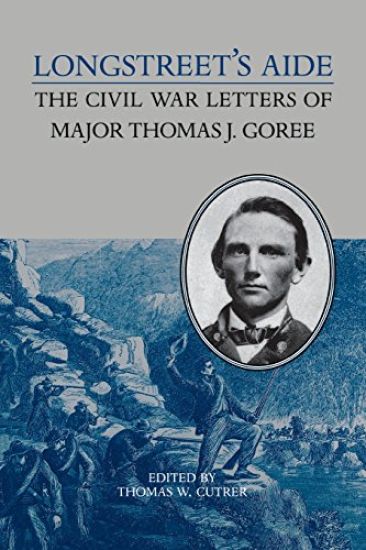
Longstreet's Aide

Longstreet's Aide

Thomas W. Cutrer

University of Virginia Press
2015
nidottu
One of the Confederacy's most loyal adherents and articulate advocates was Lieutenant Grant James Longstreet's aide-de-camp, Thomas Jewett Goree. Present at Longstreet's headquarters and party to the counsels of Robert E. Lee and his lieutenants, Goree wrote incisively on matters of strategy and politics and drew revealing portraits of Longstreet, Jefferson Davis, P.G.T. Beauregard, John Bell Hood, J.E.B. Stuart, and others of Lee's inner circle. His letters are some of the richest and most perceptive from the Civil War period. Thomas Cutrer has collected all of Goree's wartime correspondence to his family, as well as his travel diary from June-August 1865. With its wide scope and rich detail, Longstreet's Aide represents an invaluable addition to the Civil War letter collections published in recent years. While Goree's letters will fascinate Civil War buffs, they also provide a unique opportunity for scholars of social and military history to witness from inside the workings of both an extended Southern family and the forces of the Confederacy.
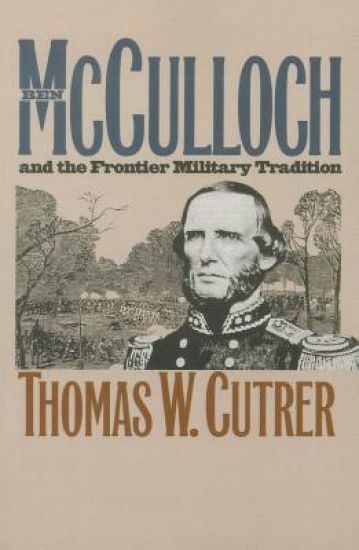
Ben Mcculloch and the Frontier Military Tradition

Ben Mcculloch and the Frontier Military Tradition

Thomas W. Cutrer

The University of North Carolina Press
2014
nidottu
[A] well-written, comprehensively researched biography.--Publishers Weekly""Will both edify the scholar while captivating and entertaining the general reader. . . . Cutrer's research is impeccable, his prose vigorous, and his life of McCulloch likely to remain the standard for many years.""--Civil War""A well-crafted work that makes an important contribution to understanding the frontier military tradition and the early stages of the Civil War in the West.""--Civil War History""A penetrating study of a man who was one of the last citizen soldiers to wear a general's stars.""--Blue and Gray""A brisk narrative filled with colorful quotations by and about the central figure. . . . Will become the standard biography of Ben McCulloch.""--Journal of Southern History""A fast-paced, clearly written narrative that does full justice to its heroically oversized subject.""--American Historical Review
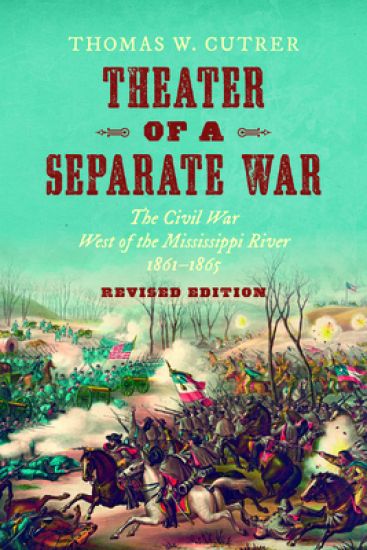
Theater of a Separate War

Theater of a Separate War

Thomas W. Cutrer

The University of North Carolina Press
2023
pokkari
Though its most famous battles were waged in the East at Antietam, Gettysburg, and throughout Virginia, the Civil War was clearly a conflict that raged across a continent. From cotton-rich Texas and the fields of Kansas through Indian Territory and into the high desert of New Mexico, the Trans-Mississippi Theater was site of major clashes from the war's earliest days through the surrenders of Confederate generals Edmund Kirby Smith and Stand Waite in June 1865. In this comprehensive military history of the war west of the Mississippi River, Thomas W. Cutrer shows that the theater's distance from events in the East does not diminish its importance to the unfolding of the larger struggle.
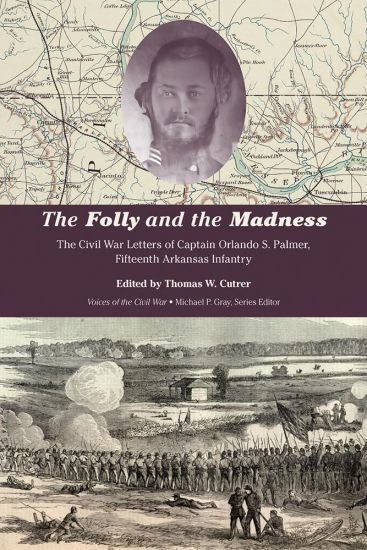
The Folly and the Madness

The Folly and the Madness

Thomas W. Cutrer

University of Tennessee Press
2023
nidottu
With a closeness perhaps unique to siblings orphaned young, Orlando and Artimisia “Missie” Palmer exchanged intimate letters throughout their lives. These letters (interspersed with additional letters from Oliver Kennedy, the Palmers’ first cousin) offer a clear and entertaining window into the life and times of a junior Confederate officer serving in the Western Theater of the Civil War. Though he initially felt Americans would see “the folly and the madness” of going to war, Orlando enlisted as a private in what would become Company H of the First (later Fifteenth) Arkansas Infantry, informing his sister that he had volunteered “not for position, not for a name, but from patriotic motivation.” However, he was ambitious enough to secure an appointment as Maj. Gen. William Joseph Hardee’s personal secretary; he then rose to become his regiment’s sergeant major, his company’s first lieutenant, and later captain and brigade adjutant. Soldier letters typically report only what can be observed at the company level, but Palmer’s high-ranking position offers a unique view of strategic rather than tactical operations. Palmer’s letters are not all related to his military experience, though, and the narrative is enhanced by his nuanced reflections on courtship customs and personal relationships. For instance, Palmer frequently attempts to entertain Missie with witticisms and tales of his active romantic life: “We have so much to do,” he quips, “that we have no time to do anything save to visit the women. I am in love with several dozen of them and am having a huge time generally.”The Folly and the Madness adds depth to the genre of Civil War correspondence and provides a window into the lives of ordinary southerners at an extraordinary time.