Kirjojen hintavertailu. Mukana 11 627 670 kirjaa ja 12 kauppaa.

Kirjahaku

Etsi kirjoja tekijän nimen, kirjan nimen tai ISBN:n perusteella.

8 kirjaa tekijältä Tiffany Stern

Rehearsal from Shakespeare to Sheridan

Rehearsal from Shakespeare to Sheridan

Tiffany Stern

Clarendon Press
2000
sidottu
Up until now, facts about theatrical rehearsal have been considered irrecoverable. But in this groundbreaking new study, Tiffany Stern gathers together two centuries' worth of historical material which shows how actors received and responded to their parts, and how rehearsal affected the creation and revision of plays. Plotting theatrical change over time, from the mid-sixteenth to the late eighteenth century, this book will revolutionize the fields of textual and theatre history alike.
Rehearsal from Shakespeare to Sheridan

Rehearsal from Shakespeare to Sheridan

Tiffany Stern

Oxford University Press
2007
nidottu
Attention is often given to the performance of a text, but not to the shaping process behind that performance. The question of rehearsal is seldom confronted directly, though important textual moments - like revision - are often attributed to it. Whatismore, up until now, facts about theatrical rehearsal have been considered irrecoverable. In this groundbreaking new study, Tiffany Stern gathers together two centuries' worth of historical material which shows how actors received and responded to their parts, and how rehearsal affected the creation and revision of plays. This is the first history of the subject, from the sixteenth century to the eighteenth. It examines the nature and changing content of rehearsal, drawing on a mass of autobiographical, textual, and journalistic sources, and in so doing throws new light on textual revision and transforms accepted notions of Renaissance, Restoration, and eighteenth-century theatrical practice. Plotting theatrical change over time, this book will revolutionize the fields of textual and theatre history alike.
Making Shakespeare

Making Shakespeare

Tiffany Stern

Routledge
2004
sidottu
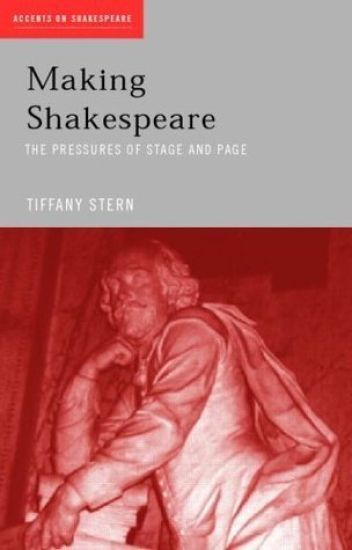
Making Shakespeare is a lively introduction to the major issues of the stage and print history, whilst also raising questions about what a Shakespeare play actually is. Tiffany Stern reveals how London, the theatre, the actors and the way in which the plays were written and printed all affect the 'Shakespeare' that we now read. Concentrating on the instability and fluidity of Shakespeare's texts, her book discusses what happened to a manuscript between its first composition, its performance on stage and its printing, and identifies traces of the production system in the plays we read. She argues that the versions of Shakespeare that have come down to us have inevitably been formed by the contexts from which they emerged; being shaped by, for example, the way actors received and responded to their lines, the props and music used in the theatre, or the continual revision of plays by the playhouses and printers. Allowing a fuller understanding of the texts we read and perform, Making Shakespeare is the perfect introduction to issues of stage and page. A refreshingly clear, accessible read, this book will allow even those with no expert knowledge to begin to contextualize Shakespeare's plays for themselves, in ways both old and new.
Making Shakespeare

Making Shakespeare

Tiffany Stern

Routledge
2004
nidottu
Making Shakespeare is a lively introduction to the major issues of the stage and print history, whilst also raising questions about what a Shakespeare play actually is. Tiffany Stern reveals how London, the theatre, the actors and the way in which the plays were written and printed all affect the 'Shakespeare' that we now read. Concentrating on the instability and fluidity of Shakespeare's texts, her book discusses what happened to a manuscript between its first composition, its performance on stage and its printing, and identifies traces of the production system in the plays we read. She argues that the versions of Shakespeare that have come down to us have inevitably been formed by the contexts from which they emerged; being shaped by, for example, the way actors received and responded to their lines, the props and music used in the theatre, or the continual revision of plays by the playhouses and printers. Allowing a fuller understanding of the texts we read and perform, Making Shakespeare is the perfect introduction to issues of stage and page. A refreshingly clear, accessible read, this book will allow even those with no expert knowledge to begin to contextualize Shakespeare's plays for themselves, in ways both old and new.
Documents of Performance in Early Modern England

Documents of Performance in Early Modern England

Tiffany Stern

Cambridge University Press
2009
sidottu
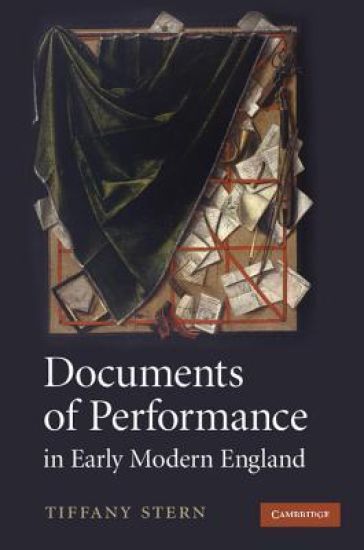
As well as 'play-makers' and 'poets', playwrights of the early modern period were known as 'play-patchers' because their texts were made from separate documents. This book is the first to consider all the papers created by authors and theatres by the time of the opening performance, recovering types of script not previously known to have existed. With chapters on plot-scenarios, arguments, playbills, prologues and epilogues, songs, staged scrolls, backstage-plots and parts, it shows how textually distinct production was from any single unified book. And, as performance documents were easily lost, relegated or reused, the story of a play's patchy creation also becomes the story of its co-authorship, cuts, revisions and additions. Using a large body of fresh evidence, Documents of Performance in Early Modern England brings a wholly new reading to printed and manuscript playbooks of the Shakespearean period, redefining what a play, and what a playwright, actually is.
Shakespeare, Malone and the Problems of Chronology

Shakespeare, Malone and the Problems of Chronology

Tiffany Stern

Cambridge University Press
2023
pokkari
In 1778 Edmond Malone published his first contribution to Shakespeare scholarship, An Attempt to Ascertain the Order in which the Plays Attributed to Shakspeare were Written. He revised and republished it in 1790 and began a further revision of it which was printed posthumously in 1821. This Element will be on the three versions of Malone's Attempt and the way they created, shaped, focused, directed, and misdirected, our idea of the chronology and sequence of Shakespeare's plays. By showing Malone's impressive, fallible choices, adopted or adapted by later editors, it reveals how current Shakespeare editions are, in good and bad ways, Malonian at heart.
Ballad Business

Ballad Business

Tiffany Stern

Cambridge University Press
2025
sidottu
Playwrights, including Shakespeare, often started out as song writers and regularly product-placed ballads within their dramas. In this enlightening study, Tiffany Stern asks who wrote, financed, published and marketed theatrical broadsheet ballads and investigates the migrants, women, and individuals with disabilities who sung and sold them outside playhouses – in striking contrast to the white, able-bodied and male actors who performed inside. With case-studies ranging from ballads in plays by Shakespeare and Jonson, sung after plays as jigs or 'themes' by the clowns Tarlton, Kemp and Armin, and performed about the plays of Marlowe, Kyd, Shakespeare and others, Ballad Business argues that broadsheet ballads were often the first and sometimes only parts of the performance to be published. Advertisements and souvenirs, ballads constituted a crucial though now forgotten form of theatrical merchandise and musical paratext.
Documents of Performance in Early Modern England

Documents of Performance in Early Modern England

Tiffany Stern

Cambridge University Press
2012
pokkari
As well as 'play-makers' and 'poets', playwrights of the early modern period were known as 'play-patchers' because their texts were made from separate documents. This book is the first to consider all the papers created by authors and theatres by the time of the opening performance, recovering types of script not previously known to have existed. With chapters on plot-scenarios, arguments, playbills, prologues and epilogues, songs, staged scrolls, backstage-plots and parts, it shows how textually distinct production was from any single unified book. And, as performance documents were easily lost, relegated or reused, the story of a play's patchy creation also becomes the story of its co-authorship, cuts, revisions and additions. Using a large body of fresh evidence, Documents of Performance in Early Modern England brings a wholly new reading to printed and manuscript playbooks of the Shakespearean period, redefining what a play, and what a playwright, actually is.