Kirjojen hintavertailu. Mukana 11 627 670 kirjaa ja 12 kauppaa.

Kirjahaku

Etsi kirjoja tekijän nimen, kirjan nimen tai ISBN:n perusteella.

33 kirjaa tekijältä Tim Ingold

Imagining for Real

Imagining for Real

Tim Ingold

Routledge
2021
sidottu
What does imagination do for our perception of the world? Why should reality be broken off from our imagining of it? It was not always thus, and in these essays, Tim Ingold sets out to heal the break between reality and imagination at the heart of modern thought and science. Imagining for Real joins with a lifeworld ever in creation, attending to its formative processes, corresponding with the lives of its human and nonhuman inhabitants. Building on his two previous essay collections, The Perception of the Environment and Being Alive , this book rounds off the extraordinary intellectual project of one of the world’s most renowned anthropologists.Offering hope in troubled times, these essays speak to coming generations in a language that surpasses disciplinary divisions. They will be essential reading not only for anthropologists but also for students in fi elds ranging from art, aesthetics, architecture and archaeology to philosophy, psychology, human geography, comparative literature and theology.
Imagining for Real

Imagining for Real

Tim Ingold

Routledge
2021
nidottu
What does imagination do for our perception of the world? Why should reality be broken off from our imagining of it? It was not always thus, and in these essays, Tim Ingold sets out to heal the break between reality and imagination at the heart of modern thought and science. Imagining for Real joins with a lifeworld ever in creation, attending to its formative processes, corresponding with the lives of its human and nonhuman inhabitants. Building on his two previous essay collections, The Perception of the Environment and Being Alive , this book rounds off the extraordinary intellectual project of one of the world’s most renowned anthropologists.Offering hope in troubled times, these essays speak to coming generations in a language that surpasses disciplinary divisions. They will be essential reading not only for anthropologists but also for students in fi elds ranging from art, aesthetics, architecture and archaeology to philosophy, psychology, human geography, comparative literature and theology.
Comp Ency Anthropology

Comp Ency Anthropology

Tim Ingold

Routledge
1997
nidottu
This comprehensive survey of contemporary thought in biological, social and cultural anthropology sets the foundation for their future development and integration. The principal rationale behind the Encyclopedia is to overcome the division and fragmentation within the approaches of the humanities and natural sciences to anthropology. It emphasizes interconnections between perspectives and sub-disciplines, producing a complete perspective on what it means to be human. The work consists of three parts--Humanity, Culture, and Social Life--and 40 major contributions. Part One emphasizes human beings as members of a species, how that species differs from others, how it has evolved, and how human populations have adapted to and in turn transformed their environments. Part Two deals with the origin and structure of human culture, and on the role of culture in action, perception, and cognition. Part Three examines the various aspects of the relationships and processes that are carried on by persons and groups in the course of social life. Useful features such as cross-references within the text, full biographical references, suggestions for further reading and carefully illustrated line drawings make this an indispensable resource for all students of anthropology or sociology.
Making

Making

Tim Ingold

Routledge
2013
sidottu
Making creates knowledge, builds environments and transforms lives. Anthropology, archaeology, art and architecture are all ways of making, and all are dedicated to exploring the conditions and potentials of human life. In this exciting book, Tim Ingold ties the four disciplines together in a way that has never been attempted before. In a radical departure from conventional studies that treat art and architecture as compendia of objects for analysis, Ingold proposes an anthropology and archaeology not of but with art and architecture. He advocates a way of thinking through making in which sentient practitioners and active materials continually answer to, or ‘correspond’, with one another in the generation of form. Making offers a series of profound reflections on what it means to create things, on materials and form, the meaning of design, landscape perception, animate life, personal knowledge and the work of the hand. It draws on examples and experiments ranging from prehistoric stone tool-making to the building of medieval cathedrals, from round mounds to monuments, from flying kites to winding string, from drawing to writing. The book will appeal to students and practitioners alike, with interests in social and cultural anthropology, archaeology, architecture, art and design, visual studies and material culture.
Making

Making

Tim Ingold

Routledge
2013
nidottu
Making creates knowledge, builds environments and transforms lives. Anthropology, archaeology, art and architecture are all ways of making, and all are dedicated to exploring the conditions and potentials of human life. In this exciting book, Tim Ingold ties the four disciplines together in a way that has never been attempted before. In a radical departure from conventional studies that treat art and architecture as compendia of objects for analysis, Ingold proposes an anthropology and archaeology not of but with art and architecture. He advocates a way of thinking through making in which sentient practitioners and active materials continually answer to, or ‘correspond’, with one another in the generation of form. Making offers a series of profound reflections on what it means to create things, on materials and form, the meaning of design, landscape perception, animate life, personal knowledge and the work of the hand. It draws on examples and experiments ranging from prehistoric stone tool-making to the building of medieval cathedrals, from round mounds to monuments, from flying kites to winding string, from drawing to writing. The book will appeal to students and practitioners alike, with interests in social and cultural anthropology, archaeology, architecture, art and design, visual studies and material culture.
The Life of Lines

The Life of Lines

Tim Ingold

Routledge
2015
sidottu
To live, every being must put out a line, and in life these lines tangle with one another. This book is a study of the life of lines. Following on from Tim Ingold's groundbreaking work Lines: A Brief History, it offers a wholly original series of meditations on life, ground, weather, walking, imagination and what it means to be human. In the first part, Ingold argues that a world of life is woven from knots, and not built from blocks as commonly thought. He shows how the principle of knotting underwrites both the way things join with one another, in walls, buildings and bodies, and the composition of the ground and the knowledge we find there. In the second part, Ingold argues that to study living lines, we must also study the weather. To complement a linealogy that asks what is common to walking, weaving, observing, singing, storytelling and writing, he develops a meteorology that seeks the common denominator of breath, time, mood, sound, memory, colour and the sky. This denominator is the atmosphere. In the third part, Ingold carries the line into the domain of human life. He shows that for life to continue, the things we do must be framed within the lives we undergo. In continually answering to one another, these lives enact a principle of correspondence that is fundamentally social. This compelling volume brings our thinking about the material world refreshingly back to life. While anchored in anthropology, the book ranges widely over an interdisciplinary terrain that includes philosophy, geography, sociology, art and architecture.
The Life of Lines

The Life of Lines

Tim Ingold

Routledge
2015
nidottu
To live, every being must put out a line, and in life these lines tangle with one another. This book is a study of the life of lines. Following on from Tim Ingold's groundbreaking work Lines: A Brief History, it offers a wholly original series of meditations on life, ground, weather, walking, imagination and what it means to be human. In the first part, Ingold argues that a world of life is woven from knots, and not built from blocks as commonly thought. He shows how the principle of knotting underwrites both the way things join with one another, in walls, buildings and bodies, and the composition of the ground and the knowledge we find there. In the second part, Ingold argues that to study living lines, we must also study the weather. To complement a linealogy that asks what is common to walking, weaving, observing, singing, storytelling and writing, he develops a meteorology that seeks the common denominator of breath, time, mood, sound, memory, colour and the sky. This denominator is the atmosphere. In the third part, Ingold carries the line into the domain of human life. He shows that for life to continue, the things we do must be framed within the lives we undergo. In continually answering to one another, these lives enact a principle of correspondence that is fundamentally social. This compelling volume brings our thinking about the material world refreshingly back to life. While anchored in anthropology, the book ranges widely over an interdisciplinary terrain that includes philosophy, geography, sociology, art and architecture.
Anthropology and/as Education

Anthropology and/as Education

Tim Ingold

Routledge
2017
sidottu
There is more to education than teaching and learning, and more to anthropology than making studies of other people’s lives. Here Tim Ingold argues that both anthropology and education are ways of studying, and of leading life, with others. In this provocative book, he goes beyond an exploration of the interface between the disciplines of anthropology and education to claim their fundamental equivalence.Taking inspiration from the writings of John Dewey, Ingold presents his argument in four close-knit chapters. Education, he contends, is not the transmission of authorised knowledge from one generation to the next but a way of attending to things, opening up paths of growth and discovery. What does this mean for the ways we think about study and the school, teaching and learning, and the freedoms they exemplify? And how does it bear on the practices of participation and observation, on ways of study in the field and in the school, on art and science, research and teaching, and the university?Written in an engaging and accessible style, this book is intended as much for educationalists as for anthropologists. It will appeal to all who are seeking alternatives to mainstream agendas in social and educational policy, including educators and students in philosophy, the social sciences, educational psychology, environmentalism and arts practice.
Anthropology and/as Education

Anthropology and/as Education

Tim Ingold

Routledge
2017
nidottu
There is more to education than teaching and learning, and more to anthropology than making studies of other people’s lives. Here Tim Ingold argues that both anthropology and education are ways of studying, and of leading life, with others. In this provocative book, he goes beyond an exploration of the interface between the disciplines of anthropology and education to claim their fundamental equivalence.Taking inspiration from the writings of John Dewey, Ingold presents his argument in four close-knit chapters. Education, he contends, is not the transmission of authorised knowledge from one generation to the next but a way of attending to things, opening up paths of growth and discovery. What does this mean for the ways we think about study and the school, teaching and learning, and the freedoms they exemplify? And how does it bear on the practices of participation and observation, on ways of study in the field and in the school, on art and science, research and teaching, and the university?Written in an engaging and accessible style, this book is intended as much for educationalists as for anthropologists. It will appeal to all who are seeking alternatives to mainstream agendas in social and educational policy, including educators and students in philosophy, the social sciences, educational psychology, environmentalism and arts practice.
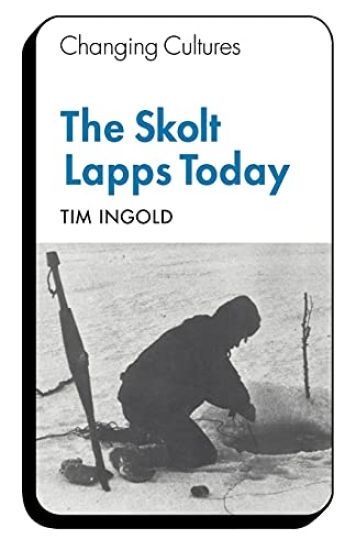
The Skolt Lapps Today

The Skolt Lapps Today

Tim Ingold

Cambridge University Press
1976
pokkari
On the conclusion of the Second World War, Finland was obliged to cede its northeasternmost territory of Petsamo to the Soviet Union. Amongst those who lost their homes were around four hundred representatives of the original native population of the territory, the Skolt Lapps. The Skolts were subsequently resettled in two 'reservations' marked out in the wilderness of Finland's present northeastern borderlands. The contemporary organization of the Skolt community in the larger of these reservations, the Sevettijärvi area, is the subject of this 1976 study. The first part of the book the ecological imbalance created by technological innovation and commercial penetration; the second analyses the the activities and relationships built up on the fixes template of the resettlement plan; and the third explores the business of 'leap-frog' politics, which links the community into the machinery of modern government and the forum of debate on the future of native minorities.
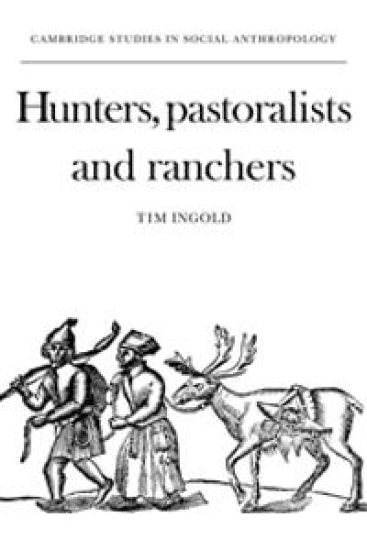
Hunters, Pastoralists and Ranchers

Hunters, Pastoralists and Ranchers

Tim Ingold

Cambridge University Press
1988
pokkari
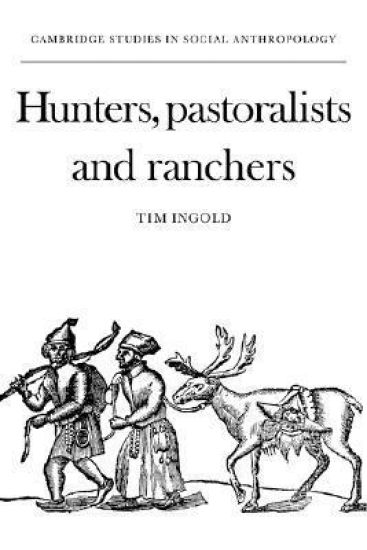
Throughout the northern circumpolar tundras and forests, and over many millennia, human populations have based their livelihood wholly or in part upon the exploitation of a single animal species–the reindeer. Yet some are hunters, others pastoralists, while today traditional pastoral economies are being replaced by a commercially oriented ranch industry. In this book, drawing on ethnographic material from North America and Eurasia, Tim Ingold explains the causes and mechanisms of transformations between hunting, pastoralism and ranching, each based on the same animal in the same environment, and each viewed in terms of a particular conjunction of social and ecological relations of production. In developing a workable synthesis between ecological and economic approaches in anthropology, Ingold introduces theoretically rigorous concepts for the analysis of specialized animal-based economies, which cast the problem of 'domestication' in an entirely new light.
The Perception of the Environment

The Perception of the Environment

Tim Ingold

TAYLOR FRANCIS LTD
2021
nidottu
In this work Tim Ingold offers a persuasive new approach to understanding how human beings perceive their surroundings. He argues that what we are used to calling cultural variation consists, in the first place, of variations in skill. Neither innate nor acquired, skills are grown, incorporated into the human organism through practice and training in an environment. They are thus as much biological as cultural. To account for the generation of skills we have therefore to understand the dynamics of development. And this in turn calls for an ecological approach that situates practitioners in the context of an active engagement with the constituents of their surroundings.The twenty-three essays comprising this book focus in turn on the procurement of livelihood, on what it means to ‘dwell’, and on the nature of skill, weaving together approaches from social anthropology, ecological psychology, developmental biology and phenomenology in a way that has never been attempted before. The book is set to revolutionise the way we think about what is ‘biological’ and ‘cultural’ in humans, about evolution and history, and indeed about what it means for human beings – at once organisms and persons – to inhabit an environment. The Perception of the Environment will be essential reading not only for anthropologists but also for biologists, psychologists, archaeologists, geographers and philosophers.This edition includes a new Preface by the author.
The Perception of the Environment

The Perception of the Environment

Tim Ingold

TAYLOR FRANCIS LTD
2021
sidottu
In this work Tim Ingold offers a persuasive new approach to understanding how human beings perceive their surroundings. He argues that what we are used to calling cultural variation consists, in the first place, of variations in skill. Neither innate nor acquired, skills are grown, incorporated into the human organism through practice and training in an environment. They are thus as much biological as cultural. To account for the generation of skills we have therefore to understand the dynamics of development. And this in turn calls for an ecological approach that situates practitioners in the context of an active engagement with the constituents of their surroundings.The twenty-three essays comprising this book focus in turn on the procurement of livelihood, on what it means to ‘dwell’, and on the nature of skill, weaving together approaches from social anthropology, ecological psychology, developmental biology and phenomenology in a way that has never been attempted before. The book is set to revolutionise the way we think about what is ‘biological’ and ‘cultural’ in humans, about evolution and history, and indeed about what it means for human beings – at once organisms and persons – to inhabit an environment. The Perception of the Environment will be essential reading not only for anthropologists but also for biologists, psychologists, archaeologists, geographers and philosophers.This edition includes a new Preface by the author.
Being Alive

Being Alive

Tim Ingold

TAYLOR FRANCIS LTD
2021
sidottu
Anthropology is a disciplined inquiry into the conditions and potentials of human life. Generations of theorists, however, have expunged life from their accounts, treating it as the mere output of patterns, codes, structures or systems variously defined as genetic or cultural, natural or social. Building on his classic work The Perception of the Environment, Tim Ingold sets out to restore life to where it should belong, at the heart of anthropological concern. Being Alive ranges over such themes as the vitality of materials; what it means to make things; the perception and formation of the ground; the mingling of earth and sky in the weather-world; the experiences of light, sound and feeling; the role of storytelling in the integration of knowledge; and the potential of drawing to unite observation and description.Our humanity, Ingold argues, does not come ready-made but is continually fashioned in our movements along ways of life. Starting from the idea of life as a process of wayfaring, Ingold presents a radically new understanding of movement, knowledge and description as dimensions not just of being in the world, but of being alive to what is going on there.This edition includes a new preface by the author.
Being Alive

Being Alive

Tim Ingold

TAYLOR FRANCIS LTD
2021
nidottu
Anthropology is a disciplined inquiry into the conditions and potentials of human life. Generations of theorists, however, have expunged life from their accounts, treating it as the mere output of patterns, codes, structures or systems variously defined as genetic or cultural, natural or social. Building on his classic work The Perception of the Environment, Tim Ingold sets out to restore life to where it should belong, at the heart of anthropological concern. Being Alive ranges over such themes as the vitality of materials; what it means to make things; the perception and formation of the ground; the mingling of earth and sky in the weather-world; the experiences of light, sound and feeling; the role of storytelling in the integration of knowledge; and the potential of drawing to unite observation and description.Our humanity, Ingold argues, does not come ready-made but is continually fashioned in our movements along ways of life. Starting from the idea of life as a process of wayfaring, Ingold presents a radically new understanding of movement, knowledge and description as dimensions not just of being in the world, but of being alive to what is going on there.This edition includes a new preface by the author.
Old Ways, New People

Old Ways, New People

Tim Ingold

TAYLOR FRANCIS LTD
2025
sidottu
In this second and retitled edition of Anthropology and/as Education, Tim Ingold shows that there is more to anthropology than ethnography and more to education than teaching and learning. Building on the first edition’s exploration of the interface between the disciplines of anthropology and education, this revised edition pushes the bounds further, calling upon anthropologists to rethink their disciplinary vocation, by regarding it as fundamentally an educational rather than an ethnographic endeavour.What does a reimagining of anthropology mean for the ways we think about study and the school, teaching and learning, and the freedoms they exemplify? And how does it bear on the practices of participation and observation, on ways of study in the field and in the school, on art and science, research and teaching? This edition has been revised and expanded throughout and includes a major new chapter on how the educational mission of anthropology can shape the university of the future. This book will appeal to all who are seeking alternatives to mainstream agendas in social and educational policy, including educators and students in philosophy, the social sciences, educational psychology, environmentalism and arts practice.
Old Ways, New People

Old Ways, New People

Tim Ingold

TAYLOR FRANCIS LTD
2025
nidottu
In this second and retitled edition of Anthropology and/as Education, Tim Ingold shows that there is more to anthropology than ethnography and more to education than teaching and learning. Building on the first edition’s exploration of the interface between the disciplines of anthropology and education, this revised edition pushes the bounds further, calling upon anthropologists to rethink their disciplinary vocation, by regarding it as fundamentally an educational rather than an ethnographic endeavour.What does a reimagining of anthropology mean for the ways we think about study and the school, teaching and learning, and the freedoms they exemplify? And how does it bear on the practices of participation and observation, on ways of study in the field and in the school, on art and science, research and teaching? This edition has been revised and expanded throughout and includes a major new chapter on how the educational mission of anthropology can shape the university of the future. This book will appeal to all who are seeking alternatives to mainstream agendas in social and educational policy, including educators and students in philosophy, the social sciences, educational psychology, environmentalism and arts practice.
Lines

Lines

Tim Ingold

Routledge
2016
nidottu
What do walking, weaving, observing, storytelling, singing, drawing and writing have in common? The answer is that they all proceed along lines. In this extraordinary book Tim Ingold imagines a world in which everyone and everything consists of interwoven or interconnected lines and lays the foundations for a completely new discipline: the anthropological archaeology of the line.Ingold’s argument leads us through the music of Ancient Greece and contemporary Japan, Siberian labyrinths and Roman roads, Chinese calligraphy and the printed alphabet, weaving a path between antiquity and the present. Drawing on a multitude of disciplines including archaeology, classical studies, art history, linguistics, psychology, musicology, philosophy and many others, and including more than seventy illustrations, this book takes us on an exhilarating intellectual journey that will change the way we look at the world and how we go about in it.This Routledge Classics edition includes a new preface by the author.
Evolution and Social Life

Evolution and Social Life

Tim Ingold

Routledge
2016
nidottu
Evolution is among the most central and most contested of ideas in the history of anthropology. This book charts the fortunes of the idea from the mid-nineteenth century to recent times. By comparing biological, historical, and anthropological approaches to the study of human culture and social life, it lays the foundation for their effective synthesis. Far ahead of its time when first published, the book anticipates debates at the forefront of contemporary thinking. Revisiting the work after almost thirty years, Tim Ingold offers a substantial new preface that describes how the book came to be written, how it was received and its bearing on later developments. Unique in scope and breadth of theoretical vision, Evolution and Social Life cuts across the boundaries of natural science and the humanities to provide a major contribution both to the history of anthropological and social thought, and to contemporary debate on the relationship between human nature, culture, and social life.