Kirjojen hintavertailu. Mukana 11 627 220 kirjaa ja 12 kauppaa.

Kirjahaku

Etsi kirjoja tekijän nimen, kirjan nimen tai ISBN:n perusteella.

9 kirjaa tekijältä Tim Wander

2mt Writtle - The Birth of British Broadcasting

2mt Writtle - The Birth of British Broadcasting

Tim Wander

New Generation Publishing
2010
pokkari
This book charts the struggle to achieve a national radio broadcasting service in Britain after World War 1. It starts with young wireless engineers struggling to develop radio systems capable of transmitting speech to aircraft during the war. It then follows those same engineers for the next five years, and details their early experimental broadcasts from the Marconi New Street works that included the famous 1920 broadcast by Dame Nellie Melba. The Marconi engineers then created the 2MT Writtle station. Its sparkling success led the same engineers to design and then build the BBC, starting in 1923.This then is the story of those amazing times. It is aimed at a wide readership, not just lovers of historic or technical tomes. The book does include separate technical/historical appendices on the Writtle, Chelmsford and 2LO transmitters, the Dutch station PCGG, Belgian station OTL and even the village of Writtle itself. The book also looks at the work of many early pioneers who tried to make broadcasting happen even sooner, including Grindell Matthews, Mahlon Loomis, Reginald Fessenden and David Hughes. It includes an overview of the explosion in radio broadcasting in America along with a detailed Glossary and Appendices on all aspects of the new science of radio.With over 200 photographs, it draws on over 25 years of research and includes much previously unpublished archive material.

Marconi's New Street Works 1912 - 2012

Marconi's New Street Works 1912 - 2012

Tim Wander

New Generation Publishing
2012
pokkari
The Marconi New Street works in Chelmsford, Essex was the world's first purpose built wireless factory and became the world's first electronics factory using mass production techniques. For well over ninety years the huge factory was the centre of the massive Marconi Company Empire that stretched across the world. However, the disastrous collapse of the Marconi Company prompted the abandonment of the huge complex of offices, workshops, laboratories, test areas and manufacturing plant that alone once employed over 10,000 people. When the factory was opened in 1912, the SS Titanic had just sunk in the middle of the Atlantic and 711 lives were saved solely due to the use of Guglielmo Marconi's invention and the brave Marconi wireless operators aboard. It was the tragedy of the Titanic that gave birth to the modern wireless age and spurred a growth in manufacture and development that probably could not have occurred otherwise. One hundred years later in 2012 the site stands empty and vandalised.This is the story of the world's first wireless factory, partly told in the words of the people who worked there. Within its walls the science and art of wireless communication was born. I also firmly believe that this is where the modern electronics age, be it radio, television, radar, satellite or even mobile telephones was born. The Marconi New Street Works, 1912 - 2012, was the birthplace of Britain's last industrial revolution.
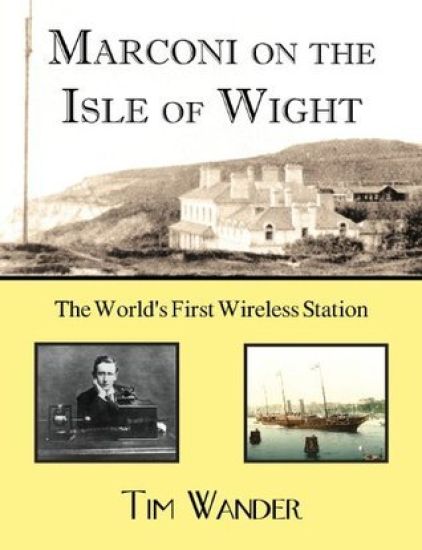
Marconi on the Isle of Wight

Marconi on the Isle of Wight

Tim Wander

New Generation Publishing
2013
pokkari
In November 1897, a twenty-three year old Italian inventor visited the Royal Needles Hotel that overlooked Alum Bay on the west coast of the Isle of Wight. The young Guglielmo Marconi's proposal to rent rooms to perform his 'experiments' over the deserted winter months was warmly welcomed by the hotels proprietors. Marconi used some of the working capital of his newly formed Wireless Telegraph & Signal Company to convert the hotel's billiard room and install his equipment and spark transmitter. Several small ships were hired and fitted with wireless aerials and receivers while moored at the pier below. A huge mast, 168 feet high, had to be hauled up the cliff face of Alum Bay and raised in the hotel grounds, a feat that required the help of most of the able bodied men in Totland. On Monday 6th December 1897 Marconi started his wireless experiments from the Royal Needles Hotel, including a month of private demonstrations for Queen Victoria and the Royal family using wireless stations he installed at Osborne House and on board the Royal Yacht. For the next two and a half years the world's first permanent wireless station would be operated from the Isle of Wight. By 1900 Marconi realised he need more space, greater privacy and longer ranges to his new stations being built in Cornwall. He moved his equipment and aerial mast from Alum Bay across the Island to a new station built in Knowles farm in Niton. While there Marconi developed the vital science of tuning, enabling multiple wireless signals to be separated without interference. In January 1901 transmissions from Niton reached Marconi's new station at Lizard Point in Cornwall. This was 196 miles away, a world record for 'radio' waves, convincing Marconi that his system was now ready to attempt to transmit across the Atlantic ocean, over 2,100 miles. The science and art of wireless communication was born on the Isle of Wight. This is the story of a young Italian engineer, whose small experiments on a small Island grew to produce our modern world of instant global communication, radio broadcasting, mobile phones, television, satellite communication and even the internet. Marconi on the Isle of Wight changed the world forever.
Marconi's Hall Street Works

Marconi's Hall Street Works

Tim Wander

New Generation Publishing
2016
pokkari
By the end of 1898 Guglielmo Marconi's fledgling new Wireless Telegraph Companywas just over two years old. The young Italian engineer was exhausted from endlessmonths of intense testing and developments, trying to prove that his systemof wireless communication was a viable commercial proposition. But Marconihad no customers and his company was teetering on the edge of bankruptcy.However Marconi was no ordinary man. He believed in his system and he believedthat the orders would come and that he would need to fulfil them.In January 1899, in a brave, perhaps even reckless move, he opened the world's first wirelessfactory in Chelmsford, employing 20 people. For a time his new factory had to scramblefor sub-contract manufacture, but over the next 13 years the Hall Street Works engineers,technicians and staff were to build the foundations of a new wireless age.Soon the Hall Street Works would send equipment to the Boer War, the Chinese BoxerRebellion and supply the huge Poldhu and Clifden transatlantic stations. In December1901, against all the odds, Marconi managed to receive a wireless message sent across theAtlantic Ocean, over 2,170 miles, and much of the equipment was built in the Hall StreetWorks. Despite Marconi and his Company becoming world famous it was still a desperatestruggle to find paying customers for his new 'wire-less' system. On 8th May 1901 the RoyalNavy would place the first order for 32 sets, which was increased to 108 sets by 1905.The Hall Street Works then supplied all the equipment for Marconi's growing networkof coastal wireless stations and started to equip increasing numbers of civilian ships.The factory supplied customers across the globe including the Amazon Basin, Hawaii,Congo, Thailand, South Africa, India, Canada and even to both sides in the Balkan Warof 1912. It was Marconi wireless equipment manufactured in Hall Street installed aboardthe ill-fated RMS Titanic that saved over 730 people when the great ship was lost in 1912and over 760 people when the RMS Lusitania was sunk in May 1915. This successful useof wireless for safety at sea effectively generated a new and vast market for Marconi'sequipment.In the same year the Hall Street Works officially closed its doors as the huge New StreetWorks took over the workload and the world's first wireless factory fell silent, apart fromits wireless station across the road that continued to eavesdrop on the German fleetfeeding vital intelligence to the Navy's top secret Room 40 code breakers. It was thisand all the work done at Hall Street that ensured that Britain and the Marconi Companywere ready to face the extreme demands ofa world now at war.
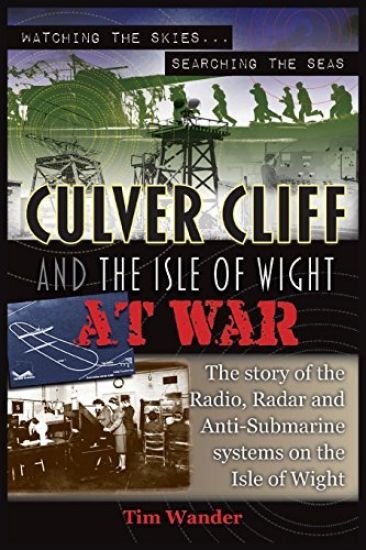
Culver Cliff and the Isle of Wight at War

Culver Cliff and the Isle of Wight at War

Tim Wander

New Generation Publishing
2018
nidottu
Defending the Realm - The Electronic Warfare Battle on Culver Cliff during WW2During most of the Second World War the Isle of Wight was essentially a closed military camp supporting over 30 anti-aircraft batteries to protect Southampton and Portsmouth dockyards and an arsenal of coastal firepower to defend the Solent and the Island from Invasion.It was a perilous time when the fate of the nation hung in the balance and the Isle of Wight was the new front line. Four hundred years after the French invasion of 1545 the battle hardened German forces had plans in place to conquer the Island in less than 72 hours.After many years of detailed research Tim Wander has built up a fascinating picture of the varied technologies, buildings and systems - some of which have now all been forgotten - that were rushed into operation to protect the Island. From miles of undersea anti-submarine cables stretched out to the NAB tower and between the Solent Sea Forts, through to remote controlled minefields, nets, barbed wires, miles of anti-landing scaffolding barriers, mine fields, prototype radars, secret wireless stations, hydrophones and even beach flame barrages and perhaps poison gas. Each had their part to play in a vital integrated defence network that was assembled in haste after the disastrous retreat from Dunkirk.Terrified of a Bruneval Type commando raid against the experimental radar installations on Bembridge Fort and the huge headland wireless station which would not only control D-Day but also was a vital “Y station”, intercepting messages for decoding at Bletchley Park, Culver Cliff became one of the most fortified parts of the South coast.It bristled with guns and defences of every type, was staffed by over 300 men and women from all three services plus the Home Guard and radar engineers.While barrage balloon floated over head for a few hours the very fate of the nation rested on young RAF engineers as they struggled to construct a temporary radar station rushed to the Island from London to mimic the destroyed Chain Home radar base at Ventnor. Their actions fooled General Wolfgang Martini, responsible for the development of the advanced German radar technology systems to convince Hermann Göring, Commander of the Luftwaffe to stop attacking British radar installations - a decision that crucially changed the course of the war.The main 9.2 inch Culver Cliff and Nodes Point gun batteries protected the Solent entrances and the now lost Redcliff and Yaverland Forts provided a curtain of searchlights and weaponry to protect the high risk invasion beaches of Sandown and Shanklin below. By 1943 this protective shield made the Bay the obvious choice to install the fuel pumping stations for the ambitious engineering project that was codenamed PLUTO, the Pipeline Under The Ocean - designed to support the D-Day invasion.
The Ghosts of Northwood House

The Ghosts of Northwood House

Tim Wander

New Generation Publishing
2018
nidottu
In truth I do not know if ghosts exist. If they do, I do not know what they are... is not a very auspicious start to a book grandly entitled 'The Ghosts of Northwood House'. The Historian Nikolaus Pevsner wrote that Northwood House: 'Is a strange house outside and stranger within.' He may be right. At Northwood House over many long and sometimes very cold evenings I have sat as a neutral observer with many 'paranormal research' and 'ghost hunting
Voices over Passchendaele: A Stage Play

Voices over Passchendaele: A Stage Play

Tim Wander

New Generation Publishing
2019
nidottu
They went with songs to the battle, they were young,Straight of limb, true of eye, steady and aglow.They were staunch to the end against odds uncounted;They fell with their faces to the foe./They shall grow not old, as we that are left grow old:Age shall not weary them, nor the years condemn.At the going down of the sun and in the morningWe will remember them.