Kirjojen hintavertailu. Mukana 11 342 296 kirjaa ja 12 kauppaa.

Kirjahaku

Etsi kirjoja tekijän nimen, kirjan nimen tai ISBN:n perusteella.

3 kirjaa tekijältä Timothy C. Campbell

Improper Life

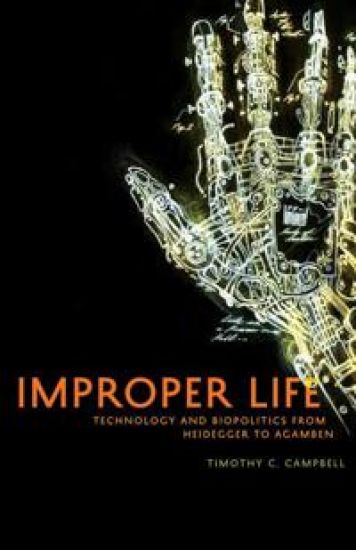
Improper Life

Timothy C. Campbell

University of Minnesota Press
2011
nidottu
Has biopolitics actually become thanatopolitics, a field of study obsessed with death? Is there something about the nature of biopolitical thought today that makes it impossible to deploy affirmatively? If this is true, what can life-minded thinkers put forward as the merits of biopolitical reflection? These questions drive Improper Life, Timothy C. Campbell’s dexterous inquiry-as-intervention.Campbell argues that a “crypto-thanatopolitics” can be teased out of Heidegger’s critique of technology and that some of the leading scholars of biopolitics-including Michel Foucault, Giorgio Agamben, and Peter Sloterdijk-have been substantively influenced by Heidegger’s thought, particularly his reading of proper and improper writing. In fact, Campbell shows how all of these philosophers have pointed toward a tragic, thanatopolitical destination as somehow an inevitable result of technology. But in Improper Life he articulates a corrective biopolitics that can begin with rereadings of Foucault (especially his late work regarding the care and technologies of the self), Freud (notably his writings on the drives and negation), and Gilles Deleuze (particularly in the relation of attention to aesthetics).Throughout Improper Life, Campbell insists that biopolitics can become more positive and productively asserts an affirmative techne not thought through thanatos but rather practiced through bÍos.
The Techne of Giving

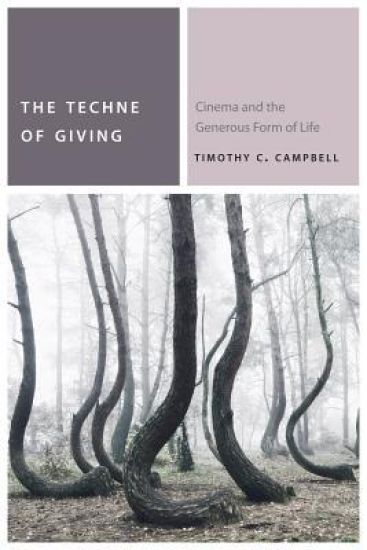
The Techne of Giving

Timothy C. Campbell

Fordham University Press
2017
sidottu
Over the last five years, corporations and individuals have given more money, more often, to charitable organizations than ever before. What could possibly be the downside to inhabiting a golden age of gift-giving? That question lies at the heart of Timothy Campbell's account of contemporary giving and its social forms. In a milieu where gift-giving dominates, nearly everything given and received becomes the subject of a calculus—gifts from God, from benefactors, from those who have. Is there another way to conceive of generosity? What would giving and receiving without gifts look like? A lucid and imaginative intervention in both European philosophy and film theory, The Techne of Giving investigates how we hold the objects of daily life—indeed, how we hold ourselves—in relation to neoliberal forms of gift-giving. Even as instrumentalism permeates giving, Campbell articulates a resistant techne locatable in forms of generosity that fail to coincide with biopower's assertion that the only gifts that count are those given and received. Moving between visual studies, Winnicottian psychoanalysis, Foucauldian biopower, and apparatus theory, Campbell makes a case for how to give and receive without giving gifts. In the conversation between political philosophy and classic Italian films by Visconti, Rossellini, and Antonioni, the potential emerges of a generous form of life that can cross between the visible and invisible, the fated and the free.
The Techne of Giving

The Techne of Giving

Timothy C. Campbell

Fordham University Press
2017
pokkari
Over the last five years, corporations and individuals have given more money, more often, to charitable organizations than ever before. What could possibly be the downside to inhabiting a golden age of gift-giving? That question lies at the heart of Timothy Campbell's account of contemporary giving and its social forms. In a milieu where gift-giving dominates, nearly everything given and received becomes the subject of a calculus—gifts from God, from benefactors, from those who have. Is there another way to conceive of generosity? What would giving and receiving without gifts look like? A lucid and imaginative intervention in both European philosophy and film theory, The Techne of Giving investigates how we hold the objects of daily life—indeed, how we hold ourselves—in relation to neoliberal forms of gift-giving. Even as instrumentalism permeates giving, Campbell articulates a resistant techne locatable in forms of generosity that fail to coincide with biopower's assertion that the only gifts that count are those given and received. Moving between visual studies, Winnicottian psychoanalysis, Foucauldian biopower, and apparatus theory, Campbell makes a case for how to give and receive without giving gifts. In the conversation between political philosophy and classic Italian films by Visconti, Rossellini, and Antonioni, the potential emerges of a generous form of life that can cross between the visible and invisible, the fated and the free.