
Kirjahaku
Etsi kirjoja tekijän nimen, kirjan nimen tai ISBN:n perusteella.
12 kirjaa tekijältä Timothy Falcon Crack

Note: eBook version of latest edition now available; see Amazon author page for details.] This revised seventh edition of the Q&A book accompanies the Foundations for Scientific Investing text. It provides 600+ multiple-choice, and 125 short-answer questions to accompany the long-answer questions already appearing in Foundations for Scientific Investing. The long-answer questions are repeated here also. The suggested solutions to the multiple-choice and short-answer questions appear here and are also available free of charge at the Web site for the book. If you have purchased the eBook version of this book (which uses DRM-PDF and is not able to be printed), it might be easiest to print out the Web-based solutions to consult while viewing the eBook questions. The multiple choice questions may also be useful as a test bank for instructors in any advanced investments class.
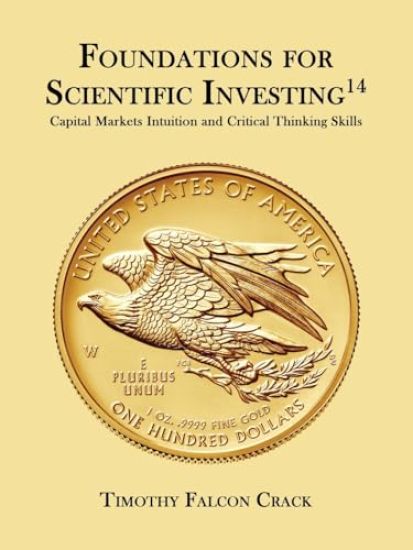
Every investor needs capital markets intuition and critical thinking skills to conduct confident, deliberate, and skeptical investment. The overarching goal of this book is to help investors build these skills.This revised 14th edition is the product of 25+ years of investment research and experience (academic, personal, and professional), and 20+ painstaking years of destructive testing in university classrooms. Although the topic is applied investments, the integration of finance, economics, accounting, pure mathematics, statistics, numerical techniques, and spreadsheets (or programming) make this an ideal capstone course at the advanced undergraduate or masters/MBA level. The book has a heavily scientific/quantitative focus, but the material should be accessible to a motivated practitioner or talented individual investor with (for the most part) only high school level mathematics or intermediate level university mathematics. Although aimed at the advanced undergraduate or masters/MBA level, the careful explanations of a wide range of advanced capital markets topics makes this an excellent book for a U.S. PhD student in need of an easily accessible foundation course in capital markets theory and practice.There are literature reviews of multiple advanced areas. More than 30 unanswered research questions are identified; these research questions would be ideal for a master's thesis or a chapter of a PhD. The applied nature of the book also makes it ideal for capital markets practitioners. For example, in one exercise, the reader is taken by the hand and walked through construction of a worked spreadsheet example of an active alpha optimization using actual stock market data. (The reader gets to build ex-ante alphas, and feed them into an optimization that weighs returns, risk, and transaction costs. A portfolio is rebalanced based on the optimization, and ultimately a backtest is conducted to measure ex post alpha.) Other practitioner material includes advanced time value of money exercises, a review of retirement topics, extensive discussions of dividends, P/E ratios, transaction costs, the CAPM, value versus growth versus glamour versus income, and a review of more than 100 years of stock market performance and more than 200 years of interest rates.There are 75 "Quant Quizzes," containing over 100 individual questions. Each is designed to reinforce key ideas. There are also more than 10 "You Need to Know" boxes, each of which focuses on an important point that is often taught poorly or overlooked completely in university courses. Special attention is paid to more difficult topics like construction of Student-t statistics, the Roll critique, smart beta, factor-based investing, the Fama-French critique, and Grinold-Kahn versus Black-Litterman models (note that a hybrid Grinold-Kahn/Black-Litterman model is introduced). A key diagram shows how the following models are related to each other: Martingale, Random Walk, ABM, GBM, APT, CAPM, Markowitz, Tobin, Zero-Beta CAPM, Black-Scholes, Bachelier, etc. Another key diagram identifies participants in securities lending transactions that stand behind any short sale of stock. Also, the Roll Critique and the Black Zero-Beta CAPM are both generalized to reference portfolios that are not necessarily fully invested. The list of references has over 1,000 items from the academic and practitioner literature and the extensive index has over 9,500 entries. Finally, note that a separate book with more than 700 classroom-tested questions exists to accompany this book.

What is it like to own your first dog? We list the many surprises that we faced with our first dog, Hazel. We tell you what we wish we had known in advance, what we would do differently next time, and what we learned the hard way. We also discuss general pros and cons of dog ownership. We did a lot of dog research before bringing Hazel into our family. Nevertheless, we still faced a constant barrage of surprises that no book, web site, or other dog owner had prepared us for. Given our prior research, why did we face so many surprises? We think the problem is that much of the advice we took was from "experts." The experts likely grew up with dogs and/or had multiple dogs over their lifetimes. The shock of bringing a first dog into their family was something that either they never knew (because their parents had handled any problems when they were children) or it was something they had long since forgotten about. We are not experts, but ordinary people, and we have done our best here to tell you what to expect with your first dog. Hazel the Chocolate Labrador has enriched our family life in ways we never expected. My family and I wish you the best of success with your own first-dog adventure. This handy pocket-sized edition (4.37in x 7in; 111mm x 178mm) is just over 150-pages long, including the preface and the index.

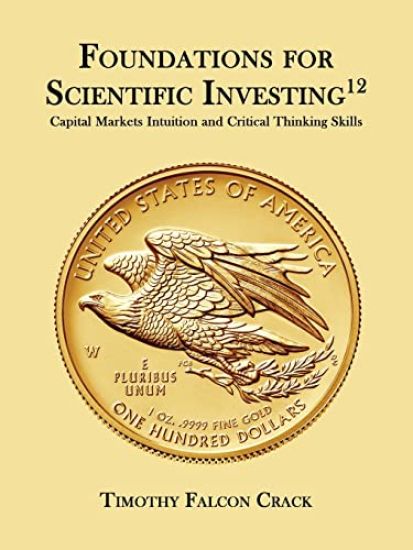
Note: eBook version of latest edition now available; see Amazon author page for details.] Every investor needs capital markets intuition and critical thinking skills to conduct confident, deliberate, and skeptical investment. The overarching goal of this book is to help investors build these skills. This revised 12th edition is the product of 25+ years of investment research and experience (academic, personal, and professional), and 20+ painstaking years of destructive testing in university classrooms. Although the topic is applied investments, the integration of finance, economics, accounting, pure mathematics, statistics, numerical techniques, and spreadsheets (or programming) make this an ideal capstone course at the advanced undergraduate or masters/MBA level. The book has a heavily scientific/quantitative focus, but the material should be accessible to a motivated practitioner or talented individual investor with (for the most part) only high school level mathematics or intermediate level university mathematics. Although aimed at the advanced undergraduate or masters/MBA level, the careful explanations of a wide range of advanced capital markets topics makes this an excellent book for a U.S. PhD student in need of an easily accessible foundation course in capital markets theory and practice. There are literature reviews of multiple advanced areas, and more than 30 unanswered research questions are identified; these research questions would be ideal for a master's thesis or a chapter of a PhD. The applied nature of the book also makes it ideal for capital markets practitioners. For example, in one exercise, the reader is taken by the hand and walked through construction of a worked spreadsheet example of an active alpha optimization using actual stock market data. (The reader gets to build ex-ante alphas, and feed them into an optimization that weighs returns, risk, and transaction costs. A portfolio is rebalanced based on the optimization, and ultimately a backtest is conducted to measure ex post alpha.) Other practitioner material includes advanced time value of money exercises, a review of retirement topics, extensive discussions of dividends, P/E ratios, transaction costs, the CAPM, value versus growth versus glamour versus income, and a review of more than 100 years of stock market performance and more than 200 years of interest rates. The book contains 72 "Quant Quizzes," containing over 100 individual questions. Each is designed to reinforce key ideas. There are also more than 10 "You Need to Know" boxes, each of which focuses on a very important point that is often taught poorly or overlooked completely in university courses. Special attention is paid to more difficult topics like construction of Student-t statistics, the Roll critique, smart beta, factor-based investing, the Fama-French critique, and Grinold-Kahn versus Black-Litterman models (note that a hybrid Grinold-Kahn/Black-Litterman model is introduced). A key diagram shows how the following models are related to each other: Martingale, Random Walk, ABM, GBM, APT, CAPM, Markowitz, Tobin, Zero-Beta CAPM, Black-Scholes, Bachelier, etc. Another key diagram identifies participants in securities lending transactions that stand behind any short sale of stock. Also, the Roll Critique and the Black Zero-Beta CAPM are both generalized to reference portfolios that are not necessarily fully invested. The list of references has over 1,000 items from the academic and practitioner literature and the extensive index has over 9,500 entries. Finally, note that a separate book with more than 600 classroom-tested questions exists to accompany this book.
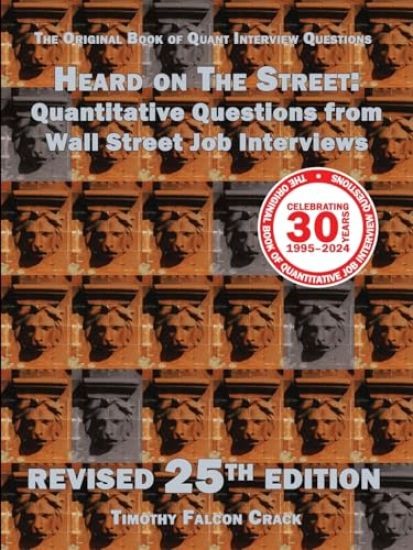
Warning: Do not buy an old edition of Timothy Crack's books by mistake. Click on the Amazon author page link for a list of the latest editions .] THIS IS A MUST READ It is the first and the original book of quantitative questions from finance job interviews. Painstakingly revised over 30 years and 25 editions, Heard on The Street has been shaped by feedback from hundreds of readers. With well over 75,000 copies in print, its readership is unmatched by any competing book. The revised 25th edition contains 242 quantitative questions collected from actual job interviews in investment banking, investment management, and options trading. The interviewers use the same questions year-after-year, and here they are with detailed solutions This edition also includes 267 non-quantitative actual interview questions, giving a total of more than 500 actual finance job interview questions.Questions that appeared in (or are likely to appear in) traditional corporate finance or investment banking job interviews are indicated with a bank symbol in the margin (72 of the 242 quant questions and 196 of the 267 non-quant questions). This makes it easier for corporate finance candidates to go directly to the questions most relevant to them. Most of these questions also appeared in capital markets interviews and quant interviews. So, they should not be skipped over by capital markets or quant candidates unless they are obviously irrelevant.There is also a recently revised section on interview technique based on feedback from interviewers worldwide. The quant questions cover pure quant/logic, financial economics, derivatives, and statistics. They come from all types of interviews (corporate finance, sales and trading, quant research, etc.), and from all levels of interviews (undergraduate, MS, MBA, PhD). The first seven editions of Heard on the Street contained an appendix on option pricing. That appendix was carved out as a standalone book many years ago and it is now available in a recently revised edition: "Basic Black-Scholes."Dr. Crack did PhD coursework at MIT and Harvard, and graduated with a PhD from MIT. He has won many teaching awards, and has publications in the top academic, practitioner, and teaching journals in finance. He has degrees/diplomas in Mathematics/Statistics, Finance, Financial Economics and Accounting/Finance. Dr. Crack taught at the university level for over 25 years including four years as a front line teaching assistant for MBA students at MIT, and four years teaching undergraduates, MBAs, and PhDs at Indiana University. He has worked as an independent consultant to the New York Stock Exchange and to a foreign government body investigating wrong doing in the financial markets. He previously held a practitioner job as the head of a quantitative active equity research team at what was the world's largest institutional money manager.
Dr. Crack studied PhD-level option pricing at MIT and Harvard Business School, taught undergrad-, MBA-, and PhD-level option pricing at Indiana University (winning many teaching awards), was an independent consultant to the New York Stock Exchange, worked as an asset management practitioner in London, and traded options for 20+ years. This unique mix of learning, teaching, consulting, practice, and trading is reflected in every page. This revised 7th edition gives clear explanations of Black-Scholes option pricing theory, and discusses direct applications of the theory to trading. The presentation does not go far beyond basic Black-Scholes for three reasons: First, a novice need not go far beyond Black-Scholes to make money in the options markets; Second, all high-level option pricing theory is simply an extension of Black-Scholes; and Third, there already exist many books that look far beyond Black-Scholes without first laying the firm foundation given here. The trading advice does not go far beyond elementary call and put positions because more complex trades are simply combinations of these. UNIQUE SELLING POINTS -The basic intuition you need to trade options for the first time, or interview for an options job. -Honest advice about trading: there is no simple way to beat the markets, but if you have skill this advice can help make you money, and if you have no skill but still choose to trade, this advice can reduce your losses. -Full immersion treatment of transactions costs (T-costs). -Lessons from trading stated in simple terms. -Stylized facts about the markets (e.g., how to profit from reversals, when are T-costs highest/lowest during the trading day, implications of the market for corporate control, etc.). -How to apply European-style Black-Scholes pricing to the trading of American-style options. -Leverage through margin trading compared with leverage through options, including worked spreadsheet examples. -Binomial and Trinomial models compared. -Black-Scholes pricing code for HP17B, HP19B, and HP12C. -Five accompanying Excel sheets: forecast T-costs for options using simple models; explore option sensitivities including the Greeks; compare stock trading to option trading; GameStop example; and, explore P(ever ITM). -Practitioner Bloomberg Terminal screenshots to aid learning. -Simple discussion of continuously-compounded returns. -Introduction to "paratrading" (trading stocks side-by-side with options). -Unique "regrets" treatment of early exercise decisions and trade-offs for American-style calls and puts. -Unique discussion of put-call parity and option pricing. -How to calculate Black-Scholes in your head in 10 seconds (also in Heard on The Street: Quantitative Questions from Wall Street Job Interviews). -Special attention to arithmetic Brownian motion with general pricing formulae and comparisons of Bachelier (1900) with Black-Scholes. -Careful attention to the impact of dividends in analytical American option pricing. -Dimensional analysis and the adequation formula (relating FX call and FX put prices through transformed Black-Scholes formulae). -Intuitive review of risk-neutral pricing/probabilities and how and why these are related to physical pricing/probabilities. -Careful distinction between the early Merton (non-risk-neutral) hedging-type argument and later Cox-Ross/Harrison-Kreps risk-neutral pricing -Simple discussion of Monte-Carlo methods in science and option pricing. -Simple interpretations of the Black-Scholes formula and PDE and implications for trading. -Careful discussion of conditional probabilities as they relate to Black-Scholes. -Intuitive treatment of high-level topics e.g., bond-numeraire interpretation of Black-Scholes (where N(d2) is P(ITM)) versus the stock-numeraire interpretation (where N(d1) is P(ITM)). -Introduction and discussion of the risk-neutral probability that a European-style call or put option is ever in the money during its life.