Kirjojen hintavertailu. Mukana 11 450 896 kirjaa ja 12 kauppaa.

Kirjahaku

Etsi kirjoja tekijän nimen, kirjan nimen tai ISBN:n perusteella.

9 kirjaa tekijältä Timothy J. Wengert

Human Freedom, Christian Righteousness

Human Freedom, Christian Righteousness

Timothy J. Wengert

Oxford University Press Inc
1998
sidottu
This book argues that Philip Melanchthon, conventionally pictured as hopelessly caught in the middle between Erasmus and Luther, and more "Erasmian" than a Lutheran theologian should have been, was, at least theologically, not Erasmian at all, but in fact sharply anti-Erasmus. Wengert draws largely on Melanchthon's Scholia on the Epistle of Paul to the Colossians as well as on a range of other contemporary sources to address a number of important questions, including the complicated and elusive relationship between humanism and the Reformation and the issues of proper biblical interpretation of free will, of divine and human righteousness, and of political order.
Martin Luther's Catechisms

Martin Luther's Catechisms

Timothy J. Wengert

Augsburg Fortress
2009
nidottu
Martin Luther's catechisms 3 the Small Catechism in 1528-29, and the Large Catechism in spring 1529 - responded in part to "the deplorable, wretched deprivation that I recently encountered while I was a visitor" to rural Saxon congregations. The former was for laity, the latter an elaboration largely for the education of clergy, with Luther excoriating "their pure laziness and concern for their bellies." Reformation scholar Timothy Wengert has studied Luther's catechisms for the light they shed on the maturing Reformation faith but also for the fascinating lens they afford into the social world of Wittenberg in those years: children, clergy, education and publishing, marriage customs, devotion and prayer, and celebration of the Lord's Supper in this period, along with Luther's own hearty faith, are all illumined by these Western classics. In this volume, which also includes the texts of the catechisms, Wengert follows the traditional catechism order to demonstrate the dynamic faith exhibited in the catechisms in their original context and ours. An ideal resource for college and seminary classes, as well as individual and group reading, this volume will be a valued vehicle for understanding Reformation faith for many years to come.
Priesthood, Pastors, Bishops

Priesthood, Pastors, Bishops

Timothy J. Wengert

Fortress Press,U.S.
2008
nidottu
Protestant churches are often rent by disagreement and dissent over the office of bishop, the roles of the ordained, and myriad forms of lay ministry. Timothy Wengert's text overturns many of the 'pious myths' about these matters to probe the core conviction of Martin Luther, Philip Melanchthon, and the early Reform about public ministry.
Reading the Bible with Martin Luther – An Introductory Guide

Reading the Bible with Martin Luther – An Introductory Guide

Timothy J. Wengert

Baker Academic, Div of Baker Publishing Group
2013
nidottu
Prominent Reformation historian Timothy Wengert introduces the basic components of Martin Luther's theology of the Bible and examines Luther's contributions to present-day biblical interpretation. Wengert addresses key points of debate regarding Luther's approach to the Bible that have often been misunderstood, including biblical authority, the distinction between law and gospel, the theology of the cross, and biblical ethics. He argues that Luther, when rightly understood, offers much wisdom to Christians searching for fresh approaches to the interpretation of Scripture. This brief but comprehensive overview is filled with insights on Luther's theology and its significance for contemporary debates on the Bible, particularly the New Perspective on Paul.
Philip Melanchthon, Speaker of the Reformation

Philip Melanchthon, Speaker of the Reformation

Timothy J. Wengert

Ashgate Publishing Limited
2010
sidottu
The studies in this volume illuminate the thought and life of Philip Melanchthon, one of the most neglected major figures in Reformation history and theology. Melanchthon was one of the most widely published and respected thinkers in his own day, who authored some of the sixteenth-century's most important books on Latin and Greek grammar, rhetoric, dialectics, and history, to say nothing of his theological output, which included the first overview of Protestant theology, the first Protestant commentaries on Romans, 1 & 2 Corinthians, and John. He was also the chief drafter of the Augsburg Confession and wrote its defense, the Apology. These essays, written over the past twenty years, commemorate the 450th anniversary of Melanchthon's death in 2010. The articles provide a wide-ranging picture of Melanchthon's thought and life with topics including his view of free will, approaches to biblical interpretation, his perspective on the church fathers and world history, and comparisons to other important figures of the age, including Calvin, Luther and Erasmus.
Martin Luther's Ninety-Five Theses

Martin Luther's Ninety-Five Theses

Timothy J. Wengert

Fortress Press,U.S.
2015
nidottu
By almost any reckoning, the Ninety-Five Theses ranks as the most important text of the Reformation, if not in substance at least in impact. As the anniversary of their posting on the church door in Wittenberg approaches, what better way to remember and recognize the occasion than to make this important text more easily understood by twenty-first-century readers? Timothy J. Wengert, one of the best-know interpreters of Luther and Lutheranism active today, sets his newly translated Ninety-Five Theses in its historical context with a detailed introduction and illuminating study notes. To help the reader understand the context and the import of the Ninety-Five Theses more deeply, Wengert provides two more related and essential documents: Luther's Letter to Archbishop Albrecht of Mainz (to which he appended a copy of the Theses) and Luther's 1518 Sermon on Indulgences and Grace (written to inform the German-speaking public of his view of indulgences). The book is simply constructed with introductions and notes for each of the writings, as well as a study guide with questions for individual or group reflection and conversation.
A Formula for Parish Practice

A Formula for Parish Practice

Timothy J. Wengert

Fortress Press,U.S.
2017
nidottu
This book combines a rich description of the (Lutheran) Formula of Concord (1577) with experiences in today's Lutheran parishes to demonstrate how confessional texts may still come to life in modern Christian congregations. Timothy Wengert takes the Formula of Concord, traditionally used as ammunition in doctrinal disagreements, back to its historical home, the local congregation, giving pastors, students, and theologians a glimpse into the original debates over each article. The most up-to-date English commentary on the Formula of Concord, A Formula for Parish Practice provides helpful, concise descriptions of key theological debates and a unique weaving of historical and textual commentary with modern Lutheran experience. Covering the entire Formula of Concord the book includes discussion questions at the end of each chapter.
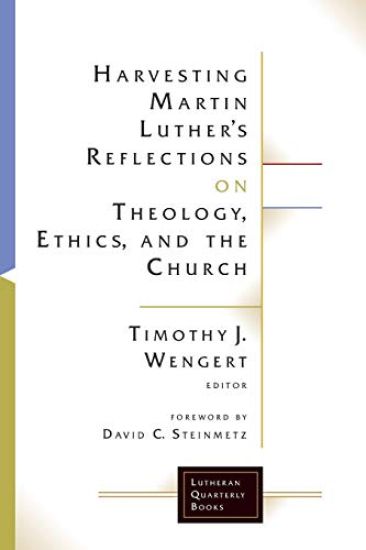
Harvesting Martin Luther's Reflections on Theology, Ethics, and the Church
As profound as Martin Luther's ideas are, this giant of church history was concerned above all with practical instruction for daily Christian living. Harvesting Martin Luther's Reflections highlights this concern of Luther, mining his thought in key areas of doctrine, ethics, and church practice. Gathering noteworthy contributions by well-known Luther scholars from Europe and the Americas, this book ranges broadly over theological questions about baptism and righteousness, ethical issues like poverty and greed, and pastoral concerns like worship and spirituality. There are even rare discussions of Luther's perspective on marriage and on Islam. As a result, Harvesting Martin Luther's Reflections is both a state-of-the-art discussion of Lutheran themes and an excellent introduction for newcomers to Luther's work.
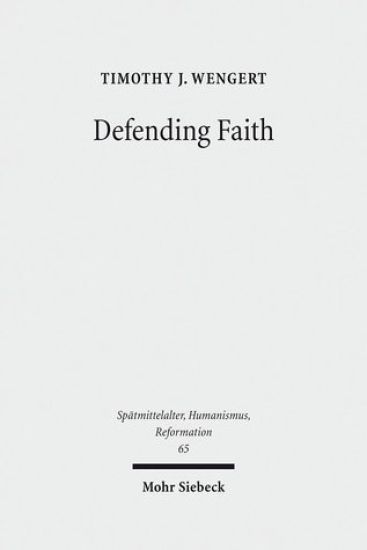
Defending Faith

Defending Faith

Timothy J. Wengert

Mohr Siebeck
2012
sidottu
Justification by faith alone defined teaching in Evangelical churches of the sixteenth century. In 1550 the former reformer of Nuremberg, Andreas Osiander (1498-1552), as a new professor of theology at the University of Königsberg in East Prussia, advocated a divergent understanding of that doctrine, arguing that a Christian's righteousness consisted of the indwelling of Christ's divine nature. In the ensuing years, almost all other Evangelical churches and theologians in German-speaking lands rejected his position. In this book Timothy J. Wengert studies their objections to Osiander's theology in detail, offering a theological perspective on the process of confessionalization among Lutherans in the period after Martin Luther's death in 1546 and before publication of the Book of Concord in 1580. Reactions against Osiander represented a singular literary event in the development of Evangelical churches in central Europe, with over 100 tracts for and against Osiander's position being published between 1551 and 1559. The lines between so-called "genuine" followers of Luther and backers of Philip Melanchthon disappeared, as nearly all Lutheran theologians joined in the attack. Timothy J. Wengert, after providing an outline of Osiander's position in an initial chapter, focuses on his opponents' published responses. Not only does he provide a detailed chronology for these tracts, he also looks at the various theological themes struck by their authors. Separate chapters pay special attention to the contributions of Gnesio-Lutherans (Joachim Mörlin, Matthias Flacius and Nicholas Gallus), to the very different approaches to the dispute pursued by Johannes Brenz and Philip Melanchthon, especially after Osiander's death, and to the struggle over Martin Luther's writings and their authority. Philip Melanchthon's contributions, especially a speech from 1551 and his 1556 commentary on Romans, are also examined.