Kirjojen hintavertailu. Mukana 12 083 983 kirjaa ja 12 kauppaa.

Kirjahaku

Etsi kirjoja tekijän nimen, kirjan nimen tai ISBN:n perusteella.

7 kirjaa tekijältä Timothy P. Roth

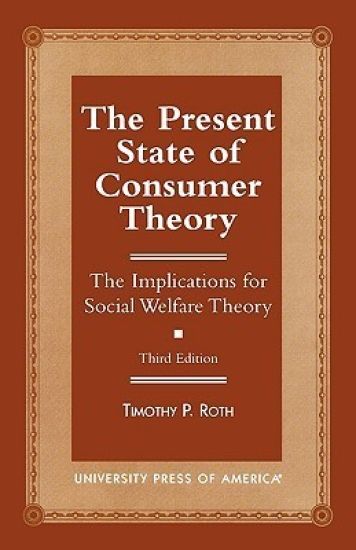
The Present State of Consumer Theory

The Present State of Consumer Theory

Timothy P. Roth

University Press of America
1997
nidottu
The neoclassical theory of choice is an integral part of a large and growing literature. Its elegance, simplicity and apparent generality appear, increasingly, to influence the thinking of psychologists, sociologists, and political scientists. At the same time, the theory is subject to robust attack. The theme of the book is that the critics have it right. Account must be taken of the endogeneity of preference and value structures, of decision makers' cognitive limitations, of information asymmetries, of opportunistic behavior, and of positive transaction and decision costs. Yet these considerations militate against the specification of both the efficiency frontier and the Social Welfare Function. This, in turn, suggests that Social Welfare Theory is an inappropriate guide for the formulation of distributional and other economic policies. A corollary is that economists' (and others) attention should center less on 'getting the prices right' and more on 'getting the institutions right'.

The Present State of Consumer Theory

The Present State of Consumer Theory

Timothy P. Roth

University Press of America
1989
nidottu
The central message of the first edition is echoed here in the second edition: the evolution of economics as an empirical science hinges importantly on the employment of realistic generative and auxiliary assumptions. This edition also includes an additional chapter of the New Institutional Economics. While demand theorists have generally not embraced the notion of cognitive limits, the new institutional economists regard economic agents as "intendedly rational, but only limitedly so." Contents: Some thoughts on Models and Model Building; Ordinal Utility Theory; The New Approach; The Multi-Equation Utility Function; The Household Production Function; Procedural Rationality and the Technology of Choice; Bounded Rationality and the New Institutional Economics; and A Postscript on Empirical Demand Estimation.
Economists and the State

Economists and the State

Timothy P. Roth

Edward Elgar Publishing Ltd
2014
sidottu
Economists and the State shows how modern economists have strayed far from Adam Smith's procedurally based, consequence-detached political economy. Timothy P. Roth argues that this wrong turn has left economists ill-equipped to address an expanding federal enterprise and new threats to our self-governing republic. He subsequently sets out to offer ways to redress this.Making the case for a return to the moral and political philosophy that informed Adam Smith's 'science of the statesman or legislator,' this book argues that economists must reject their relentlessly utilitarian, teleological theory of the state and embrace Nobel Laureate James M. Buchanan's constitutional political economy project. The author outlines the specific requirements of a non-teleological conception of the state - a conception that is vital to the continuing development of a theory of the state informed by a prior ethical commitment to the moral equivalence of persons.This book will appeal to scholars and students of political economy, political thought, public choice economics and Austrian economics as well as to practitioners and policy-makers interested in how economics should support those serving the public.
The Ethics and the Economics of Minimalist Government

The Ethics and the Economics of Minimalist Government

Timothy P. Roth

Edward Elgar Publishing Ltd
2002
sidottu
Because it is technically flawed and morally bankrupt, the author argues, the economist's consequence-based, procedurally detached theory of the state has contributed to the growth of government. As part of the Kantian-Rawlsian contractarian project, this book seeks to return economics to its foundations in moral philosophy. Given the moral equivalence of persons, the greatest possible equal participation must be promoted, persons must be impartially treated and, because it is grounded in consequentialist social welfare theory (SWT), the economist's theory of the state must be rejected. Ad hoc deployment of SWT has facilitated discriminatory rent seeking and contributed to larger government. In contrast, this book argues that equal political participation and a constitutional impartiality constraint minimize rent seeking, respect individual perceptions of the 'public good' and underwrite the legitimacy of government. Economists, moral philosophers and political scientists will find this book a unique contribution to the literature.
Equality, Rights and the Autonomous Self

Equality, Rights and the Autonomous Self

Timothy P. Roth

Edward Elgar Publishing Ltd
2004
sidottu
Modern liberalism asserts the transcendental, autonomous self's 'natural rights' against others' moralistic and political preferences, and regards the economist's utilitarian social welfare theory as instrumental to the achievement of 'social justice'. Timothy Roth argues that the liberal enterprise ignores Kant's 'two points of view', confuses Kantian autonomy with moral and political license, mistakes utilitarian impersonality for impartiality, and takes no account of the indeterminacy of social welfare theory's fundamental theoretical constructs. In contrast, the author shows that Kant's 'two points of view' inform the conservative's constitutive political position and animate the consequence-detached, explicitly normative work of the conservative, constitutional political economist. He shows that, unlike modern liberalism, conservatism is grounded in Kant's 'two points of view', that utilitarian social welfare theory cannot be instrumental to the achievement of social justice, and that constitutional political economy is conservative economics. Economists interested in political economy, methodological issues, social welfare theory, public choice theory, or the moral foundations of economics will find much of interest in this thought-provoking volume. Political scientists interested in the philosophical foundations of modern liberalism and conservatism will also want to add this title to their library.
Morality, Political Economy and American Constitutionalism

Morality, Political Economy and American Constitutionalism

Timothy P. Roth

Edward Elgar Publishing Ltd
2007
sidottu
The Founders of the American Republic set up a remarkable experiment in self-government. Today, debates rage as to the philosophical legacy of this ongoing experiment. In this fascinating study, Timothy Roth offers a critical analysis of modern liberalism and the economic theory to which it is conjoined - social welfare theory. The author argues that social welfare theory cannot be reconciled with the American Founders' procedurally based, consequence-detached republican self-government project. The book goes on to explore and expound the Founders' desire to promote respect for the moral law, their appreciation of the reciprocal relationship between morality and law, and their commitment to the promotion of justice in the sense of impartial institutions; ideas which find expression in contractarian, constitutional political economy.Scholars and students in economics, political science, law and philosophy will find this marvelous treatise an engaging and thought-provoking read.
Politicians, Economists and the Supreme Court at Work

Politicians, Economists and the Supreme Court at Work

Timothy P. Roth

Edward Elgar Publishing Ltd
2010
sidottu
Thomas Jefferson wrote 'I wish - never to see all offices transferred to Washington, where, further withdrawn from the eyes of the people, they may more secretly be bought and sold at market'. What would Jefferson, Madison and the other Founders write today? Deploying their moral and political philosophy, their political economy and their understanding of the Constitution, Timothy P. Roth contends that the Founders would tell us that most of what the federal government does is either immoral, unconstitutional, or both. Presented as an engaging thought experiment, Politicians, Economists and the Supreme Court at Work examines the metastasizing federal role through two different means: first, as it relates to the increasing concerns of a contemporary nation, and second, the depth to which that nation's Founders would be appalled by the actions of their successors. Additionally, the book provides a critical appraisal of the burgeoning federal enterprise and the federal government's 'on-, off-, and off-off' budget activities - ultimately answering the question, 'What would the Founders do?' The nature and timeliness of this volume will appeal to moral and political philosophers, political scientists, historians, economists, scholars and students. In addition, the accessibility of the text provides for a compelling read that will pique the interest of the general public.