Kirjojen hintavertailu. Mukana 11 370 699 kirjaa ja 12 kauppaa.

Kirjahaku

Etsi kirjoja tekijän nimen, kirjan nimen tai ISBN:n perusteella.

4 kirjaa tekijältä Timothy W. Luke

Capitalism, Democracy, and Ecology

Capitalism, Democracy, and Ecology

Timothy W. Luke

University of Illinois Press
1999
nidottu
The world that was revolutionized by industrialization is being remade by the information revolution. But this is mostly a revolution from above, increasingly shaped by a new class of technocrats, experts, and professionals in the service of corporate capitalism. Using Marx as a touchstone, Timothy W. Luke warns that if communities are not to be overwhelmed by new class economic and political agendas, then the practice of democracy must be reconstituted on a more populist basis. However, the galvanizing force for this new, more community-centered populism will not be the proletariat, as Marx predicted, nor contemporary militant patriotic groups. Rather, Luke argues that many groups unified by a concern for ecological justice present the strongest potential opposition to capitalism. Wide-ranging and lucid, Capitalism, Democracy, and Ecology is essential reading in the age of information.
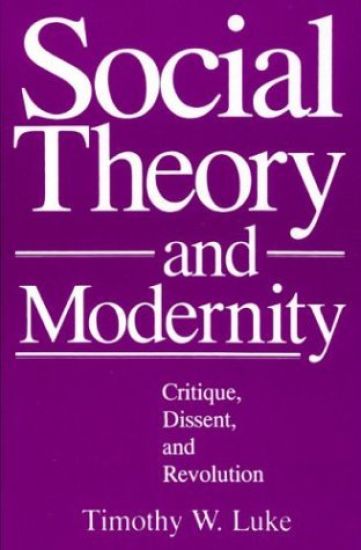
Social Theory and Modernity

Social Theory and Modernity

Timothy W. Luke

SAGE Publications Inc
1991
nidottu
Social Theory and Modernity combines the analytical techniques of political theory and comparative politics as a method for conducting innovative inquiry and research in political science. The focus of political theory, for example, results in new issues for historical and cross-national comparative analysis--whereas comparative analysis provides new parameters for analyzing the ideology of social institutions. In presenting this method, Luke elaborates upon Rousseau's discursive style and critical methods, Marx's historical materialism, Gramsci's theoretical tactics, Marcuse's instrumental rationality, Cabral's theories of critique and revolution, Weber's interpretive method, and Foucault's system of political and social analysis. It concludes by offering an incisive analysis of the moral and ideological influence of behavior and the link between ideology and political economy, especially in modern society. Social Theory and Modernity is essential reading for professionals and students in the fields of political theory, history, comparative politics, sociology, anthropology, social philosophy, and cultural studies. "Luke's book is a tour de force. He writes critical theory in the best sense, applying the ideas of the Frankfurt School, Gramsci, and postmodernism to real social and political issues today. Social Theory and Modernity avoids arid exegesis in favor of engaged and lucid analysis of the global problematics of late capitalism. Not content simply to rehearse the masters of critical theory, Luke refreshes and extends their ideas by developing his own important theoretical voice. Luke is witty and pulls no punches. This accessible book will appeal to readers in a wide range of social-science disciplines, notably including political science and sociology. This book reinforces Luke's reputation as one of the two or three leading critical theorists working today." --Ben Agger, SUNY, University at Buffalo "This collection of essays provides a rich reading for it collates a lot of innovative ideas in the present day Marxist theory." --Financial Express
Museum Politics

Museum Politics

Timothy W. Luke

University of Minnesota Press
2002
nidottu
The first sustained critique of the ways museum exhibits shape cultural assumptions and political valuesEach year the more than seven thousand museums in the United States attract more attendees than either movies or sports. Yet until recently, museums have escaped serious political analysis. The past decade, however, has witnessed a series of unusually acrimonious debates about the social, political, and moral implications of museum exhibitions as varied as the Enola Gay display at the Smithsonian’s Air and Space Museum and the Sensation exhibit at the Brooklyn Museum of Art. In this important volume, Timothy W. Luke explores museums’s power to shape collective values and social understandings, and argues persuasively that museum exhibitions have a profound effect on the body politic. Through discussions of topics ranging from how the National Holocaust Museum and the Museum of Tolerance in Los Angeles have interpreted the Holocaust to the ways in which the American Museum of Natural History, the Missouri Botanical Gardens, and Tucson’s Arizona-Sonora Desert Museum have depicted the natural world, Luke exposes the processes through which museums challenge but more often affirm key cultural and social realities.
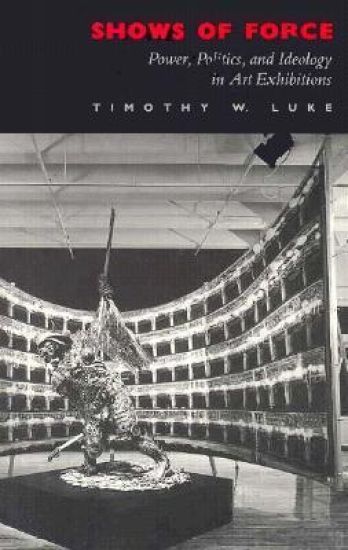
Shows of Force

Shows of Force

Timothy W. Luke

Duke University Press
1992
pokkari
It has long been considered a mark of naÏvetÉ to ask of a work of art: What does it say? But as Timothy W. Luke demonstrates in Shows of Force, artwork is capable of saying plenty, and much of the message resides in the way it is exhibited. By critically examining the exhibition of art in contemporary American museums, Luke identifies how art showings are elaborate works of theater that reveal underlying political, social, and economic agendas.The first section, “Envisioning a Past, Imagining the West,” looks at art exhibitions devoted to artworks about or from the American West. Luke shows how these exhibitions-displaying nineteenth- and early-twentieth century works by artists such as George Caleb Bingham, Frederic Remington, Frederic Edwin Church, and Georgia O’Keefe-express contemporary political agendas in the way the portray “the past” and shape new visions of “the West.”In “Developing the Present, Defining a World,” Luke considers artists from the post-1945 era, including Ilya Kabokov, Hans Haacke, Sue Coe, Roger Brown, and Robert Longo. Recent art exhibits, his analysis reveals, attempt to develop politically charged conceptions of the present, which in turn struggle to define the changing contemporary world and art’s various roles within it.Luke brings to light the contradictions encoded in the exhibition of art and, in doing so, illuminates the political realities and cultural ideologies of the present. Shows of Force offers a timely and surely controversial contribution to current discussions of the politics of exhibiting art.