Kirjojen hintavertailu. Mukana 11 244 527 kirjaa ja 12 kauppaa.

Kirjahaku

Etsi kirjoja tekijän nimen, kirjan nimen tai ISBN:n perusteella.

18 kirjaa tekijältä Timothy Williamson

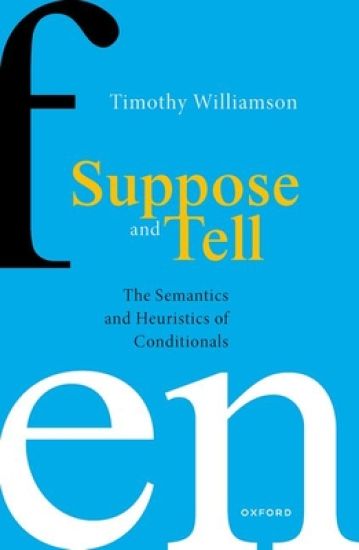
Suppose and Tell

Suppose and Tell

Timothy Williamson

Oxford University Press
2022
nidottu
What does 'if' mean? It is one of the most commonly used words in the English language, in itself a sign to the importance of conditional thinking to human cognitive life. We make conditional statements, ask conditional questions, and issue conditional orders. We need to think and talk conditionally for many purposes, from everyday decision-making to mathematical proof. Yet the meaning of conditionals has been debated for thousands of years. Suppose and Tell brings together ideas from philosophy, linguistics, and psychology to present a controversial new approach to understanding conditionals. It argues that in using 'if' we rely on psychological heuristics, methods which are fast and frugal and mostly, but not always, reliable. As a result philosophers and linguists have been led astray in theorizing about conditionals through trusting faulty data generated by such methods and prematurely rejecting simple theories on the basis of merely apparent counterexamples. Williamson shows how one such simple theory of conditionals can explain the data, and draws wider implications for the nature of meaning and its non-transparency to native speakers, vagueness in thought and language, and the need for semantics to attend to the unreliable heuristics underlying our judgments.
Good as Usual

Good as Usual

Timothy Williamson

Oxford University Press
2025
sidottu
Good as Usual argues that contemporary discussion on the nature of norms and values goes wrong by treating them as exceptional and mysterious, since they do not fit popular philosophical assumptions about metaphysics, epistemology, and the philosophy of language. Timothy Williamson shows that, once we throw out those preconceived and outdated ideas, we can understand moral and evaluative features of reality as similar to its other features, and capable of being known and described in similar ways. The result is a new and anti-reductionist form of moral and evaluative realism and cognitivism. Williamson applies the same approach to practical reasoning about what to do, criticizing the subjectivist assumptions of standard decision theory, showing how the desires as well as the beliefs on which we act can amount to knowledge, and how connections between the justification of belief and the justification of action can benefit epistemology. Light is cast on the nature of rationality by a sharp distinction between rational beliefs and rational believers. Subtle logical fallacies about permissibility, obligation, and reasons are shown to have confused our normative thinking. This volume brings together and expands all of the author's work on normativity and value; it can be understood as the application to practical philosophy of the approach to theoretical philosophy developed in earlier work.
Overfitting and Heuristics in Philosophy

Overfitting and Heuristics in Philosophy

Timothy Williamson

OXFORD UNIVERSITY PRESS INC
2024
sidottu
In his Rutgers Lectures, Timothy Williamson explains how contemporary philosophy suffers from a widespread pathology known as overfitting to natural and social scientists, but little understood by most philosophers. Overfitting involves an insufficiently critical attitude towards data, which leads to over-complicated theories designed to fit what are in fact errors in the data. In philosophy, the data typically comprise verdicts on hypothetical or actual cases. Errors in such data can result from our reliance on heuristics, efficient cognitive shortcuts, simple to use but not fully reliable. Just as heuristics embedded in our visual system produce visual illusions, so heuristics embedded in our general cognitive systems produce philosophical paradoxes. Williamson explains the heuristics responsible for paradoxes of vagueness and identity over time, paradoxes of conditionals, paradoxes in ascribing beliefs and other mental states to others, paradoxes of truth and falsity, and paradoxes of weighing reasons and intersectionality. As a case study, Williamson shows how illusions of hyperintensionality can result from a heuristic that projects cognitively significant differences in how explanations are presented onto supposed differences in the non-linguistic world, which then form the starting point for metaphysicians' theorizing. In each case, Williamson provides independent evidence that we commonly use the heuristic, and that it sometimes leads us astray. In short, we are being suckered by our own heuristics, and the result is overfitting. Williamson also discusses how philosophers can best avoid these problems. Williamson's important diagnosis and prescription will be of interest to a wide range of philosophers.
Knowledge and its Limits

Knowledge and its Limits

Timothy Williamson

Clarendon Press
2000
sidottu
Knowledge and its Limits presents a systematic new conception of knowledge as a fundamental kind of mental stage sensitive to the knower's environment. It makes a major contribution to the debate between externalist and internalist philosophies of mind, and breaks radically with the epistemological tradition of analysing knowledge in terms of true belief. The theory casts light on a wide variety of philosophical issues: the problem of scepticism, the nature of evidence, probability and assertion, the dispute between realism and anti-realism and the paradox of the surprise examination. Williamson relates the new conception to structural limits on knowledge which imply that what can be known never exhausts what is true. The arguments are illustrated by rigorous models based on epistemic logic and probability theory. The result is a new way of doing epistemology for the twenty-first-century.
Modal Logic as Metaphysics

Modal Logic as Metaphysics

Timothy Williamson

Oxford University Press
2015
nidottu
Are there such things as merely possible people, who would have lived if our ancestors had acted differently? Are there future people, who have not yet been conceived? Questions like those raise deep issues about both the nature of being and its logical relations with contingency and change. In Modal Logic as Metaphysics, Timothy Williamson argues for positive answers to those questions on the basis of an integrated approach to the issues, applying the technical resources of modal logic to provide structural cores for metaphysical theories. He rejects the search for a metaphysically neutral logic as futile. The book contains detailed historical discussion of how the metaphysical issues emerged in the twentieth century development of quantified modal logic, through the work of such figures as Rudolf Carnap, Ruth Barcan Marcus, Arthur Prior, and Saul Kripke. It proposes higher-order modal logic as a new setting in which to resolve such metaphysical questions scientifically, by the construction of systematic logical theories embodying rival answers and their comparison by normal scientific standards. Williamson provides both a rigorous introduction to the technical background needed to understand metaphysical questions in quantified modal logic and an extended argument for controversial, provocative answers to them. He gives original, precise treatments of topics including the relation between logic and metaphysics, the methodology of theory choice in philosophy, the nature of possible worlds and their role in semantics, plural quantification compared to quantification into predicate position, communication across metaphysical disagreement, and problems for truthmaker theory.
Tetralogue

Tetralogue

Timothy Williamson

Oxford University Press
2017
nidottu
Four people with radically different outlooks on the world meet on a train and start talking about what they believe. Their conversation varies from cool logical reasoning to heated personal confrontation. Each starts off convinced that he or she is right, but then doubts creep in. In a tradition going back to Plato, Timothy Williamson uses a fictional conversation to explore questions about truth and falsity, and knowledge and belief. Is truth always relative to a point of view? Is every opinion fallible? Such ideas have been used to combat dogmatism and intolerance, but are they compatible with taking each opposing point of view seriously? This book presupposes no prior acquaintance with philosophy, and introduces its concerns in an accessible and light-hearted way. Is one point of view really right and the other really wrong? That is for the reader to decide.
Philosophical Method

Philosophical Method

Timothy Williamson

Oxford University Press
2020
nidottu
What are philosophers trying to achieve? How can they succeed? Does philosophy make progress? Is it in competition with science, or doing something completely different, or neither? Timothy Williamson tackles some of the key questions surrounding philosophy in new and provocative ways, showing how philosophy begins in common sense curiosity, and develops through our capacity to dispute rationally with each other. Discussing philosophy's ability to clarify our thoughts, he explains why such clarification depends on the development of philosophical theories, and how those theories can be tested by imaginative thought experiments, and compared against each other by standards similar to those used in the natural and social sciences. He also shows how logical rigour can be understood as a way of enhancing the explanatory power of philosophical theories. Drawing on the history of philosophy to provide a track record of philosophical thinking's successes and failures, Williams overturns widely held dogmas about the distinctive nature of philosophy in comparison to the sciences, demystifies its methods, and considers the future of the discipline. From thought experiments, to deduction, to theories, this Very Short Introduction will cause you to totally rethink what philosophy is. ABOUT THE SERIES: The Very Short Introductions series from Oxford University Press contains hundreds of titles in almost every subject area. These pocket-sized books are the perfect way to get ahead in a new subject quickly. Our expert authors combine facts, analysis, perspective, new ideas, and enthusiasm to make interesting and challenging topics highly readable. Previously published in hardback as Doing Philosophy
Doing Philosophy

Doing Philosophy

Timothy Williamson

Oxford University Press
2018
sidottu
What are philosophers trying to achieve? How can they succeed? Does philosophy make progress? Is it in competition with science, or doing something completely different, or neither? Timothy Williamson tackles some of the key questions surrounding philosophy in new and provocative ways, showing how philosophy begins in common sense curiosity, and develops through our capacity to dispute rationally with each other. Discussing philosophy's ability to clarify our thoughts, he explains why such clarification depends on the development of philosophical theories, and how those theories can be tested by imaginative thought experiments, and compared against each other by standards similar to those used in the natural and social sciences. He also shows how logical rigour can be understood as a way of enhancing the explanatory power of philosophical theories. Drawing on the history of philosophy to provide a track record of philosophical thinking's successes and failures, Williamson overturns widely held dogmas about the distinctive nature of philosophy in comparison to the sciences, demystifies its methods, and considers the future of the discipline. From thought experiments, to deduction, to theories, this little book will cause you to totally rethink what philosophy is.
Suppose and Tell

Suppose and Tell

Timothy Williamson

Oxford University Press
2020
sidottu
What does 'if' mean? It is one of the most commonly used words in the English language, in itself a sign to the importance of conditional thinking to human cognitive life. We make conditional statements, ask conditional questions, and issue conditional orders. We need to think and talk conditionally for many purposes, from everyday decision-making to mathematical proof. Yet the meaning of conditionals has been debated for thousands of years. Suppose and Tell brings together ideas from philosophy, linguistics, and psychology to present a controversial new approach to understanding conditionals. It argues that in using 'if' we rely on psychological heuristics, methods which are fast and frugal and mostly, but not always, reliable. As a result philosophers and linguists have been led astray in theorizing about conditionals through trusting faulty data generated by such methods and prematurely rejecting simple theories on the basis of merely apparent counterexamples. This book shows how one such simple theory of conditionals can explain the data, and draws wider implications for the nature of meaning and its non-transparency to native speakers, vagueness in thought and language, and the need for semantics to attend to the unreliable heuristics underlying our judgments.
Knowledge and its Limits

Knowledge and its Limits

Timothy Williamson

Oxford University Press
2002
nidottu
"Knowledge and its Limits" presents a systematic conception of knowledge as a kind of mental state. Timothy Williamson casts light on many philosophical problems: scepticism, evidence, probability and assertion, realism and anti-realism, and the limits of what can be known.
Modal Logic as Metaphysics

Modal Logic as Metaphysics

Timothy Williamson

Oxford University Press
2013
sidottu
Are there such things as merely possible people, who would have lived if our ancestors had acted differently? Are there future people, who have not yet been conceived? Questions like those raise deep issues about both the nature of being and its logical relations with contingency and change. In Modal Logic as Metaphysics, Timothy Williamson argues for positive answers to those questions on the basis of an integrated approach to the issues, applying the technical resources of modal logic to provide structural cores for metaphysical theories. He rejects the search for a metaphysically neutral logic as futile. The book contains detailed historical discussion of how the metaphysical issues emerged in the twentieth century development of quantified modal logic, through the work of such figures as Rudolf Carnap, Ruth Barcan Marcus, Arthur Prior, and Saul Kripke. It proposes higher-order modal logic as a new setting in which to resolve such metaphysical questions scientifically, by the construction of systematic logical theories embodying rival answers and their comparison by normal scientific standards. Williamson provides both a rigorous introduction to the technical background needed to understand metaphysical questions in quantified modal logic and an extended argument for controversial, provocative answers to them. He gives original, precise treatments of topics including the relation between logic and metaphysics, the methodology of theory choice in philosophy, the nature of possible worlds and their role in semantics, plural quantification compared to quantification into predicate position, communication across metaphysical disagreement, and problems for truthmaker theory.
Vagueness

Vagueness

Timothy Williamson

Routledge
1994
sidottu
If you keep removing single grains of sand from a heap, when is it no longer a heap? From discussions of the heap paradox in classical Greece, to modern formal approaches like fuzzy logic, Timothy Williamson traces the history of the problem of vagueness. He argues that standard logic and formal semantics apply even to vague languages and defends the controversial, realist view that vagueness is a form of ignorance - there really is a grain of sand whose removal turns a heap into a non-heap, but we can never know exactly which one it is.
Vagueness

Vagueness

Timothy Williamson

Routledge
1996
nidottu
If you keep removing single grains of sand from a heap, when is it no longer a heap? From discussions of the heap paradox in classical Greece, to modern formal approaches like fuzzy logic, Timothy Williamson traces the history of the problem of vagueness. He argues that standard logic and formal semantics apply even to vague languages and defends the controversial, realist view that vagueness is a form of ignorance - there really is a grain of sand whose removal turns a heap into a non-heap, but we can never know exactly which one it is.
Identity and Discrimination

Identity and Discrimination

Timothy Williamson

John Wiley Sons Inc
2013
nidottu
Identity and Discrimination This updated edition of Identity and Discrimination, first published in 1990 and the first book by well-known philosopher Timothy Williamson, is now reissued with the inclusion of significant new material. This major work – influential in philosophy of perception and the theory of vagueness – continues in an original and rigorous way to highlight the necessity of discrimination and the thresholds which determine the approximate criteria of identity. Williamson’s proposal for an original and rigorous theory links identity, a relation central to metaphysics, and indiscriminability, a relation central to epistemology. He provides a distinctive cognitive account of the nature of discrimination, with important applications to the philosophy of perception and the theory of vagueness. The book pioneers the use of epistemic logic to solve the notorious paradoxes of indiscriminability, and develops the application of techniques from mathematical logic to understand issues about identity over time and across possible worlds.
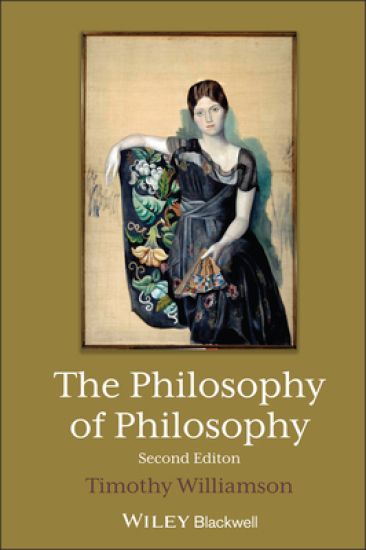
The Philosophy of Philosophy

The Philosophy of Philosophy

Timothy Williamson

Wiley-Blackwell
2021
sidottu
The Philosophy of Philosophy The Blackwell / Brown Lectures in Philosophy The Philosophy of Philosophy presents an original, unified concept of philosophy as a non-natural science. In this provocative work, distinguished philosopher Timothy Williamson challenges widely-held assumptions and clarifies long-standing misconceptions about the methodology and nature of philosophical inquiry. The author rejects the standard narratives of contemporary philosophy developed from naturalism, the linguistic turn, postmodern irony, and other prominent trends of the twentieth century. Viewing the method of philosophy as evolving from non-philosophical pursuits, Williamson provides readers with fresh insight into the “self-image” of philosophy and offers new ways of understanding what philosophy is and how it actually works. Now in its second edition, this landmark volume comprises the original book and the author’s subsequent work. New topics include the recent history of analytic philosophy, assessments of experimental philosophy, theories of concepts and understanding, Wittgensteinian approaches, popular philosophy, naturalism, morally-loaded examples in philosophy, philosophical applications of scientific methods, and many more. This edition features the author’s latest thoughts on a variety of issues, autobiographical reflections, and replies to critics. The Philosophy of Philosophy, Second Edition remains essential reading for philosophers, scholars, graduate and advanced undergraduate students in philosophy, and other readers with a sustained interest in the method and rationale of the doing of philosophy.
The Philosophy of Philosophy

The Philosophy of Philosophy

Timothy Williamson

JOHN WILEY AND SONS LTD
2023
nidottu
The Philosophy of Philosophy The Blackwell / Brown Lectures in Philosophy The Philosophy of Philosophy presents an original, unified concept of philosophy as a non-natural science. In this provocative work, distinguished philosopher Timothy Williamson challenges widely-held assumptions and clarifies long-standing misconceptions about the methodology and nature of philosophical inquiry. The author rejects the standard narratives of contemporary philosophy developed from naturalism, the linguistic turn, postmodern irony, and other prominent trends of the twentieth century. Viewing the method of philosophy as evolving from non-philosophical pursuits, Williamson provides readers with fresh insight into the “self-image” of philosophy and offers new ways of understanding what philosophy is and how it actually works. Now in its second edition, this landmark volume comprises the original book and the author’s subsequent work. New topics include the recent history of analytic philosophy, assessments of experimental philosophy, theories of concepts and understanding, Wittgensteinian approaches, popular philosophy, naturalism, morally-loaded examples in philosophy, philosophical applications of scientific methods, and many more. This edition features the author’s latest thoughts on a variety of issues, autobiographical reflections, and replies to critics. The Philosophy of Philosophy, Second Edition remains essential reading for philosophers, scholars, graduate and advanced undergraduate students in philosophy, and other readers with a sustained interest in the method and rationale of the doing of philosophy.
The Philosophy of Philosophy

The Philosophy of Philosophy

Timothy Williamson

Wiley-Blackwell (an imprint of John Wiley Sons Ltd)
2007
sidottu
The second volume in the Blackwell Brown Lectures in Philosophy, this volume offers an original and provocative take on the nature and methodology of philosophy. Based on public lectures at Brown University, given by the pre-eminent philosopher, Timothy WilliamsonRejects the ideology of the 'linguistic turn', the most distinctive trend of 20th century philosophyExplains the method of philosophy as a development from non-philosophical ways of thinkingSuggests new ways of understanding what contemporary and past philosophers are doing
Filosofinen menetelmä

Filosofinen menetelmä

Timothy Williamson

Eurooppalaisen filosofian seura
2022
nidottu
Filosofinen menetelmä tarjoaa ajantasaisen kuvan siitä, mitä filosofit tekevät ja miten. Kirja ei edellytä ennakkotietoja filosofiasta, ja sen luettuaan ymmärtää, miksi filosofia ei ole nojatuolipohdiskelua vaan kurinalaista, älyllisesti tarpeellista toimintaa.