Kirjojen hintavertailu. Mukana 11 244 527 kirjaa ja 12 kauppaa.

Kirjahaku

Etsi kirjoja tekijän nimen, kirjan nimen tai ISBN:n perusteella.

8 kirjaa tekijältä Timothy Zick

The First Amendment in the Trump Era

The First Amendment in the Trump Era

Timothy Zick

Oxford University Press Inc
2019
sidottu
Regardless of how the presidency of Donald J. Trump ultimately concludes, a significant part of its legacy will relate to the First Amendment. The president has publicly attacked the institutional press and individual reporters, calling them the "enemy of the people." He has proposed that flag burners be jailed and de-naturalized, blocked critics from his Twitter page, communicated hateful and derogatory ideas, and defended the speech of white nationalists. More than any other modern president, Trump has openly challenged fundamental First Amendment norms and principles relating to free speech and free press. These challenges have come at a time when the institutional press faces economic and other pressures that negatively affect their functions and legitimacy, political and other forms of polarization are on the rise, and protesters face diminished space and opportunities for exercising free speech rights. The First Amendment in the Trump Era catalogs and analyzes the various First Amendment conflicts that have occurred during the Trump presidency. It places these conflicts in historical context-as part of our current digitized and polarized era but also as part of a broader narrative concerning attacks on free speech and press. We must understand what is familiar in terms of the First Amendment concerns of the present era, but also what is distinctive about these concerns. The Trump Era has once again reminded us of the need for a free and independent press, the need to protect robust and sometimes caustic criticism of public officials, and the importance of protest and dissent to effective self-government.
The Dynamic Free Speech Clause

The Dynamic Free Speech Clause

Timothy Zick

Oxford University Press Inc
2018
sidottu
The right to free speech intersects with many other constitutional rights. Those intersections have significantly influenced the recognition, scope, and meaning of rights, ranging from freedom of the press to the Second Amendment right to bear arms. They have also influenced interpretation of the Free Speech Clause itself. This book examines the relations between the U.S. Constitution's Free Speech Clause and other constitutional rights. Free speech principles and doctrines have brought about constitutional rights including equal protection, the right to abortion, and the free exercise of religion. They have also provided mediating principles for constructive debates about constitutional rights. At the same time, in its interactions with other constitutional rights, the Free Speech Clause has also been a complicating force. It has often dominated rights discourse and has subordinated or supplanted free press, assembly, petition, and free exercise rights. Currently, courts and commentators are fashioning the Second Amendment right to keep and bear arms in the image of the Free Speech Clause. Borrowing the Free Speech Clause for this purpose may turn out to be detrimental for both rights. While examining the dynamics that have brought free speech and other rights together, the book assesses the products and consequences of these intersections, and draws important lessons from them about constitutional rights and constitutional liberty. Ultimately, the book defends a pluralistic conception of constitutional rights that seeks to leverage the power of the Free Speech Clause but also tame its propensity to subordinate, supplant, and eclipse other constitutional rights.
Speech Out of Doors

Speech Out of Doors

Timothy Zick

Cambridge University Press
2008
sidottu
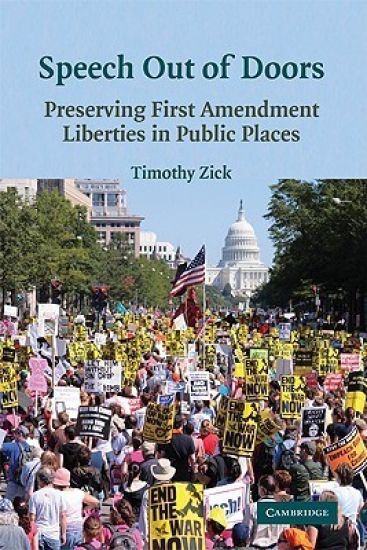
The Supreme Court has emphasized that expressive liberties require 'breathing space' in which to thrive. At a minimum, speakers need places in which to assemble, speak, and petition government. This book is a comprehensive examination of First Amendment rights in public places. It shows that the literal ground beneath speakers' feet has been steadily eroding, from personal spaces to college campuses and to once vast and important inscribed places, such as public parks and public squares. Through the study of 'expressive topography', this book considers a variety of contemporary speech contests including restrictions on abortion clinic sidewalk counselors, protests at military funerals, and restrictions on assembly and speech at political conventions. Countering or reversing these forces will require a focused and sustained effort by public officials, courts, and, of course, the people themselves.
Speech Out of Doors

Speech Out of Doors

Timothy Zick

Cambridge University Press
2008
pokkari
The Supreme Court has emphasized that expressive liberties require 'breathing space' in which to thrive. At a minimum, speakers need places in which to assemble, speak, and petition government. This book is a comprehensive examination of First Amendment rights in public places. It shows that the literal ground beneath speakers' feet has been steadily eroding, from personal spaces to college campuses and to once vast and important inscribed places, such as public parks and public squares. Through the study of 'expressive topography', this book considers a variety of contemporary speech contests including restrictions on abortion clinic sidewalk counselors, protests at military funerals, and restrictions on assembly and speech at political conventions. Countering or reversing these forces will require a focused and sustained effort by public officials, courts, and, of course, the people themselves.
Managed Dissent

Managed Dissent

Timothy Zick

Cambridge University Press
2023
pokkari
The mass street demonstrations that followed the 2020 police murder of George Floyd were perhaps the largest in American history. These events confirmed that even in a digital era, people rely on public dissent to communicate grievances, change public discourse, and stand in collective solidarity with others. However, the demonstrations also showed that the laws surrounding public protest make public contention more dangerous, more costly, and less effective. Police fired tear gas into peaceful crowds, used physical force against compliant demonstrators, imposed broad curfews, limited the places where protesters could assemble, and abused 'unlawful assembly' and other public disorder laws. These and other pathologies epitomize a system in which public protest is tightly constrained in the name of public order. Managed Dissent argues that in order to preserve the venerable tradition of public protest in the US, we must reform several aspects of the law of public protest.
The Cosmopolitan First Amendment

The Cosmopolitan First Amendment

Timothy Zick

Cambridge University Press
2013
sidottu
We live in an interconnected world in which expressive and religious cultures increasingly commingle and collide. In a globalized and digitized era, we need to better understand the relationship between the First Amendment to the United States Constitution and international borders. This book focuses on the exercise and protection of cross-border and beyond-border expressive and religious liberties, and on the First Amendment's relationship to the world beyond US shores. It reveals a cosmopolitan First Amendment that protects cross-border conversation, facilitates the global spread of democratic principles, recognizes expressive and religious liberties regardless of location, is influential across the world, and encourages respectful engagement with the liberty regimes of other nations. The Cosmopolitan First Amendment is the product of historical, social, political, technological and legal developments. It examines the First Amendment's relationship to foreign travel, immigration, cross-border communication and association, religious activities that traverse international borders, conflicts among foreign and US speech and religious liberty models, and the conduct of international affairs and diplomacy.
The Cosmopolitan First Amendment

The Cosmopolitan First Amendment

Timothy Zick

Cambridge University Press
2015
pokkari
We live in an interconnected world in which expressive and religious cultures increasingly commingle and collide. In a globalized and digitized era, we need to better understand the relationship between the First Amendment to the United States Constitution and international borders. This book focuses on the exercise and protection of cross-border and beyond-border expressive and religious liberties, and on the First Amendment's relationship to the world beyond US shores. It reveals a cosmopolitan First Amendment that protects cross-border conversation, facilitates the global spread of democratic principles, recognizes expressive and religious liberties regardless of location, is influential across the world, and encourages respectful engagement with the liberty regimes of other nations. The Cosmopolitan First Amendment is the product of historical, social, political, technological and legal developments. It examines the First Amendment's relationship to foreign travel, immigration, cross-border communication and association, religious activities that traverse international borders, conflicts among foreign and US speech and religious liberty models, and the conduct of international affairs and diplomacy.
Managed Dissent

Managed Dissent

Timothy Zick

Cambridge University Press
2023
sidottu
The mass street demonstrations that followed the 2020 police murder of George Floyd were perhaps the largest in American history. These events confirmed that even in a digital era, people rely on public dissent to communicate grievances, change public discourse, and stand in collective solidarity with others. However, the demonstrations also showed that the laws surrounding public protest make public contention more dangerous, more costly, and less effective. Police fired tear gas into peaceful crowds, used physical force against compliant demonstrators, imposed broad curfews, limited the places where protesters could assemble, and abused 'unlawful assembly' and other public disorder laws. These and other pathologies epitomize a system in which public protest is tightly constrained in the name of public order. Managed Dissent argues that in order to preserve the venerable tradition of public protest in the US, we must reform several aspects of the law of public protest.