Kirjojen hintavertailu. Mukana 12 016 292 kirjaa ja 12 kauppaa.

Kirjahaku

Etsi kirjoja tekijän nimen, kirjan nimen tai ISBN:n perusteella.

6 kirjaa tekijältä Toby Thompson

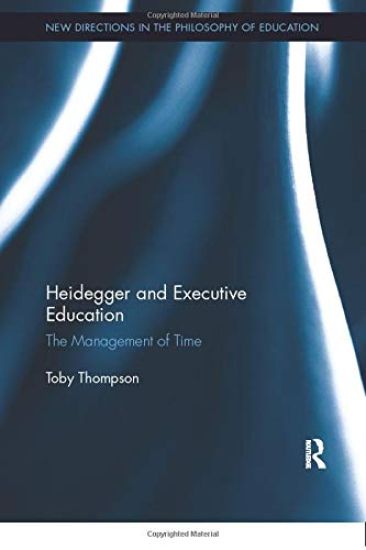
Heidegger and Executive Education

Heidegger and Executive Education

Toby Thompson

Routledge
2019
nidottu
Global corporations and the senior executives who oversee them have been subject to great criticism in recent times: not only do such corporations hold extreme concentrations of wealth, but they continue to sanction staggering pay inequalities between the haves and the have-nots. At the same time, university-based business schools are conducting programmes of executive education seemingly customised to sanction these same inequalities. Heidegger and Executive Education is a piece of critical philosophy that has been written from within the business school in order to examine how this sheltered process of educating in-role corporate executives operates. Thompson claims that executive education is based on a very simple premise: that an executive executes an order, and that executive education is an amelioration of that process. Thompson argues that the easiest way to conceive of executive education is to treat order and execution as cognates, as a single conceptual entity. Thus, he asks, if educating executives in line with the order-execution cognate involves swapping the boardroom for the classroom, and in keeping with the ‘critical’ tag, shouldn’t executive education be about questioning not only the execution, but also the dominant order? The author uses ‘time’ as the philosophical method by which one can undo the order-execution cognate, question the sanctity of the cognate and thereby halt the seemingly inexorable temporal sequence from order through to those orders becoming executed. This book uses Martin Heidegger’s exotic philosophy of time in order to mount a philosophical challenge to the temporal sequentiality of executive education. It will therefore be of great interest to academics, researchers and postgraduates who are interested in Heidegger, the philosophy of education and executive education. It should also be essential reading for those involved in training, developing, and educating corporate executives.

Positively Main Street

Positively Main Street

Toby Thompson

University of Minnesota Press
2008
nidottu
“That boy . . . this fellow, Toby . . . has got some lessons to learn.” -Bob Dylan, Rolling Stone, November 29, 1969"Toby Thompson was there first." -Greil Marcus“A first-rate novelistic account of Thompson’s own psyche as he uncovers the Dylan few people know . . . A new look at young Dylan done with kindness, enthusiasm and superb language.” -William Kennedy, Look Magazine “Essential reading. Thompson, unprecedentedly, managed to interview not only Echo Helstrom, almost certainly the ‘Girl of the North Country,’ but Dylan’s mother and brother, his uncle, his friends.” -Michael Gray, Bob Dylan Encyclopedia“Dylan fans will not want to miss this book.” -Sioux City Journal“Enough to satisfy any Dylan fan with all the gossip he’ll ever need.” -Huntsville Times“Well worth the attention of anyone who has fallen under the spell of the boy from the North Country.” -Los Angeles Times“It’s a must.” -Ft. Worth Press"Thompson tracked down anybody who knew 'Die-lan' (as the Hibbingites called him), including the guy at the local music store, the guy at the motorcycle shop, his English and music teachers, his uncles, his brother David and even his reluctant but ultimately charmingly chatty mother. Of course, Thompson traveled into a few dead ends. But the stuff with Dylan's mom and his high school girlfriend, Echo Helstrom, is priceless. Positively Main Street is a free-wheelin', fun and quick read that is surprisingly informative." -Minneapolis Star Tribune"Hundreds of books have been written about Minnesota's most famous songwriter; Bob Dylan's life and music has been analyzed by fans, scholars, and even himself. So, why do we need Toby Thompson's Positively Main Street: Bob Dylan's Minnesota? Because it's a forgotten milestone. Published in 1971, it was the first biography on Dylan. Although it's been out of print since 1977, the book is, with the exception of Dylan's autobiography, perhaps the most readable and necessary volume on the folk icon." -City Pages"The new Positively Main Street is a lovely little book, even better than the original, a cherished addition to the Dylan bookshelf. Thompson and the University of Minnesota Press have enhanced what was already a classic and made it available to a whole new audience. Dylan fans owe them a debt of gratitude." -The Dylan Daily"[Thompson] ends up not only interviewing 'the Girl from the North Country,' Echo Haelstrom, and 'Bob’s' mother and brother and teachers etc., but also filling in for Dylan among his old friends and acquaintances, playing Dylan’s songs on the guitar and harmonica and singing them, in a way that may have seemed stratingly revolutionary at the time for a journalist to do, he actually recreates a bit of Dylan’s existence as his own." -Michael Lally, Lally's Alley
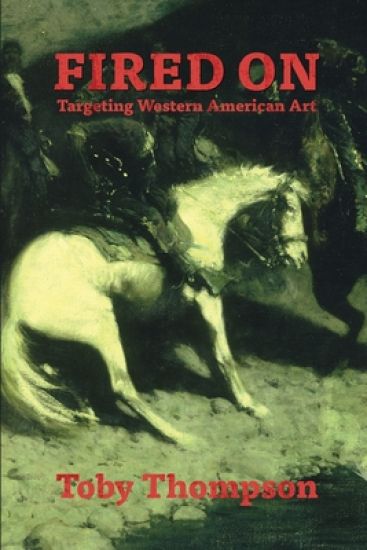
Fired On: Targeting Western American Art

Fired On: Targeting Western American Art

Toby Thompson

Bangtail Press
2020
nidottu
The third in a trilogy of collected pieces of reportorial nonfiction, personal essays, and profiles from Toby Thompson, Fired On joins Thompson's Riding the Rough String and Metroliner in charting one of the most respected careers in American letters. For more than forty years, Thompson has been preoccupied with western art and those who create it. From early works by Carl Bodmer, Paul Kane, Charles M. Russell and Fredrick Remington to modern masters like Russell Chatham and T.C. Cannon, in Fired On Thompson considers three centuries' worth of art across western America. In the process and in aggregate, he finally paints a larger portrait of the place and its inhabitants. This anthology includes pieces previously published as well as essays written specifically for this collection.
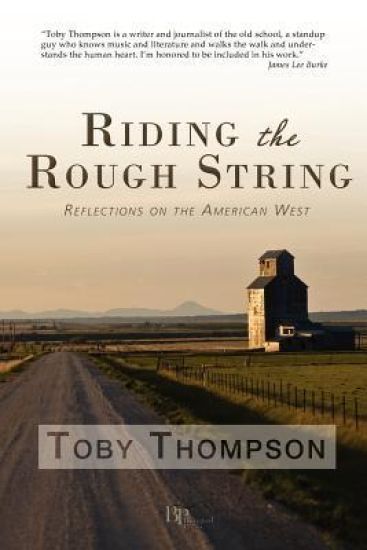
Riding the Rough String: Reflections on the American West
Profiles, meditations, essays, and explorations...For more than forty years, Toby Thompson has been considering what it means to live and work in the American West. And now, with Riding the Rough String, a lifetime's worth of accomplishment is roped together under one cover. His wide-ranging curiosity considers not only our most luminous literary figures (Gary Snyder to Gretel Ehrlich, Thomas McGuane to Hunter Thompson) but the region's history and culture as well. Saloons and art, pickups and A River Runs Through It, Thompson shows us the West through a new lens: unique, clear-eyed, essential. "The mountains and rivers, the high plains and the good Montana people (and the funny and the not so good or funny)--the dead-on info, the stories, that's the main thing, the stories)--Toby Thompson has it right. Riding the Rough String is a fine sport and an all-day pleasure." William Kittredge author of Hole in the Sky "Toby Thompson knows Montana's bars, books, bridges, and backcountry. I'll read anything he writes." Tim Cahill author of Hold the Enlightenment Like the rest of the gang, Toby Thompson played it smart and went west. His sharp eye and interviewer's ear caught every nuance. Riding the Rough String sets it all down with verve and assurance." William Hjortsberg author of Jubilee Hitchhiker "Toby Thompson is a writer and journalist of the old school, a standup guy who knows music and literature and walks the walk and understands the human heart. I'm honored to be included in his work." James Lee Burke author of Creole Belle
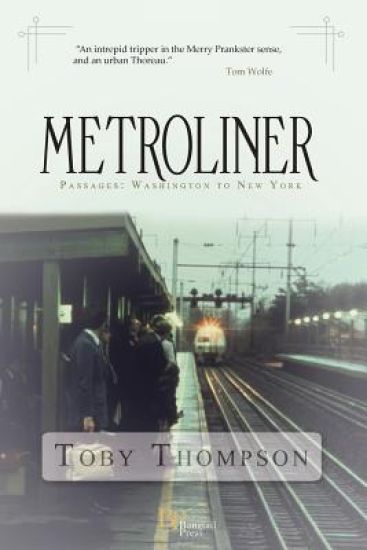
Metroliner

Metroliner

Toby Thompson

Bangtail Press
2013
nidottu
An essential companion to Riding the Rough String, his previous collection of reportage, personal essays, and profiles, Metroliner explores the two poles of Toby Thompson's life on the East Coast. For more than forty years, he has ridden the rails between Washington, DC and New York, capturing not only the sensibilities of these two cities but the tenor of his time as well. From the Smithsonian to the secret fishing spots of Manhattan, from profiles of Norman Mailer and Jackie Gleason to the White House press corps, Metroliner represents a career's worth of reportage from one of America's most accomplished writers. "An intrepid tripper in the Merry Prankster sense, and an urban Thoreau," - Tom Wolfe "A first-rate collection, impressively diverse and vastly enjoyable." - Carl Hiaasen "...graceful and entertaining, to say nothing of the] energetic reporting..." - Tom Brokaw
Heidegger and Executive Education

Heidegger and Executive Education

Toby Thompson

Routledge
2017
sidottu
Global corporations and the senior executives who oversee them have been subject to great criticism in recent times: not only do such corporations hold extreme concentrations of wealth, but they continue to sanction staggering pay inequalities between the haves and the have-nots. At the same time, university-based business schools are conducting programmes of executive education seemingly customised to sanction these same inequalities. Heidegger and Executive Education is a piece of critical philosophy that has been written from within the business school in order to examine how this sheltered process of educating in-role corporate executives operates. Thompson claims that executive education is based on a very simple premise: that an executive executes an order, and that executive education is an amelioration of that process. Thompson argues that the easiest way to conceive of executive education is to treat order and execution as cognates, as a single conceptual entity. Thus, he asks, if educating executives in line with the order-execution cognate involves swapping the boardroom for the classroom, and in keeping with the ‘critical’ tag, shouldn’t executive education be about questioning not only the execution, but also the dominant order? The author uses ‘time’ as the philosophical method by which one can undo the order-execution cognate, question the sanctity of the cognate and thereby halt the seemingly inexorable temporal sequence from order through to those orders becoming executed. This book uses Martin Heidegger’s exotic philosophy of time in order to mount a philosophical challenge to the temporal sequentiality of executive education. It will therefore be of great interest to academics, researchers and postgraduates who are interested in Heidegger, the philosophy of education and executive education. It should also be essential reading for those involved in training, developing, and educating corporate executives.