Kirjojen hintavertailu. Mukana 11 717 486 kirjaa ja 12 kauppaa.

Kirjahaku

Etsi kirjoja tekijän nimen, kirjan nimen tai ISBN:n perusteella.

7 kirjaa tekijältä Tom Cohen

Anti-Mimesis from Plato to Hitchcock

Anti-Mimesis from Plato to Hitchcock

Tom Cohen

Cambridge University Press
1994
sidottu
The material elements of writing have long been undervalued, and have been dismissed by recent historicising trends of criticism; but analysis of these elements - sound, signature, letters - can transform our understanding of literary texts. In this book Tom Cohen shows how, in an era of representational criticism and cultural studies, the role of close reading has been overlooked. Arguing that much recent criticism has been caught in potentially regressive models of representation, Professor Cohen undertakes to counter this by rethinking the ‘materiality’ of the text itself. Through a series of revealing new readings of the work of writers including Plato, Bakhtin, Poe, Whitman and Conrad, Professor Cohen exposes the limitations of new historicism and neo-pragmatism, and demonstrates how ‘the materiality of language’ operates to undo the representational models of meaning imposed by the literary canon.
Anti-Mimesis from Plato to Hitchcock

Anti-Mimesis from Plato to Hitchcock

Tom Cohen

Cambridge University Press
1994
pokkari
The material elements of writing have long been undervalued, and have been dismissed by recent historicising trends of criticism; but analysis of these elements - sound, signature, letters - can transform our understanding of literary texts. In this book Tom Cohen shows how, in an era of representational criticism and cultural studies, the role of close reading has been overlooked. Arguing that much recent criticism has been caught in potentially regressive models of representation, Professor Cohen undertakes to counter this by rethinking the ‘materiality’ of the text itself. Through a series of revealing new readings of the work of writers including Plato, Bakhtin, Poe, Whitman and Conrad, Professor Cohen exposes the limitations of new historicism and neo-pragmatism, and demonstrates how ‘the materiality of language’ operates to undo the representational models of meaning imposed by the literary canon.
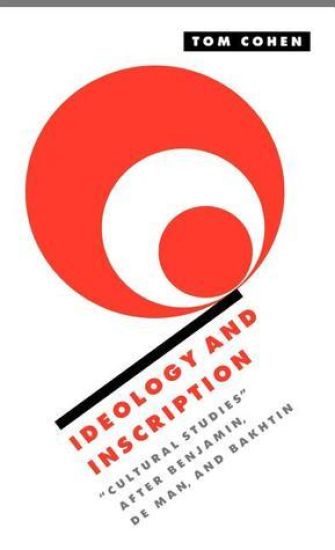
Ideology and Inscription

Ideology and Inscription

Tom Cohen

Cambridge University Press
1998
sidottu
In Ideology and Inscription Tom Cohen questions the way history, ideology and politics are invoked in contemporary cultural studies. Enlisting the work of three seminal figures in literary theory - Walter Benjamin, Paul de Man, and M. Bakhtin - Cohen argues for a new politics of memory that moves beyond what he sees as our current paralysing preoccupation with the present, and also for a new approach to the reading and analysis of cultural texts that breaks with the mimetic premises of traditional criticism. The book challenges many of the prevailing methodologies and assumptions of the contemporary critical scene and, through analyses of such topics as the rhetoric of science, ecological criticism, and the films of Hitchcock, demonstrates the subtlety and critical power of a more genuinely 'materialist' approach to a wide range of cultural texts.
Ideology and Inscription

Ideology and Inscription

Tom Cohen

Cambridge University Press
1998
pokkari
In Ideology and Inscription Tom Cohen questions the way history, ideology and politics are invoked in contemporary cultural studies. Enlisting the work of three seminal figures in literary theory - Walter Benjamin, Paul de Man, and M. Bakhtin - Cohen argues for a new politics of memory that moves beyond what he sees as our current paralysing preoccupation with the present, and also for a new approach to the reading and analysis of cultural texts that breaks with the mimetic premises of traditional criticism. The book challenges many of the prevailing methodologies and assumptions of the contemporary critical scene and, through analyses of such topics as the rhetoric of science, ecological criticism, and the films of Hitchcock, demonstrates the subtlety and critical power of a more genuinely ‘materialist’ approach to a wide range of cultural texts.
Hitchcock's Cryptonymies V2

Hitchcock's Cryptonymies V2

Tom Cohen

University of Minnesota Press
2005
nidottu
In the first The Man Who Knew Too Much, Alfred Hitchcock films a clay pigeon crossing the sky, a dark disc resembling a black sun. When the same work takes viewers into a temple for sun worshippers (it turns out to be a front for spies), another black orb is introduced: a black marble used to hypnotize initiates. Tom Cohen traces this motif—and many others—seeing it as an explicit challenge both to Enlightenment-era protocols of representation and to the auteurism that has defined studies of Hitchcock. This second volume of Hitchcock's Cryptonomies presents the director's works as a radical collage of images and absences, letters and numbers, citations and sounds that together mark Hitchcock as a knowing figure who was entirely aware of his—and cinema's—place at the dawn of a global media culture, as well as of the cinema's revolutionary impact on perception and memory. Cohen's provocative interrogation culminates in an innovative close analysis of To Catch a Thief, a work disregarded by the critical establishment as being merely light entertainment. Disguised as thrillers, Hitchcock's films are as subversive as the spies around which their plots often revolve. Cohen sees them as "war machines"—hiding in plain sight at the center of the film canon—designed as much to erode traditional models of home, family, and state as to sabotage increasingly obsolete ways of seeing and knowing.Tom Cohen is professor of American literary, critical, and cinematic studies at the University at Albany. He is the author of Anti-Mimesis: From Plato to Hitchcock and Ideology and Inscription: "Cultural Studies" after Benjamin, and coeditor of Material Events (Minnesota, 2000).
Hitchcock's Cryptonymies V1

Hitchcock's Cryptonymies V1

Tom Cohen

University of Minnesota Press
2005
nidottu
Tom Cohen's radical exploration of Hitchcock's cinema departs from conventional approaches—psychoanalytic, feminist, political—to emphasize the dense web of signatures and markings inscribed on and around his films. Aligning Hitchcock's agenda with the philosophical and aesthetic writings of Nietzsche, Derrida, and Benjamin, Cohen's project dramatically recasts the history and meaning of cinema itself.This first volume of Hitchcock's Cryptonymies provides a singularly close reading of films such as The Lady Vanishes, Spellbound, and North by Northwest, exposing the often imperceptible visual and aural puns, graphic elements, and cryptograms that traverse his entire body of work. Within Hitchcock's cinema, Cohen argues, these "secret agents" have more than just decorative or symbolic significance; they also reflect, critique, and disrupt traditional cinematic practice, undermining ways of seeing inherited from the Enlightenment and prefiguring postmodern culture. From the recurrence of the eye motif and the frequency of names beginning with "Mar" to the role of memory and the director's trademark cameos, Cohen offers an unprecedented guide to the entirety of Hitchcock's labyrinthine signature system. At the same time, he liberates Hitchcock's works from film history (modernist, auteurist), revealing them as unsettled events in the archaeology of contemporary global image culture.Tom Cohen is professor of American literary, critical, and cinematic studies at the University at Albany. He is the author of Anti-Mimesis: From Plato to Hitchcock and Ideology and Inscription: "Cultural Studies" after Benjamin, and coeditor of Material Events (Minnesota, 2000).