Kirjojen hintavertailu. Mukana 11 244 527 kirjaa ja 12 kauppaa.

Kirjahaku

Etsi kirjoja tekijän nimen, kirjan nimen tai ISBN:n perusteella.

10 kirjaa tekijältä Tom Conley

The Graphic Unconscious in Early Modern French Writing

The Graphic Unconscious in Early Modern French Writing

Tom Conley

Cambridge University Press
2006
pokkari
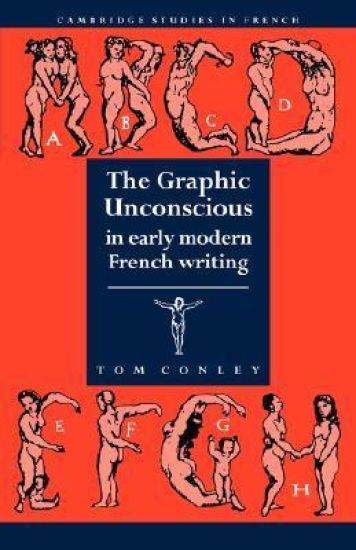
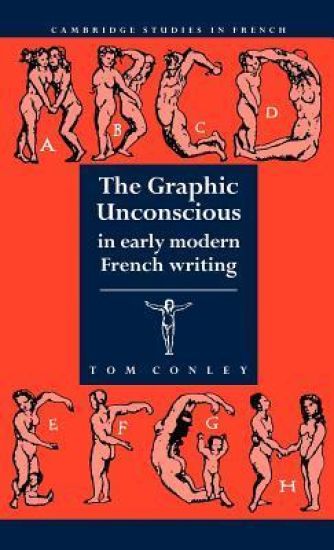
This 1992 book studies the importance of typographic shapes in French Renaissance literature in the context of psychoanalysis and of the history of printed writing. Focusing on the poetry of Clement Marot, Rabelais's Gargantua, Ronsard's sonnets and the Essais of Montaigne, it argues that printed characters can either supplement or betray what they appear to articulate, revealing compositional patterns that do not appear to be under authorial control. Professor Conley shows that graphic forms are crucial for the development of complex interactions of verbal and visual materials in the early years of print culture. Marot and Rabelais articulate a religious programme through the letter; Ronsard conflates the arts in poetry of the French court in the middle years of the sixteenth century; Montaigne stages the birth of the self in print and inscribes political dimensions in the relationship between the letter and meaning. This unconscious, proto-Freudian writing has complex historical relations with verbal and visual practices in the media of the twentieth century.
The Graphic Unconscious in Early Modern French Writing

The Graphic Unconscious in Early Modern French Writing

Tom Conley

Cambridge University Press
1992
sidottu
This 1992 book studies the importance of typographic shapes in French Renaissance literature in the context of psychoanalysis and of the history of printed writing. Focusing on the poetry of Clement Marot, Rabelais's Gargantua, Ronsard's sonnets and the Essais of Montaigne, it argues that printed characters can either supplement or betray what they appear to articulate, revealing compositional patterns that do not appear to be under authorial control. Professor Conley shows that graphic forms are crucial for the development of complex interactions of verbal and visual materials in the early years of print culture. Marot and Rabelais articulate a religious programme through the letter; Ronsard conflates the arts in poetry of the French court in the middle years of the sixteenth century; Montaigne stages the birth of the self in print and inscribes political dimensions in the relationship between the letter and meaning. This unconscious, proto-Freudian writing has complex historical relations with verbal and visual practices in the media of the twentieth century.
Cartographic Cinema

Cartographic Cinema

Tom Conley

University of Minnesota Press
2007
nidottu
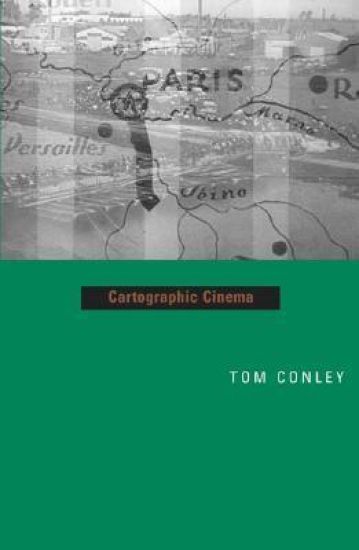
Cartography and cinema are what might be called locational machinery. Maps and movies tell their viewers where they are situated, what they are doing, and, to a strong degree, who they are. In this groundbreaking work, eminent scholar Tom Conley establishes the ideological power of maps in classic, contemporary, and avant-garde cinema to shape the imaginary and mediated relations we hold with the world. Cartographic Cinema examines the affinities of maps and movies through comparative theory and close analysis of films from the silent era to the French New Wave to Hollywood blockbusters. In doing so, Conley reveals that most of the movies we see contain maps of various kinds and almost invariably constitute a projective apparatus similar to cartography. In addition, he demonstrates that spatial signs in film foster a critical relation with the prevailing narrative and mimetic registers of cinema. Conley convincingly argues that the very act of watching films, and cinema itself, is actually a form of cartography. Unlike its function in an atlas, a map in a movie often causes the spectator to entertain broader questions—not only about cinema but also of the nature of space and being.
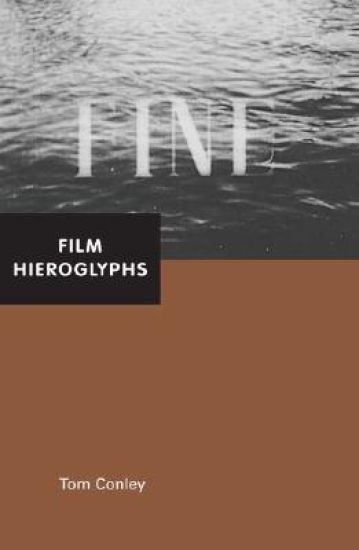
Film Hieroglyphs

Film Hieroglyphs

Tom Conley

University of Minnesota Press
2007
nidottu
At a time when traditional film theory privileged the purely visual, Film Hieroglyphs introduced a new way of watching film—examining the ways in which writing bears on cinema. Author Tom Conley gives special consideration to the points (ruptures) at which story, image, and writing appear to be at odds with one another.Conley hypothesizes that major directors—Renoir, Lang, Walsh, Rossellini—tend unconsciously to meld history and ideology. Graphic elements are seen as simultaneously foreign and integral to the field of the image. From these contradictions hieroglyphs emerge that mark a design attesting to a hidden rhetoric and to configurations of meaning that cinema cannot always control.Tom Conley is Lowell Professor of romance languages and visual and environmental studies at Harvard University. Among his books is The Self-Made Map (1996), as well as translations of The Fold (1992) by Gilles Deleuze and In the Metro (2002) by Marc Augé, all available from the University of Minnesota Press.
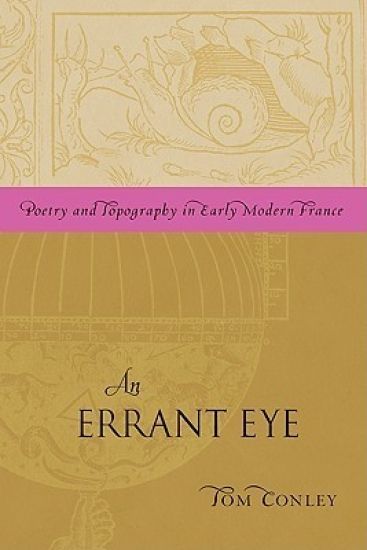
AN Errant Eye

AN Errant Eye

Tom Conley

University of Minnesota Press
2011
nidottu
An Errant Eye studies how topography, the art of describing local space and place, developed literary and visual form in early modern France. Arguing for a "new poetics of space" ranging throughout French Renaissance poetry, prose, and cartography, Tom Conley performs dazzling readings of maps, woodcuts, and poems to plot a topographical shift in the late Renaissance in which space, subjectivity, and politics fall into crisis. He charts the paradox of a period whose demarcation of national space through cartography is rendered unstable by an ambient world of printed writing.This tension, Conley demonstrates, cuts through literature and graphic matter of various shapes and forms-hybrid genres that include the comic novel, the emblem-book, the eclogue, sonnets, and the personal essay. An Errant Eye differs from historical treatments of spatial invention through Conley's argument that the topographic sensibility is one in which the ocular faculty, vital to the description of locale, is endowed with tact and touch.Detailed close readings of Apian, Rabelais, Montaigne, and others empower the reader with a lively sense of the topographical impulse, deriving from Conley's own "errant eye," which is singularly discerning in attentiveness to the ambiguities of charted territory, the contours of woodcut images, and the complex combinations of word and figure in French Renaissance poetry, emblem, and politics.
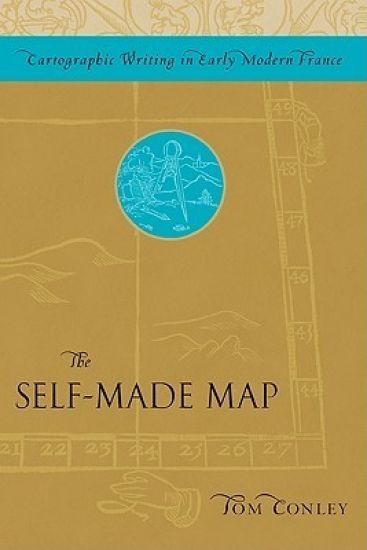
The Self-Made Map

The Self-Made Map

Tom Conley

University of Minnesota Press
2011
nidottu
The Self-Made Map argues that during the Renaissance in France a "new cartographic impulse" affected both the "graphic and imaginary forms of literature." In this wide-ranging and fascinating work, Tom Conley demonstrates that as new maps were plotted during this period, a new sense of self emerged, one defined in part by the relationship of the self to space.Conley traces the explosion of interest in mapmaking that occurred with the discovery of the New World, and discusses the commensurate rise of what he defines as cartographic writing-writing that "holds, penetrates, delineates, and explores space." Considering the works of such writers as Rabelais, Montaigne, and Descartes, Conley provides a "navigation" through the printed page, revealing the emerging values of Renaissance France. In his examination of the placing of words, letters, and graphic elements in books, he exposes the playful and sometimes enigmatic relation between spatial organization and text.Conley also exposes the ideological exercise inherent in mapmaking, arguing that Renaissance cartography is inseparably bound up with the politics of the era. He undertakes close readings of maps and illustrations, discussing the necessity of viewing Renaissance maps in the context of their typographic layout, graphic reproduction, and literary and ideological import.Richly illustrated throughout, The Self-Made Map combines studies of art, geography, history, literature, and printing to show a clear historical transformation, along the way linking geographical discoveries, printing processes, and political awareness. Conley's provocative analysis discloses how early modern printed literature and cartography worked together to crystallize broader issues engaging the then emergent status of cultural identity, nation, and individuality.
Action, Action, Action

Action, Action, Action

Tom Conley

STATE UNIVERSITY OF NEW YORK PRESS
2022
sidottu
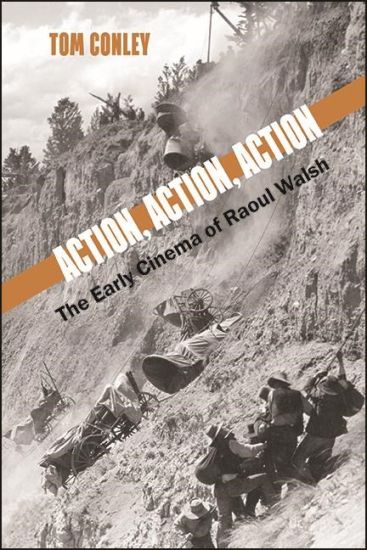
Studies the force of action, motion, and vision in the early cinema of Hollywood director Raoul Walsh.Director of over 150 films from 1912 to 1964, Raoul Walsh was a core figure in Hollywood from its beginnings to the end of the studio system. Perhaps best known for such films as The Big Trail (starring John Wayne in his first leading role), High Sierra, and White Heat, Walsh cut his teeth under D. W. Griffith, and, like his contemporary John Ford, found a style and signature in his silent cinema and early talkies. Through close analysis of seven of his films, six shot between 1915 and 1933 and one a remake from 1956, and stressing the visual character of their settings and situations, Tom Conley examines how composition and montage-or action-often overtake the crisp narratives these films convey. Rife with contradiction, they ask us to see what makes them possible and how they contend with prevailing codes. Films discussed include Regeneration (1915); Sadie Thompson (1928) and a likely avatar, The Revolt of Mamie Stover (1956); The Cock-Eyed World (1929); The Big Trail (1930); Me and My Gal (1932); and The Bowery (1933).
Action, Action, Action

Action, Action, Action

Tom Conley

STATE UNIVERSITY OF NEW YORK PRESS
2022
pokkari
Studies the force of action, motion, and vision in the early cinema of Hollywood director Raoul Walsh.Director of over 150 films from 1912 to 1964, Raoul Walsh was a core figure in Hollywood from its beginnings to the end of the studio system. Perhaps best known for such films as The Big Trail (starring John Wayne in his first leading role), High Sierra, and White Heat, Walsh cut his teeth under D. W. Griffith, and, like his contemporary John Ford, found a style and signature in his silent cinema and early talkies. Through close analysis of seven of his films, six shot between 1915 and 1933 and one a remake from 1956, and stressing the visual character of their settings and situations, Tom Conley examines how composition and montage-or action-often overtake the crisp narratives these films convey. Rife with contradiction, they ask us to see what makes them possible and how they contend with prevailing codes. Films discussed include Regeneration (1915); Sadie Thompson (1928) and a likely avatar, The Revolt of Mamie Stover (1956); The Cock-Eyed World (1929); The Big Trail (1930); Me and My Gal (1932); and The Bowery (1933).
The Vulnerable Country

The Vulnerable Country

Tom Conley

NewSouth Publishing
2009
nidottu
Australia was born vulnerable. From its beginnings as a precarious convict settlement on the 'other side of the world', through the development of self-governing colonies, to Federation and beyond, recognising and dealing with vulnerability led Australians to embrace an insular attitude to the outside world, which in turn translated into state control over the economy and highly protectionist policies. So how did Australia transform from a protected, insular country to an outwardly focused, globalised one? And why, in the current economic climate, should Australia resist a return to its protectionist past? The Vulnerable Country begins with historical analysis of the interaction between politics and economics, covers the credit crunch of 2007 and culminates with the current global financial crisis. Tom Conley argues that now, more than ever, the state has a responsibility to promote diversification of trade while regulating economic activity and ensuring that the benefits of growth are spread as widely as possible.