Kirjojen hintavertailu. Mukana 11 244 527 kirjaa ja 12 kauppaa.

Kirjahaku

Etsi kirjoja tekijän nimen, kirjan nimen tai ISBN:n perusteella.

21 kirjaa tekijältä Tom Cooper

Florida Man

Florida Man

Tom Cooper

Random House
2020
sidottu
"A riotous journey into the heart of insanity also known as the State of Florida. Bravo "--Gary Shteyngart, author of Lake Success Florida, circa 1980. Reed Crowe, the eponymous Florida Man, is a middle-aged beach bum, beleaguered and disenfranchised, living on ill-gotten gains deep in the jungly heart of Florida. When sinkholes start opening on Emerald Island, not only are Reed Crowe's seedy businesses--a moribund motel and a shabby amusement park--endangered, but so are his secrets. Crowe, amateur spelunker, begins uncovering artifacts that change his understanding of the island's history, as well as his understanding of his family's birthright as pioneering homesteaders. Meanwhile, there are other Florida men with whom Crowe must contend. Hector "Catface" Morales, a Cuban refugee, trained assassin, and crack-addicted Marielito, is seeking revenge on Reed for stealing his stash of drugs and leaving him for dead (unbeknownst to Reed) in the wreckage of a plane crash in the Everglades decades ago. Loner and misanthrope Henry Yahchilane, a Seminole native, has something to hide on the island. So does irascible and pervy Wayne Wade, Reed Crowe's childhood friend turned bad penny. Then there are the Florida women, including Heidi Karavas, Reed Crowe's ex-wife, now a globe-trekking art curator, and Nina Arango, a Cuban refugee and fiercely protective woman with whom Reed Crowe falls in love. There are curses. There are sea monsters. There are biblical storms. There's something called the Jupiter Effect. Ultimately, Florida Man is a generation-spanning story about how a man decides to live his life, and how despite staying landlocked and stubbornly in one place, the world nevertheless comes to him.
Florida Man

Florida Man

Tom Cooper

Random House Trade
2022
nidottu
"A riotous journey into the heart of insanity also known as the State of Florida. Bravo "--Gary Shteyngart, author of Lake Success Florida, circa 1980. Reed Crowe, the eponymous Florida Man, is a middle-aged beach bum, beleaguered and disenfranchised, living on ill-gotten gains deep in the jungly heart of Florida. When sinkholes start opening on Emerald Island, not only are Reed Crowe's seedy businesses--a moribund motel and a shabby amusement park--endangered, but so are his secrets. Crowe, amateur spelunker, begins uncovering artifacts that change his understanding of the island's history, as well as his understanding of his family's birthright as pioneering homesteaders. Meanwhile, there are other Florida men with whom Crowe must contend. Hector "Catface" Morales, a Cuban refugee, trained assassin, and crack-addicted Marielito, is seeking revenge on Reed for stealing his stash of drugs and leaving him for dead (unbeknownst to Reed) in the wreckage of a plane crash in the Everglades decades ago. Loner and misanthrope Henry Yahchilane, a Seminole native, has something to hide on the island. So does irascible and pervy Wayne Wade, Reed Crowe's childhood friend turned bad penny. Then there are the Florida women, including Heidi Karavas, Reed Crowe's ex-wife, now a globe-trekking art curator, and Nina Arango, a Cuban refugee and fiercely protective woman with whom Reed Crowe falls in love. There are curses. There are sea monsters. There are biblical storms. There's something called the Jupiter Effect. Ultimately, Florida Man is a generation-spanning story about how a man decides to live his life, and how despite staying landlocked and stubbornly in one place, the world nevertheless comes to him.
The Marauders

The Marauders

Tom Cooper

Broadway Books (A Division of Bantam Doubleday Dell Publishing Group Inc)
2015
pokkari
"A little Elmore Leonard, a little Charles Portis, and very much its own uniquely American self. . .Tom Cooper has written one hell of a novel." -Stephen King When the BP oil spill devastates the Louisiana Gulf Coast, the citizens of the bayou town of Jeanette scramble to replace their lost livelihoods. Among them is one-armed, pill-popping shrimper Gus Lindquist, who has nothing left but the dying glimmer of a boyhood dream: finding the lost treasure of pirate Jean Lafitte. With his metal detector and Pez dispenser full of Oxycontin, Lindquist steers his rickety shrimp boat into the savage Louisiana swamps. Along his journey, Gus meets a motley crew of characters: Wes Trench, a young Cajun man estranged from his father since his mother died in Katrina; Reginald and Victor Toup, sociopathic twin brothers and drug lords; Cosgrove and Hanson, petty criminals searching for a secret that could make them rich, or kill them; and Brady Grimes, a BP middleman out to make his career by swindling the townsfolk of Jeanette, among them his own mother. Funny, dark, and compelling, The Marauders throws these characters on a rollicking collision course that all of them might not survive.
Love Relevancy for an Ordinary Jerk

Love Relevancy for an Ordinary Jerk

Tom Cooper

Independently Published
2019
nidottu
This book is a collection of eloquent excerpts that express loves influence on human social interactions and the environment. In the words of Tom Cooper, "If the world just had more love, it would be a much better place." Although the pages are few in this book, the impacts are numerous. Love Relevancy for an "Ordinary Jerk" is all about providing insight about life, and how to make it meaningful. This is a great read and eye opener to the world around you. Tom Cooper will channel your energy with his words to help motivate and inspire readers.
The Wild Atlantic Way and Western Ireland
A guidebook to 6 cycle-touring routes along Ireland’s west coast. Based on the Wild Atlantic Way, the world’s longest signed coastal route, each tour can be completed in 7-10 days by any reasonably fit cyclist. Presented in 6 tours between 291 and 504km (181-313 miles) in length, with optional variants givenAverage daily stages of 55km (34 miles) that take 4-5 hours of ridingTours can be linked together to form a 44 stage, 2450km (1522 mile) trip between Derry/Londonderry and CorkKey centres include Donegal, Sligo, Achill Island, Galway, Westport, the Aran Islands, Limerick, Tralee, Bantry, KinsaleMaps and route cards provided for each stageGPX files available to downloadDetailed information on accommodation, facilities and transport along the route
Great Lakes Holocaust

Great Lakes Holocaust

Tom Cooper

Helion Company
2013
nidottu
Great Lakes Holocaust is the first in two volumes covering military operations in Zaire - as the Congo was named from 1971 until 1997 - and the Democratic Republic of Congo at the turn of the 21st century. This volume explores the events of the 1980s and 1990s in Rwanda and Uganda, which eventually spilled over the borders into Zaire, resulting in one of the worst tragedies ever to befall an African region. The narrative traces the ascent of crucial Rwandan, Congolese and Ugandan military and political figures, and their connections within influential business and political circles in and outside Africa. It examines the build-up of the Zairian military under the government of dictator Mobutu Sese Seko in the 1960s and 1970s, and provides an in-depth study into reasons for its near-collapse in the early 1990s. The military build-up of Rwanda and Uganda is discussed in detail as is their planning for operations inside Zaire, and the global logistic tail that provided the Rwandan military, particularly, but also most of its opponents, with a capability of not only waging war beyond their borders, but - in the case of Rwanda - of invading and practically conquering a country the size of Western Europe or the USA east of the Mississippi. The book further traces the covert Rwandan military actions inside Zaire, initially run under the guise of an insurgency by one of Zaire's ethnic minorities; how ever-deepening Rwandan operations inside Zaire were practically dictated by concentrations of Hutu refugees; and how the insurgency - led by Laurent-DésiréKabila who was installed by key Rwandan and Ugandan military and political figures - developed into an organisation that sought autonomy from the military and political dictates of Rwanda, in turn delivering a direct reason for the Second Congo War which was fought from 1998-2003.
Great Lakes Conflagration

Great Lakes Conflagration

Tom Cooper

Helion Company
2013
nidottu
Great Lakes Conflagration is the second in two volumes covering military operations in the Democratic Republic of Congo (DRC) at the turn from the 21st century. This volume explores developments in the DRC that led to the outbreak of violence in August 1998, and systematically details the continued build-up and status of the Congolese, Rwandan and Ugandan armies, as well as the forces of other African countries. Recounted is the Rwandan attempt to topple the government of Laurent Kabila through an operation that saw a redeployment of some of best Rwandan units from Kigali and Goma to the western DRC, resulting in a series of fierce air-land clashes with Zimbabwean and Angolan forces and culminating in the Battle of Kinshasa. Also described is the fighting along what became the 'Eastern Front' in the DRC, as Zimbabwean and allied troops attempted to stop Rwandan, Ugandan and rebel advances out of Kivu Province in the direction of the Congo River through 1998 and 1999. These early phases of the war, or 'The First African War' as it has come to be known, were characterised by surprising outflanking and infiltration manoeuvres; foreign mercenaries; Zimbabwean Hawk and Lynx light strikers flying intensive combat operations from N'Djili airport, half of which was occupied by Rwandans, Ugandans and Congolese rebels; interdiction strikes guided by special forces deployed deep behind enemy lines; operations of helicopter gunships and transport aircraft under intense ground attack in support of troops cut off by advancing opponents; use of transport aircraft as makeshift bombers in bad weather and by night and clashes of armoured forces and many other elements of 'high-technology' warfare. All the protagonists deployed their best military units, their best equipment and some of their best military commanders, yet despite their best efforts, and hampered by infighting, the conflict ultimately resulted in a stalemate which dragged on for a further three years while negotiations bogged down. This book is illustrated with an extensive selection of exclusive photography, colour profiles and markings, making it of special interest to enthusiasts and professionals alike.
Wings Over Ogaden

Wings Over Ogaden

Tom Cooper

Helion Company
2015
nidottu
With Ethiopia in disarray following a period of severe internal unrest and the spread of insurgencies in Eritrea and Tigray, Ethiopia and its armed forces should have offered little opposition to well-equipped Somali armed forces which were unleashed to capture Ogaden, in July 1977. However, excellently trained pilots of the Ethiopian Air Force took full advantage of their US-made equipment, primarily their few brand-new Northrop F-5E Tiger II fighter-bombers, to take the fight to their opponents, win air superiority over the battlefield, and thus have their hands free to interdict the Somali supply links to stop the invasion cold. This air victory practically sealed the fate of the Somali juggernaut in Ogaden, especially so once Ethiopia convinced Cuba and the Soviet Bloc to support her instead of Somalia. In a fit of pique, Somalia forced all Soviet advisers to leave the country. Already bitter over similar experiences in Egypt in 1972, Moscow's revenge was designed as a clear message: nobody was to treat her in such fashion again. The USSR subsequently launched an air bridge to Ethiopia, unique and unprecedented in its extension and importance, delivering huge quantities of armament and equipment necessary for the Ethiopians to reconquer Ogaden, and beyond. In turn Somalia asked the USA for help and thus occurred an unprecedented switch of Cold War alliances. This volume details the history and training of both Ethiopian and Somali air forces, their equipment and training, tactics used and kills claimed, against the backdrop of the flow of the Ogaden war. It explains in detail, supported by over 100 contemporary and exclusive photographs, maps and colour profiles, how the Ethiopian Air Force won the decisive victory in the air by expertly deploying the F-5Es - unequalled in manoeuvrability, small size and powerful armament - to practically destroy the Somali Air Force and its MiG-17s and MiG-21s.
Hot Skies Over Yemen

Hot Skies Over Yemen

Tom Cooper

Helion Company
2018
nidottu
Following the Civil War of 1994, Yemen experienced few years of relative peace. This was rudely interrupted in 2004, when the government opened the first of six campaigns against the movement colloquially known as ‘Houthis’. The Yemeni Air Force – partially re-equipped over the previous years – saw intensive involvement in this conflict, but proved insufficient. In late 2009 and through 2010, the war spread into Saudi Arabia, which reacted with its first military intervention in the country. A host of long-simmering internal conflicts culminated in the second Saudi-led military intervention in Yemen, launched in March 2015. Although run along widely accepted Western doctrine of aerial warfare, and highly effective, the campaign in question experienced a number of massive problems – primarily related to unexpected developments and extremely complex relations between multiple parties in Yemen. That the air forces of the Saudi-led alliance involved in the ongoing campaign in Yemen are operating some of most modern combat aircraft and weaponry manufactured in the West is no secret. But, exactly how, why, when, and where are they deploying weapons systems in question and for what purpose remains entirely unknown in the public. Thanks to approach to first-hand sources, this volume is providing answers to precisely these questions and thus providing an exclusive insight into the conduct of operations by such modern aircraft types like F-15S, F-16E/F, EF-2000 Typhoon, and Mirage 2000. Containing over 140 photographs, colour profiles, maps and extensive tables, Hot Skies over Yemen is a richly illustrated and unique point of reference about one segment of modern aerial warfare that remains entirely unknown until today.
Hot Skies Over Yemen

Hot Skies Over Yemen

Tom Cooper

Helion Company
2017
nidottu
Since September 1962, hardly a week passed without a major armed confrontation or an outright war in Yemen. The number of long-lasting insurgencies, mutinies, rebellions, or terrorism-related activities that took place during this period is going into dozens. Despite duration of all these conflicts and although they may have caused as many as half a million of deaths, the rest of the World heard very little about them. At best, Yemen is nowadays known as a hotbed of international terrorism, an area that is on the receiving end of frequent US air strikes flown by UAVs, or as 'some place' fiercely bombarded by a coalition led by Saudi Arabia. While at least some details about British aerial operations in what was Southern Arabia of the 1960s were published over the years, next to nothing is known about activities of other, `local’ air forces – like those of Egypt – and even less so about that of Yemen. This is even more surprising considering that for nearly two decades there were no less than two, fully developed services of that kind - one operated by what was then North Yemen, another by what used to be South Yemen - and that these were deeply involved in the Cold War, too. Using newly released secret intelligence sources, neglected memoirs, and popular memory, this book is telling the story of military flying in Yemen between 1962 and 1994. It is providing in-depth insights and analysis of campaigns fought by the Egyptian air force of the 1960s, the creation of two Yemeni air forces in the 1970s, an entire series of inter-Yemeni wars of the 1980s and 1990s. Containing over 140 photographs, colour profiles, maps and extensive tables, Hot Skies over Yemen is a richly illustrated and unique point of reference about one segment of modern aerial warfare that remains entirely unknown until today.
Mig-23 Flogger in the Middle East

Mig-23 Flogger in the Middle East

Tom Cooper

Helion Company
2018
nidottu
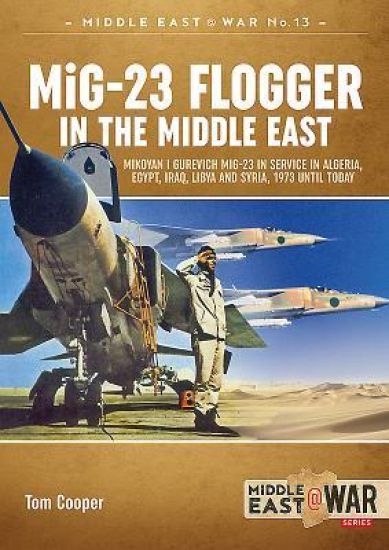
Following a protracted research and development phase, Mikoyan Gurevich’s MiG-23 finally entered service with the former Soviet Air Force in the early 1970s. Almost immediately, a number of foreign customers pressed Moscow for deliveries of this long-overdue type, expected to succeed the popular MiG-21 as a standard interceptor. Correspondingly, large numbers of MiG-23 interceptors and fighter-bombers were exported to five major Arab air forces in the mid-1970s. This is a detailed history of the operational service of this Soviet-manufactured interceptor and its fighter-bomber variants in service with Algerian, Egyptian, Iraqi, Libyan, and Syrian air forces, since 1974. While Egypt purchased only a handful before its final break with Moscow, and Algeria limited related acquisitions, Iraq, Libya and Syria continued purchasing advanced variants in significant numbers through the 1980s. The units operating MiG-23s were soon transformed into the backbone of the military services in question, and they saw combat service in a number of intensive military conflicts. In the 1980s, they fought against Israeli jets over Lebanon, against the Iranians in the Iran-Iraq War, and confronted US Navy’s F-14s on numerous occasions off Libya. In 1991 Iraqi MiG-23s were deployed in combat against the US-led coalition’s F-15s. Indeed, in Syria, different versions of MiG-23 continue flying combat operations today. Illustrated with over 110 photographs – many of these never published before –colour profiles and a dozen maps, this volume provides a unique point of reference, revealing much detail about camouflage patterns, unit insignia and aircraft markings.
In the Claws of the Tomcat

In the Claws of the Tomcat

Tom Cooper

Helion Company
2021
nidottu
Equipped with well-balanced air wings, huge aircraft carriers have formed the backbone of the United States Navy’s doctrine and strategy since the Second World War. Packing an enormous punch, their purpose is to exercise control over enormous portions of airspace – in the offence or defence. From the mid-1970s until the mid-2000s, the spear tip of the USN air wings was the famous Grumman F-14 Tomcat – widely considered one of the finest air superiority systems in the world. Originally designed as a fast, manoeuvrable and well-armed fighter, the Tomcat entered service as the ultimate long-range fleet defender and became the biggest, most complex and most expensive naval aircraft of its time. Including a unique and exceptional combination of flight characteristics, detection systems and weapons, it earned itself the status of a legend by the mid-1980s. The F-14 Tomcats of the US Navy achieved their first aerial victories during freedom of navigation exercises off Libya in 1981. However, the period during which they saw most combat followed several years later, during Operations Earnest Will and then Desert Storm, from 1987 until 1991. To date, very little has been published about the operations in question. Indeed, the widespread belief is that USN F-14s saw next to no air combat against Iran, and even less so during Operation Desert Storm in 1991. As so often, the reality is entirely different: Tomcats engaged dozens of opponents, often on the verge of the engagement envelope of their powerful AWG-9 radars and AIM-54 Phoenix long-range air-to-air missiles, and sometimes at such close ranges that their pilots selected ‘guns’. Weather- and communications-related problems, but also the incredible discipline of their crews prevented them from scoring up to a dozen aerial victories: however, it is perfectly possible that they scored at least one, perhaps more previously entirely unknown aerial victories – and also lost one of their own to an enemy fighter. Richly illustrated by over 100 photographs and authentic colour profiles, ‘Tomcats of the Storm’ is an exclusive source of reference about some of least-well known air combats fought by US Navy’s fighter crews in recent history.