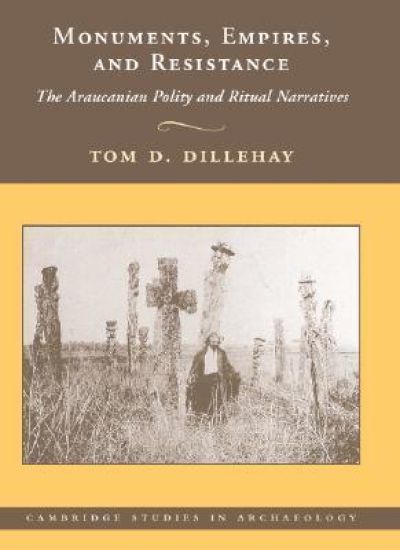
From AD 1550 to 1850, the Araucanian polity in southern Chile was a center of political resistance to the intruding Spanish empire. In this book, Tom D. Dillehay examines the resistance strategies of the Araucanians and how they used mound building and other sacred monuments to reorganize their political and culture life in order to unite against the Spanish. Drawing on anthropological research conducted over three decades, Dillehay focuses on the development of leadership, shamanism, ritual, and power relations. His study combines developments in social theory with the archaeological, ethnographic, and historical records. Both theoretically and empirically informed, this book is a fascinating account of the only indigenous ethnic group to successfully resist outsiders for more than three centuries and to flourish under these conditions.
From AD 1550 to 1850, the Araucanian polity in southern Chile was a center of political resistance to the intruding Spanish empire. In this book, Tom D. Dillehay examines the resistance strategies of the Araucanians and how they used mound building and other sacred monuments to reorganize their political and culture life in order to unite against the Spanish. Drawing on anthropological research conducted over three decades, Dillehay focuses on the development of leadership, shamanism, ritual, and power relations. His study combines developments in social theory with the archaeological, ethnographic, and historical records. Both theoretically and empirically informed, this book is a fascinating account of the only indigenous ethnic group to successfully resist outsiders for more than three centuries and to flourish under these conditions.
This volume provides an up-to-date and in-depth summary and analysis of the political practices of pre-Columbian communities of the Araucanians or Mapuche of south-central Chile and adjacent regions. This synthesis draws upon the empirical record documented in original research, as well as a critical examination of previous studies. By applying both archaeological and ethnohistorical approaches, the latter including ethnography, this volume distinguishes itself from many other studies that explore South American archaeology. Archaeological and traditional-historical narratives of the pre-European past are considered in their own terms and for the extent to which they can be integrated in order to provide a more rounded and realistic understanding than otherwise of the origins and courses of ecological, economic, social and political changes in south-central Chile from late pre-Hispanic times, through the contact period and up to Chile’s independence from Spain (ca. AD 1450-1810). Both the approach and the results are discussed in the light of similar situations elsewhere.Throughout its treatment, the volume continually comes back to two central questions: (1) how did the varied practices, institutions and worldviews of the Mapuche’s ancient communities emerge as a historical process that resisted the Spanish empire for more than 250 years? and (2) how were these communities reproduced and transformed in the face of ongoing culture contact and landscape change during the early Colonial period? These questions are considered in light of contemporary theoretical concepts regarding practice, landscape, environment, social organization, materiality and community that will make the book relevant for students and scholars interested in similar processes elsewhere.
This volume provides an up-to-date and in-depth summary and analysis of the political practices of pre-Columbian communities of the Araucanians or Mapuche of south-central Chile and adjacent regions. This synthesis draws upon the empirical record documented in original research, as well as a critical examination of previous studies. By applying both archaeological and ethnohistorical approaches, the latter including ethnography, this volume distinguishes itself from many other studies that explore South American archaeology. Archaeological and traditional-historical narratives of the pre-European past are considered in their own terms and for the extent to which they can be integrated in order to provide a more rounded and realistic understanding than otherwise of the origins and courses of ecological, economic, social and political changes in south-central Chile from late pre-Hispanic times, through the contact period and up to Chile’s independence from Spain (ca. AD 1450-1810). Both the approach and the results are discussed in the light of similar situations elsewhere.Throughout its treatment, the volume continually comes back to two central questions: (1) how did the varied practices, institutions and worldviews of the Mapuche’s ancient communities emerge as a historical process that resisted the Spanish empire for more than 250 years? and (2) how were these communities reproduced and transformed in the face of ongoing culture contact and landscape change during the early Colonial period? These questions are considered in light of contemporary theoretical concepts regarding practice, landscape, environment, social organization, materiality and community that will make the book relevant for students and scholars interested in similar processes elsewhere.