Kirjojen hintavertailu. Mukana 12 095 585 kirjaa ja 12 kauppaa.

Kirjahaku

Etsi kirjoja tekijän nimen, kirjan nimen tai ISBN:n perusteella.

5 kirjaa tekijältä Tom Holert

Marc Camille Chaimowicz

Marc Camille Chaimowicz

Tom Holert

Afterall Publishing
2007
sidottu
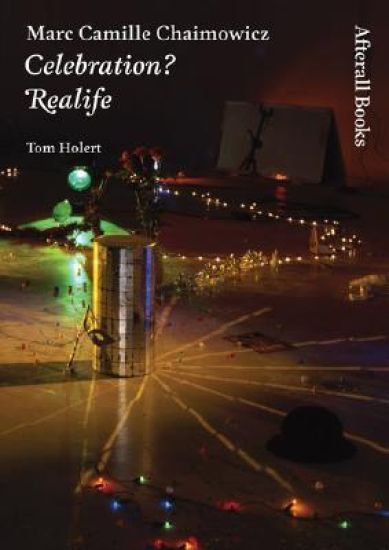
A richly illustrated study of Marc Chaimowicz's groundbreaking 1972 post-Pop installation-performance piece Celebration? Realife.Marc Camille Chaimowicz (born in 1947) was one of the first artists to merge the realms of performance and installation art. Chaimowicz distinguished himself in an era of stark minimalism by his unabashed pursuit of the beautiful, establishing himself in the 1970s with art that was playful and subtly seductive. Chaimowicz's post-Pop scatter environments owed as much to glam rock as to art practice and were informed by modern French literature (Gide, Cocteau, Proust, and Genet) as well as by art theory. His important 1972 installation Celebration? Realife featured masks, mirrors, various small objects (including a pair of orange knickers and a white bra), a glitter ball, music by the Rolling Stones, David Bowie, and others-and the artist, serving tea and engaging visitors in conversation in an adjacent room. It raised questions about public/private dichotomies, art/design boundaries, and identifications based on gender, and recast the artist as a kind of art director and stage designer. This work's recent reinstallation (as Celebration? Realife Revisited 1972/2000) and the critical acclaim it inspired confirms Chaimowicz's importance and points to his relationships with artists as different and as difficult as Cerith Wyn Evans, Jutta Koether, Kai Althoff, and others. This richly illustrated study of Celebration? Realife, with many color images, uses Chaimowicz's installation to reconstruct that cultural moment in the 1970s when the role of the artist and the relationships of art, design, popular culture, and performance changed.Performance artist Marc Camille Chaimowicz, born in Paris in 1947, teaches in the M.F.A. course at the University of Reading and is visiting consultant at L'Ecole Nationale des Beaux-Arts, Dijon. He is the author of Cafe du Reve.
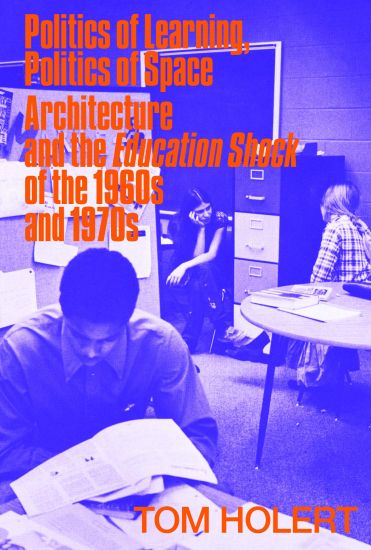
Politics of Learning, Politics of Space

Politics of Learning, Politics of Space

Tom Holert

De Gruyter
2021
isokokoinen pokkari
How the relationships between education and outer space have developed historically is exemplified in an incisive way by the decades that followed the "Sputnik shock" of 1957. The wake-up call that resulted from the Soviet space program set the global landscape of learning in motion. New schools and universities came into being against the backdrop of the reform euphoria and mood of catastrophe. At the same time, traditional pedagogical concepts were severely called into question—including the call to do away with institutions of education. What is shown in the architectures of learning is not only a politics of space, but also the educational shock that intensively shook up the global societies of the 1960s and 1970s, while they were gradually being transformed into knowledge societies.
Knowledge Beside Itself

Knowledge Beside Itself

Tom Holert

Sternberg Press
2020
pokkari
An examination of contemporary art's recent emphasis on "research" and "knowledge production," and its claims to provide a novel access to "knowledge."Questioning the role and function of contemporary art in economic and political systems that increasingly manage data and affect, Knowledge Beside Itself delves into the peculiar emphasis placed in recent years, curatorially and institutionally, on such notions as "research" and "knowledge production." Contemporary art is viewed here as a strategic bet on the social distinctions and value extractions made possible by claiming a different, novel access to "knowledge." Contemporary art's various liaisons with the humanities and the social and natural sciences, as well as its practitioners' frequent embeddedness within transdisciplinary research environments and educational settings, have created a sense of epistemo-aesthetic departure, which concurs with the growing relevance of art as conduit or catalyst of knowledge. Discussing the practice of artists such as Christine Borland, Bureau d' tudes, Tony Chakar, Lina Dokuzovic, Fernando Garc a-Dory, Natascha Sadr Haghighian, Adelita Husni-Bey, Jakob Jakobsen, Claire Pentecost, and Pilvi Takala, writer and curator Tom Holert submits the gambit of conceptualizing contemporary art as an agent of epistemic politics to a genealogical analysis of its political-economic underpinnings--in times of cognitive capitalism, machine learning, and a renewed urgency of epistemological disobedience.
Neolithic Childhood – Art in a False Present, c. 1930

Neolithic Childhood – Art in a False Present, c. 1930

Anselm Franke; Tom Holert

Diaphanes AG
2018
sidottu
Resonating at the heart of Neolithic Childhood. Art in a False Present, c. 1930 is the question whether art has present, past, and future functions. The modernist assertion of the autonomy of art was intended to render superfluous art’s social and religious functions. But what if the functionlessness of art comes under suspicion of being instrumentalized by bourgeois capitalism? This was an accusation that informed the anti-modernist critique of the avant-garde, and particularly of Surrealism. The objective throughout the crisis-ridden present of the 1920s to the 1940s was to reaffirm a once ubiquitous, but long-lost functionality—not only of art.The publication accompanying the exhibition examines the strategies deployed in this reaffirmation. These include the surrealist Primitivism of an “Ethnology of the White Man” together with the excavation of the deep time of humanity—into the “Neolithic Childhood” mapped out by the notoriously anti-modernist Carl Einstein (1885-1940) as a hallucinatory retro-utopia. The volume brings together essays by the curators and academics involved in the project, primary texts by Carl Einstein and a comprehensive documentation of the exhibition including lists of works, texts on as well as images of numerous exhibits and finally installation views. At the center of the volume, a glossary discusses Carl Einstein’s own theoretical vocabulary as well as further associated terms, such as Autonomy, Formalism, Function, Gesture, Hallucination, Art, Metamorphosis, Primitivisms, Totality.With contributions by: Irene Albers, Philipp Albers, Joyce S. Cheng, Rosa Eidelpes, Carl Einstein, Anselm Franke, Charles W. Haxthausen, Tom Holert, Sven Lütticken, Ulrike Müller, Jenny Nachtigall, David Quigley, Cornelius Reiber, Erhard Schüttpelz, Kerstin Stakemeier, Maria Stavrinaki, Elena Vogman, Zairong Xiang, Sebastian ZeidlerWith reproductions of artworks by: Jean (Hans) Arp, Willi Baumeister, Georges Braque, Brassaï, Claude Cahun, Lux T. Feininger, Max Ernst, Florence Henri, Barbara Hepworth, Hannah Höch, Heinrich Hoerle, Paul Klee, Germaine Krull, Helen Levitt, André Masson, Alexandra Povòrina, Gaston-Louis Roux, Kalifala Sidibé, Louis Soutter, Yves Tanguy, Toyen, Jindrich Štyrský, Raoul Ubac, Paule Vézelay and others.