Kirjojen hintavertailu. Mukana 11 244 527 kirjaa ja 12 kauppaa.

Kirjahaku

Etsi kirjoja tekijän nimen, kirjan nimen tai ISBN:n perusteella.

8 kirjaa tekijältä Tony Hunt

Tony Hunt's Structures Notebook
The purpose of the Structures Notebook is to explain, in the simplest possible terms, about the structure of 'things', and to demonstrate the fact that everything you see and touch, live in and use, living and man-made, has a structure which is acted upon by natural forces and reacts to these forces according to its form and material. The Structures Notebook was originally written by Tony Hunt as a brief teaching aid for students at the Royal College of Art who had very little, if any, knowledge of physics or structural behaviour. It has now been expanded, and with this second edition, updated, into a more comprehensive book while retaining a simple visual and non-mathematical approach to structures. The book is divided into seven main sections, in a logical sequence, and is written in simple language. Each section, related to its text, has a comprehensive set of hand-drawn sketches which show, as simply as possible, what the text is about. The book is almost totally non-mathematical since the author believes very strongly that structural behaviour can be understood best by diagrams and simple descriptions and that mathematics for the majority of people interested in design is a barrier. The design of structures is a combination of art and science and to achieve the best solution, concept should always come before calculation.
Villon's Last Will

Villon's Last Will

Tony Hunt

Clarendon Press
1996
sidottu
Villon studies have traditionally emphasized the documentary and didactic value of the Testament, concentrating on problems of historical referentiality. It is assumed that the work has a significant autobiographical element and that it has much to tell us about life in fifteenth-century Paris. The Testament has thus been avidly exploited by historians of the period and its interest as a document is well-established. Tony Hunt's present study concentrates exclusively on the textual strategies of the Testament, in particular on rhetorical techniques involving dialogue and irony. Villon's Last Will views the Testament as ironic from start to finish, and the main objects of the irony are identified as language and authority. The dissolution of meaning, authority, and even authorial identity are seen to be the principal results of the poet's rhetoric. Tony Hunt's close reading of the text has produced a lively and well-informed commentary, full of fresh insights.
The Medieval Surgery

The Medieval Surgery

Tony Hunt

The Boydell Press
1999
pokkari
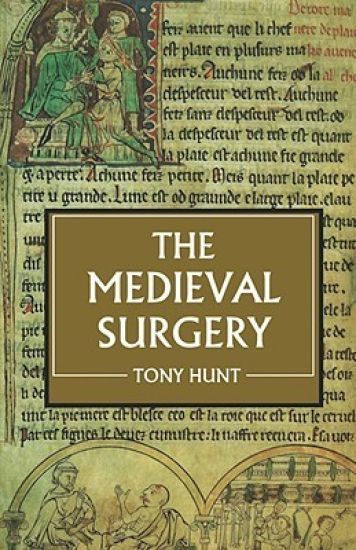
The complete illustrations, with commentary, from the 13th-century Anglo-Norman translations of Roger of Parma's Surgery(c.1180), the first original treatise on surgery to be written in the medieval West. Tony Hunt presents, for the first time, the complete set of illustrations which accompany a 13th-century Anglo-Norman translation of Roger of Parma's Surgery (c.1180), the first original treatise on surgery to be written inthe medieval West. His commentary relates the drawings precisely to the sections of text they illustrate, providing accurate identification of the different medical treatments depicted, fusing careful translation from the Latintext with modern medical perception. These distinctive drawings, almost without parallel in 13th-century England, show a consummate medical illustrator at work and reveal a great deal of information on the medieval pharmacy and the range of therapeutic treatments practised. TONY HUNT is the author of Popular Medicine, Plant Names of Medieval England and Teaching and Learning Latin in Thirteenth-Century England.
Plant Names of Medieval England

Plant Names of Medieval England

Tony Hunt

D.S. Brewer
1989
sidottu
` Compiled with great care, cautious in its claims and rich with suggestions for further scholarship; will be of great value to lexicographers and all students of medieval medicine and botany.' PAULINE THOMPSON, NOTES AND QUERIES `...compiled with great care, cautious in its claims and rich with suggestions for further scholarship...' NOTES AND QUERIES The first reference work on the botanical language of the English middle ages to appear inprint. Covering approximately 1800 names, applied to some six hundred species, and including over five hundred names not recorded in the OED, it is an indispensable reference work and a comprehensive guide to the bibliography of the subject. Lexicologistswill find a wealth of new material.
Popular Medicine in 13th-Century England
'Fills a big gap. It is concerned with recipe collections, perhaps the least studied of all medical documents, and includes - chants, charms and prayers, as well as herbal remedies for a variety of ailments.' 'Popular Medicinesucceeds in two ways: the quality of its philological scholarship confirms the growing academic respectability of an interest in medical history, and the abundance of primary material made available for the first time in print offers a way of reconciling opposing views on medieval English medicine. It forces medical historians to think hard about the diagnostic categories they use, and sanctions a pluralist approach to an equally diverse systemof medicine.' TIMES LITERARY SUPPLEMENT The first study of Anglo-Norman medical prescriptions to appear in print. Six major collections, comprising over 1000 receipts, are analysed and edited. A historical introduction provides the richest and most up-to-date account of popular medicine in the period 1100-1300 yet published. Full botanical glossaries are provided. TONY HUNTis a Fellow of St Peter's College, Oxford.
Teaching and Learning Latin in Thirteenth Century England, Volume One
First systematic study of the teaching aid which constituted the set-texts of Latin instruction in 13c England. Based on nearly two hundred manuscripts containing vernacular glosses, this is the first systematic study of the teaching aids which constituted the set-texts of Latin instruction in thirteenth-century England, some of which are printed here for the first time. These glosses provide the key to discovering the linguistic competence and interest of students at an elementary level: men and women who needed a working knowledge of Latin for practical purposes.The received view that Latin was the exclusive language of the schoolroom is shown to be mistaken and the exhaustive recording of the vernacular glosses provides a hitherto untapped source of lexical materials in French and Middle English.
Teaching and Learning Latin in Thirteenth Century England, Volume Two
Here at last is the first systematic study of the teaching and learning of Latin in thirteenth century England based on evidence from nearly 200 manuscripts where the text has been glossed in the vernacular. These glosses providethe key to discovering the linguistic competence and interest of students at an elementary level: men and women who needed a working knowledge of Latin for practical purposes. The received view that Latin was the exclusive language of the schoolroom is shown to be mistaken and the exhaustive recording of the vernacular glosses provides a hitherto untapped source of lexical materials in French and Middle English. Teaching and Learning Latin is destined to become an essential source-book for medievalists interested in language, literacy and culture.
Teaching and Learning Latin in Thirteenth Century England, Volume Three
Here at last is the first systematic study of the teaching and learning of Latin in thirteenth century England based on evidence from nearly 200 manuscripts where the text has been glossed in the vernacular. These glosses providethe key to discovering the linguistic competence and interest of students at an elementary level: men and women who needed a working knowledge of Latin for practical purposes. The received view that Latin was the exclusive language of the schoolroom is shown to be mistaken and the exhaustive recording of the vernacular glosses provides a hitherto untapped source of lexical materials in French and Middle English. An essential source-book for medievalists interested in language, literacy and culture.