Kirjojen hintavertailu. Mukana 11 244 527 kirjaa ja 12 kauppaa.

Kirjahaku

Etsi kirjoja tekijän nimen, kirjan nimen tai ISBN:n perusteella.

10 kirjaa tekijältä Tony Tanner

Jane Austen

Jane Austen

Tony Tanner

Red Globe Press
2007
sidottu
Tony Tanner's classic text on Jane Austen addresses the issues that have always occupied the author's most perceptive critics, and offers an illuminating and refreshing analysis of Austen's novels. Tanner shows how Austen changed from a basically accepting view of 'society' to a more questioning one and considers the problems of authority, power and the position of women, as well as the relationship between ethics, language and behaviour. This reissued edition features a new Preface by leading Romantic scholar Marilyn Gaull who examines Tanner's background and places the original work in context. Lively and informative, the Preface helps to reinforce and explain the continued importance of Tanner's work. Accompanied by an insightful Note on the Text by Austen scholar John Wiltshire, and an expanded Bibliography and Index, this is a timely republication of a study which is now regarded as one of the finest, and most accessible, introductions to a great novelist.
Thomas Pynchon

Thomas Pynchon

Tony Tanner

Routledge
2019
sidottu
Thomas Pynchon is now recognized as a major contemporary novelist and perhaps the most important American writer since Melville. His work is both richly imaginative and amazingly erudite and can be compared, in its complexity, linguistic playfulness and experimentation and wealth of allusion, to the work of James Joyce. Aspects of history, psychology, technology and science, cultural and political movements, problems of identity and society and the status and function of fiction and narrative in the modern world are all dramatized with extraordinary wit and power.Tony Tanner provides a brief, comprehensive introduction to his work. Against the background of Pynchon the man, this book, originally published in 1982, examines in detail his early short stories (some of which are not easily accessible) and offers a guide to the reading of his novels, V., The Crying of Lot 49 and Gravity’s Rainbow. Many of Pynchon’s recurrent themes, from entropy and information theory to his interest in the operations and divisions of power in the world since the Second World War, are considered. Finally, Tony Tanner places Pynchon and his work in a broader cultural and literary context.
Thomas Pynchon

Thomas Pynchon

Tony Tanner

Routledge
2021
nidottu
Thomas Pynchon is now recognized as a major contemporary novelist and perhaps the most important American writer since Melville. His work is both richly imaginative and amazingly erudite and can be compared, in its complexity, linguistic playfulness and experimentation and wealth of allusion, to the work of James Joyce. Aspects of history, psychology, technology and science, cultural and political movements, problems of identity and society and the status and function of fiction and narrative in the modern world are all dramatized with extraordinary wit and power.Tony Tanner provides a brief, comprehensive introduction to his work. Against the background of Pynchon the man, this book, originally published in 1982, examines in detail his early short stories (some of which are not easily accessible) and offers a guide to the reading of his novels, V., The Crying of Lot 49 and Gravity’s Rainbow. Many of Pynchon’s recurrent themes, from entropy and information theory to his interest in the operations and divisions of power in the world since the Second World War, are considered. Finally, Tony Tanner places Pynchon and his work in a broader cultural and literary context.
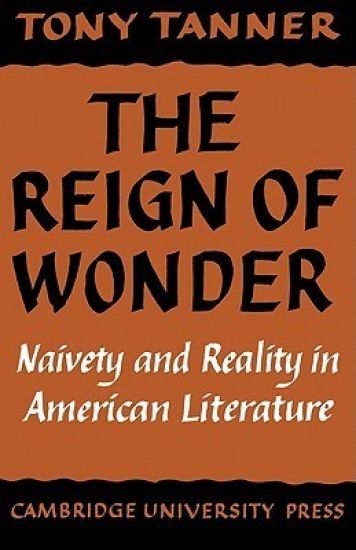
The Reign of Wonder

The Reign of Wonder

Tony Tanner

Cambridge University Press
1977
pokkari
The adopted attitude towards reality and experience in American literature tends to be one of wonder and cultivated naivety rather than analysis and judgement. In this book, Dr Tanner offers some reasons for this and seeks to demonstrate the peculiar importance of wonder in American literature, by examining a number of key writers and showing how they confronted and assimilated reality at the same time he considers some of the difficulties incurred by this approach and studies its effects on American style.
Scenes of Nature, Signs of Men

Scenes of Nature, Signs of Men

Tony Tanner

Cambridge University Press
1989
pokkari
This book is about the relationship of the American writer to his land and language - to the ‘scene’ and the ‘sign’, to the natural landscape and the inscriptions imposed upon it by men. Among the questions considered in the first section of the book are how does American Romantic writing differ from European; what are the peculiar problems faced by the American artist, and what roles does he adopt to tackle them; what kind of writing results when authors as different as Henry Adams and Mark Twain lament the vanishing of an earlier America, or when Adams and Henry James review their complex relationship to their homeland, or when W. D. Howells and Stephen Crane seek to define their themes in a specifically American setting. The second section of the book examines similar concerns in a number of contemporary writers, notably Thomas Pynchon, John Barth, Donald Barthelme, John DeLillo, and William Gass.
Henry James: Book. 1

Henry James: Book. 1

Tony Tanner

LIVERPOOL UNIVERSITY PRESS
1980
nidottu
A volume in the Writers and Their Work series, which draws upon recent thinking in English studies to introduce writers and their contexts. Each volume includes biographical material, an examination of recent criticism, a bibliography and a reappraisal of a major work by the writer.
Jane Austen

Jane Austen

Tony Tanner

HARVARD UNIVERSITY PRESS
1986
nidottu
Devoted fans and scholars of Jane Austen--as well as skeptics--will rejoice at Tony Tanner's superb book on the incomparable novelist. Distilling twenty years of thinking and writing about Austen, Tanner treats in fresh and illuminating ways the questions that have always occupied her most perceptive critics. How can we reconcile the limited social world of her novels with the largeness of her vision? How does she deal with depicting a once-stable society that was changing alarmingly during her lifetime? How does she express and control the sexuality and violence beneath the well-mannered surface of her milieu? How does she resolve the problems of communication among characters pinioned by social reticences? Tanner guides us through Austen's novels from relatively sunny early works to the darker, more pessimistic Persuasion and fragmentary Sanditon--a journey that takes her from acceptance of a society maintained by landed property, family, money, and strict propriety through an insistence on the need for authentication of these values to a final skepticism and even rejection. In showing her progress from a parochial optimism to an ability to encompass her whole society, Tanner renews our sense of Jane Austen as one of the great novelists, confirming both her local and abiding relevance.
Venice Desired

Venice Desired

Tony Tanner

HARVARD UNIVERSITY PRESS
1992
sidottu
If there is one city that might be said to embody both reason and desire, it would surely be Venice: a thousand-year triumph of rational legislation, aesthetic and sensual self-expression, and self-creation--powerful, lovely, serene. Unique in so many ways, Venice is also unique in its relation to writing. London has Dickens, Paris has Balzac, Saint Petersburg has Dostoevsky, Dublin has Joyce, but there is simply no comparable writer for, or out of, Venice. Venice effectively disappeared from history altogether in 1797 after its defeat by Napoleon. From then on, it seemed to exist as a curiously marooned spectacle. Literally marooned--the city mysteriously growing out of the sea, the beautiful stone impossibly floating on water--but temporally marooned as well, stagnating outside history. Yet as spectacle, as the beautiful city par excellence, the city of art, the city as art and as spectacular example, as the greatest and richest republic in the history of the world, now declined and fallen, Venice became an important site for the European imagination. Watery, dark, silent, a place of sensuality and secrecy; of masks and masquerading; of an always possibly treacherous beauty; of Desdemona and Iago, Shylock, Volpone; of conspiracy and courtesans in Otway; an obvious setting for many Gothic novels--Venice is not written from the inside but variously appropriated from without. Venice--the place, the name, the dream--seems to lend itself to a whole variety of appreciations, recuperations, and and hallucinations. In decay and decline, yet saturated with secret sexuality--suggesting a heady compound of death and desire--Venice becomes for many writers what is was for Byron: both "the greenest island of my imagination" and a "sea-sodom." It also, as this book tries to show, plays a crucial role in the development of modern writing. Tony Tanner skillfully lays before us the many ways in which this dreamlike city has been summoned up, depicted, dramatized--then rediscovered or transfigured in selected writings through the years.
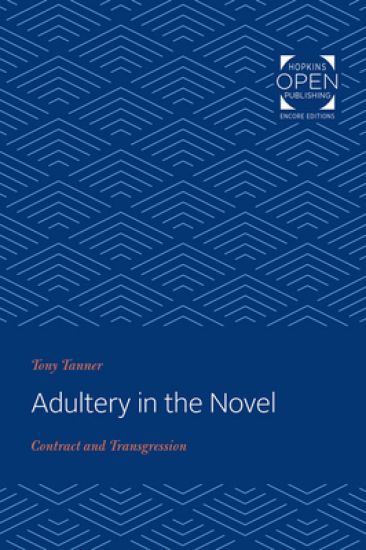
Adultery in the Novel

Adultery in the Novel

Tony Tanner

Johns Hopkins University Press
2020
pokkari
Originally published in 1979. Adultery is a dominant feature in chivalric literature; it becomes a major concern in Shakespeare's last plays; and it forms the central plot of novels from Anna Karenina to Couples. Tony Tanner proposes that transgressions of the marriage contract take on a special significance in the "bourgeois novels" of the eighteenth and nineteenth centuries. His interpretation begins with the general topic of adultery in literature and then zeroes in on three works—Rousseau's La Nouvelle Héloïse, Goethe's Die Wahlverwandtschaften, and Flaubert's Madame Bovary. His interpretation encompasses the role of women, the structure of the family, social mores, and the history of sexuality.