Kirjojen hintavertailu. Mukana 11 424 357 kirjaa ja 12 kauppaa.

Kirjahaku

Etsi kirjoja tekijän nimen, kirjan nimen tai ISBN:n perusteella.

3 kirjaa tekijältä Tora Lane

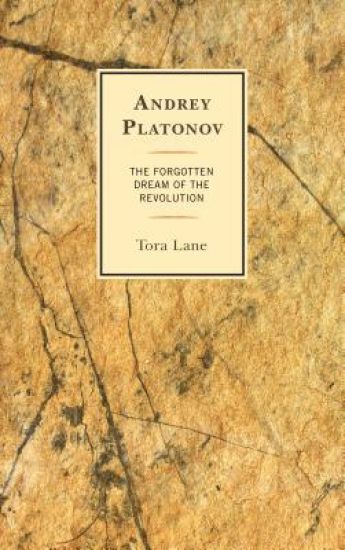
Andrey Platonov

Andrey Platonov

Tora Lane

Lexington Books
2018
sidottu
This book traces the originality of Andrey Platonov’s vision of the Revolution in readings of his works. It has been common in Platonov scholarship to measure him within the parameters of a political pro et contra the October Revolution and Soviet society, but the proposal of this book is to look for the way in which the writer continuously asked into the disastrous aspects of the implementation of a new proletarian community for what they could tell us about the promise of the Revolution to open up the experience of the world as common. In readings of selected works by Andrei Platonov I follow the development of his chronicle of revolutionary society, and from within it the outline of the forgotten utopian dream of a common world. I bring Platonov into a dialogue with certain questions that arise from the philosophy of Martin Heidegger and that were later re-addressed in the works of Maurice Blanchot, Georges Bataille and Jean-Luc Nancy, related to the experience of the modern world in terms of communality, groundlessness, memory, interiority. I show that Platonov writes the Revolution as an implementation of common being in society that needs to retrieve the forgotten memory of what being in common means.
Andrey Platonov

Andrey Platonov

Tora Lane

Lexington Books
2020
nidottu
This book traces the originality of Andrey Platonov’s vision of the Revolution in readings of his works. It has been common in Platonov scholarship to measure him within the parameters of a political pro et contra the October Revolution and Soviet society, but the proposal of this book is to look for the way in which the writer continuously asked into the disastrous aspects of the implementation of a new proletarian community for what they could tell us about the promise of the Revolution to open up the experience of the world as common. In readings of selected works by Andrei Platonov I follow the development of his chronicle of revolutionary society, and from within it the outline of the forgotten utopian dream of a common world. I bring Platonov into a dialogue with certain questions that arise from the philosophy of Martin Heidegger and that were later re-addressed in the works of Maurice Blanchot, Georges Bataille and Jean-Luc Nancy, related to the experience of the modern world in terms of communality, groundlessness, memory, interiority. I show that Platonov writes the Revolution as an implementation of common being in society that needs to retrieve the forgotten memory of what being in common means.
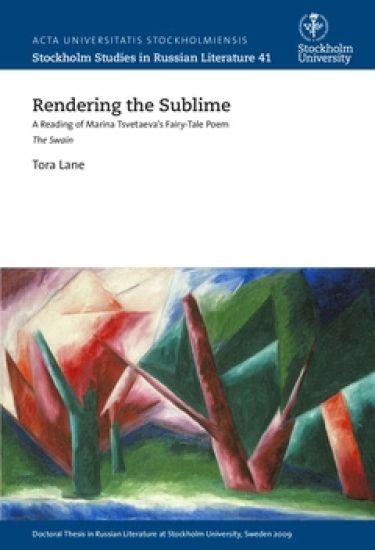
Rendering the sublime : a reading of Marina Tsvetaeva's fairy-tale poem The swain
The present study is a reading of the folkloric fairy-tale poem The Swain (Mólodets) (1924) by the Russian Modernist poet Marina Tsvetaeva (1892-1941). The poem represents a high point in Tsvetaeva's experiments with Russian folk art, and it is thoroughly folkloric in its theme, forms of writing and poetic language. At the same time, the poem can be linked to the attraction to folk art as a locus of the Sublime in literary tradition, which originates in German Romanticism, and finds its echoes in Russian Modernism. This study seeks to show that Tsvetaeva's exploration of folk art in the poem was inspired by a quandary linked to the Sublime; namely the paradoxical question how to present in art what is too great to be represented. The poem is read as an image and an illustration of the poet's understanding of the means of presenting the unrepresentable. Tsvetaeva renders the tale as an uncanny story about a horrifying elemental force. She seeks to avoid representation by bringing out the story in a poetic performance, which has the character of a lyrical drama, where the voices of the characters speak and sing in a direct manner. Within the canvas of the folkloric performance, the poet explores poetic language to render the Sublime. She experiments with secondary meanings in order to bring out a language, which at the same time is "secret" and "literal", and where the element can be made present in its sublimity.