Kirjojen hintavertailu. Mukana 11 244 527 kirjaa ja 12 kauppaa.

Kirjahaku

Etsi kirjoja tekijän nimen, kirjan nimen tai ISBN:n perusteella.

4 kirjaa tekijältä Tracy B. Strong

Politics without Vision

Politics without Vision

Tracy B. Strong

University of Chicago Press
2013
nidottu
From Plato through the nineteenth century, the West could draw on comprehensive political visions to guide government and society. Now, for the first time in more than two thousand years, Tracy B. Strong contends, we have lost our foundational supports. In the words of Hannah Arendt, the state of political thought in the twentieth and twenty-first centuries has left us effectively "thinking without a banister." Politics without Vision takes up the thought of seven influential thinkers, each of whom attempted to construct a political solution to this problem. Nietzsche, Weber, Freud, Lenin, Schmitt, Heidegger, and Arendt. None of these theorists were liberals nor, excepting possibly Arendt, were they democrats - and some might even be said to have served as handmaidens to totalitarianism. And all to a greater or lesser extent shared the common conviction that the practices of liberalism are inadequate to the demands and stresses of the present time. In examining their thought, Strong acknowledges the political evil that some of their ideas served to foster but argues that these were not the only paths their explorations could have taken. By uncovering the turning points in their thought - and the paths not taken - Strong strives to develop a political theory that can avoid, and perhaps help explain, the mistakes of the past while furthering the democratic impulse.
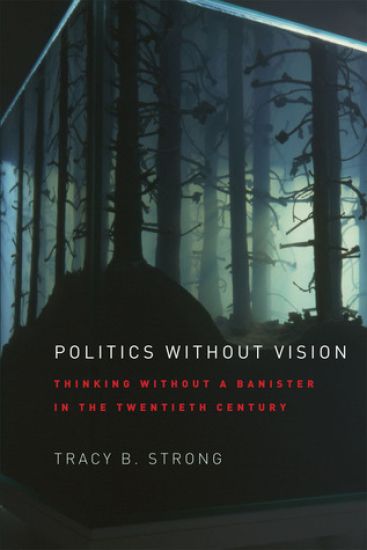
Politics without Vision

Politics without Vision

Tracy B. Strong

University of Chicago Press
2012
sidottu
From Plato through the nineteenth century, the West could draw on comprehensive political visions to guide government and society. Now, for the first time in more than two thousand years, Tracy B. Strong contends, we have lost our foundational supports. In the words of Hannah Arendt, the state of political thought in the twentieth and twenty-first centuries has left us effectively "thinking without a banister." "Politics without Vision" takes up the work of seven influential thinkers, each of whom attempted to construct a political solution to this problem: Nietzsche, Weber, Freud, Lenin, Schmitt, Heidegger, and Arendt. None of these theorists were liberals nor, excepting possibly Arendt, were they democrats-and some might even be said to have served as handmaidens to totalitarianism. And all to a greater or lesser extent shared the common conviction that the institutions and practices of liberalism are inadequate to the demands and stresses of the present time. In examining their thought, Strong acknowledges the political evil that some of their ideas served to foster but argues that these were not necessarily the only paths their explorations could have taken. By uncovering the turning points in their thought - and the paths not taken - Strong strives to develop a political theory that can avoid, and perhaps help explain, the mistakes of the past while furthering the democratic impulse. Confronting the widespread belief that political thought is on the decline, Strong puts forth a brilliant and provocative counterargument that in fact it has endured - without the benefit of outside support. A compelling rendering of contemporary political theory, "Politics without Vision" is sure to provoke discussion among scholars in many fields.

Friedrich Nietzsche and the Politics of Transfiguration (expanded ed.)
Friedrich Nietzsche and the Politics of Transfiguration provides a comprehensive analysis of the politics that are implicit and explicit in Nietzsche's work. Tracy B. Strong's discussion shows that Nietzsche's writings are of a piece and have as their common goal a politics of transfiguration: a politics that seeks radical change in how human beings live and act in the modern Western world. This edition includes a new introduction that demonstrates how the styles of Nietzsche's writings expand our notions of democratic politics and democratic understanding.
Jean-Jacques Rousseau

Jean-Jacques Rousseau

Tracy B. Strong

Rowman Littlefield Publishers
2002
nidottu
Rousseau is most often read either as a theorist of individual authenticity or as a communitarian. In this book, he is neither. Instead, Rousseau is understood as a theorist of the common person. In Strong's understanding, Rousseau's use of 'common' always refers both to that which is common and to that which is ordinary, vulgar, everyday. For Strong, Rousseau resonates with Kant, Hegel, and Marx, but he is more modern like Emerson, Nietzsche, Eittegenstein, and Heidegger. Rousseau's democratic individual is an ordinary self, paradoxically multiple and not singular. In the course of exploring this contention, Strong examines Rousseau's fear of authorship (though not of authority), his understanding of the human, his attempt to overcome the scandal that relativism posed for politics, and the political importance of sexuality.