Kirjojen hintavertailu. Mukana 11 420 364 kirjaa ja 12 kauppaa.

Kirjahaku

Etsi kirjoja tekijän nimen, kirjan nimen tai ISBN:n perusteella.

23 kirjaa tekijältä Ulrich de Balbian

Consciousness because Embodied Beings

Consciousness because Embodied Beings

Ulrich de Balbian

Independently Published
2019
pokkari
Working towards a multi-dimensional, many-leveled model of at least some of the many meanings, functions, nature, aims and purposes of the misleading, everyday, common sense umbrella notion of consciousness. Often misleading employed as if they are technical terms devised by scientific disciplines. All sorts of neologisms, irrelevant speculations and fake problems result from this misuse, abuse, overuse and technical usage of this and related notions such as mind. Notions that are employed as if they refer to one thing or phenomenon and invisible organs and operations.
(Meta) Philosophy and I

(Meta) Philosophy and I

Ulrich de Balbian

Createspace Independent Publishing Platform
2018
nidottu
Many themes and topics, both immanent as well as non- immanent, concerning philosophy and meta-philosophy are dealt with. Many of these take the form of my answers to questions addressed at me. Some of the topics and themes that are dealt with are - Self-reference and Self-application Immanence and non-immanence Disagreement and diversity Primacy of the practical Philosophy good and bad Philosophy and expertise Ends of philosophy Death of philosophy Anti-philosophies Philosophy and assertion Philosophy and exposition Philosophy and style
Embodied Consciousness: we dont know how to think with or about these notions

Embodied Consciousness: we dont know how to think with or about these notions

Ulrich de Balbian

Createspace Independent Publishing Platform
2018
nidottu
Mind, Consciousness and Body We do not know how to think with or about these notions and others such as reality, perception, space, time, etc...In the following I will deal with the umbrella notions of mind, consciousness and body. The contents is relevant, but of greater importance is the manner or method in which I deal with these notions. I first present as an illustration of my approach or method, how I have dealt with the notions of intuition and intuiting. One of the points I am trying to make is that: we do not know how to think about many things, for example mind, consciousness, awareness, body, intuition, etc. Therefore, I attempt to explore a number of things that we must investigate and deal with before we use these and other notions, as if they are clearly defined terms, before we try to use them to think and to think about anything, especially many levelled and multi- dimensional issues and problems such as the workings of 'the mind, the body, intuition, consciousness and the relationship, if there are any, between these and other things. Then I suggest the initial steps for a few very basic requirements before the exploration of a theory of embodied, living, conscious tissues and a model for embodied (self-) consciousness research.
Absolute Determinism and lack of Free Will: (free choice, law nf God)

Absolute Determinism and lack of Free Will: (free choice, law nf God)

Ulrich de Balbian

Createspace Independent Publishing Platform
2018
nidottu
Determinism from the 1st and 3rd person perspective as well as the universal point of reference aee dealt with. This is to show the absence of free will in the last perspective and the illusion of it when seen from the first two perspectives. 'Free' choice is dealt with as well as the absence of free will and the consequences of determinism for law and court judgements are explored. So, what if any, is the place and the role of God in all this? Did s/he create determinism and the potential for or any semblance of choice and free will? Or is the existence of God, the fulfilling of prayer intentions and miracles impossible and redundant in a universe of determinism (laws of nature etc) or universal determinism?
(Meta-Philosophy) All-inclusive Theory

(Meta-Philosophy) All-inclusive Theory

Ulrich de Balbian

Createspace Independent Publishing Platform
2018
nidottu
I explore the frame of reference of the multiverse and the universe as point of reference for the meta-philosophical reflection on philosophy and the doing of philosophy. Some of the many topics being dealt with in this frame of reference and from this perspective of the bigger picture are - Determinism, The absence of Free Will, Consequences of this for Law, God and determinism, Embodied Consciousness and Conscious Embodiment, Radical Scepticism, Nihilism, Libertarianism, minarchism and anarchism, Amoralism, Intersubjectivity, Mysticism and the Unity Experience, Theorizing, Philosophizing as part of the processes of theorizing, Contexts, many levels and multi-dimensionality, The Institutionalization of philosophy, The professionalization of philosophy, Philosophy as realization of wisdom, Knowing that, facts, factual information, knowing how, insights and understanding, Art and music as making the invisible visible without the use of words...
What we can and may know (of): Meta-Philosophy

What we can and may know (of): Meta-Philosophy

Ulrich de Balbian

Createspace Independent Publishing Platform
2018
nidottu
As long as I can remember I was told that I never stop asking question. All sorts of questions, about facts, why, wherefores, reasons etc. I suppose one function of questioning and questioning questioning is to attempt to assimilate constitutions of reality b oneself and others, aspects of those reality constitutions, assumptions underlying them, the functions of those things and the nature, values, norms, methods, tools, purposes and aims of the specialized intersubjectivities being employed to enable such socio-cultural constitutions. Questioning forms part of the multi-dimensional and many- levelled processes of theorizing, of which philosophizing is one stage or aspect. It also enables one to explore the lay of the conceptual landscape and devise, modify, develop and transform oneself, others, social and cultural practices and the intersubjectivities being employed by them. Questions have different function and are of different types. Depending on the context the most meaningful and appropriate question need to be asked. It took my years to develop this so-called Socratic skill to naturally and automatically respond in any situation with the most appropriate and relevant question. An example of this are the relevant and appropriate questions to be asked in different domains and contexts of the visual arts, especially painting (not all questions in words or verbally, but visually as well), musically-relevant questions, questions concerning spirituality, theology, different scientific disciplines, social. Psychological and cognitive sciences, etc. And, of course, first order philosophical questions as well as second-order or meta-philosophy questions and the identification of relevant meta-philosophy themes.
Theorizing - a mystical approach

Theorizing - a mystical approach

Ulrich de Balbian

Createspace Independent Publishing Platform
2018
nidottu
Names and links to other texts can be found in this research by myself - (apparently the first video link in that text no longer works) - https: //www.academia.edu/30704161/NON-PHILOSOPHY_OF_THE_ONE_Turning_away_from_Philosophy_of_Being This work consists of short summaries of the mystical ideas and visions of a number of well known mystics. The theme of the work concerns the so-called 'unity experience' of these mystics. The unity or oneness or the realization of 'being oned' with, can be referred to the beatific vision. In the case of Christian mystics it is unity experience of The Gottheit (or Godhead) of Meister Eckhart, in Sufism it is being united with The Beloved, in Buddhism it could be said to realize The Buddha mind or Cosmic Buddha's consciousness and in Vedanta, the realization of The One Real Self, non-dualism, non-religious non-duality and to be more and only in the 'present now' moment with a type of depth psychology and introspection and a kind of 'the brain watching the brain', physicalist, neuro-scientific approach. What is absent from mystical studies and required is a multi-disciplinary neurosciences approach, as well as detailed, micro research by different disciplines.
Making Philosophically Relevant Ideas

Making Philosophically Relevant Ideas

Ulrich de Balbian

Independently Published
2018
pokkari
How does anything become philosophy? How does anything become philosophically relevant? What is it that makes something, any thing, philosophically relevant? What are the ingredients or components of something philosophical? What must such a thing contain so as to be philosophically relevant?How can one make anything of relevance to thed discourse of philosophy?What is it that makes anything and/or thought or idea aof and about anything philosophical. and of philosophical relevance?What is the nature, the characteristics and components of the methods, the techniques, approach, questions, etc that enable soemthing to be made philosophy, andphilosophically relevant?
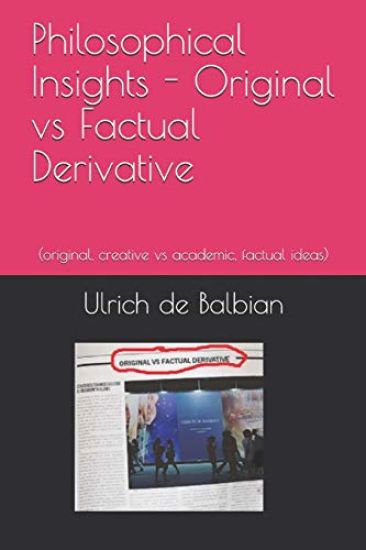
Philosophical Insights Original vs Factual Derivative

Philosophical Insights Original vs Factual Derivative

Ulrich de Balbian

Independently Published
2018
pokkari
It will be noticed that original- and creative-thinkers in the socio-cultural practice of philosophy present us with their own, new and original ideas and patterns, sets or models of such ideas.In the case of original/creative-thinkers these things will be 'intuitive' or 'devised' by the the individual himself while in the case of lesser original- and creative-thinkers these things (ideas, insights, tools, techniques, the ways they are arrived at or being constituted, employed to devise or express sets of new ideas or insights or models) will be obtained from the ideas, insights, statements, hypotheses and theories of other thinkers. The latter employs insights and ideas of others as 'facts or factual ideas' as 'truths' so as to argue for, establish, validate and legitimize their own derivative ideas resembling a kind of empirical research and the presentation of data in lectures and conferences and it is far removed from the approach of original thinkers.
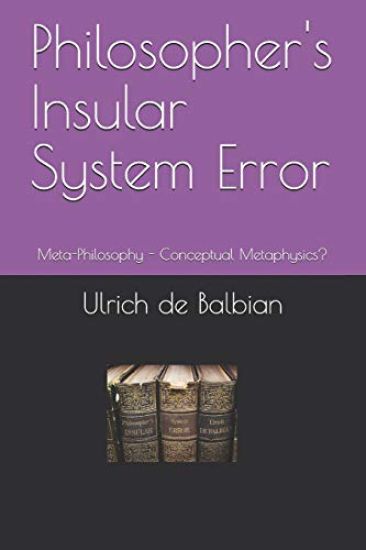
Philosopher's Insular System Error: Meta-Philosophy - Conceptual Metaphysics?
It seems as if those who construct all-inclusive, insular philosophical systems attempt to control others like individuals who create chaos in different ways try to manipulate and control people.Do those players have other intentions, motives, objectives and aims (for example purist philosophical aspirations to devise the final, absolute all-explanatory philosophical, metaphysical and ontological system by means of immaculate methods, logical, sound reasoning and valid arguments and argumentation) as well, apart from the need to manipulate, and be the master of others and their control goals?What, if any, is the intended relationship of such insular systems with 'the real world', the universe or multiverse, the Kantian 'reality-in-itself', the life-worlds of cultures, sub-cultures, societies, communities, individuals, other socio-cultural practices, discourses and disciplines?How are such insular philosophical systems meant to fit, relate to, mirror, express, reveal, explain, conceptualize reality, other realities, life worlds, the multiverse? Are they accompanied by or do they come with codes or rules, systems or models of transformation, interpretation and application to be related to 'the real world', other theories, systems and models of the universe, reality and life-worlds?
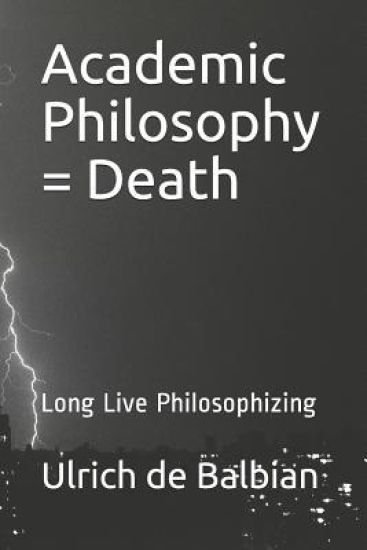
Academic Philosophy = Death: Long Live Philosophizing

Academic Philosophy = Death: Long Live Philosophizing

Ulrich de Balbian

Independently Published
2019
nidottu
Philosophy is the making of theories, badly or occasionally better, with sets of concepts.It resembles fiction, poetry and literature and theology in certain ways in so far as the author uses his imagination and intuition to produce a set of ideas that may or may not attempt to refer to and/or represent or reflect and create a certain reality or life-world.It differs from fiction and is relatively unique in so far as it employs reasoning, argumentation and other philosophical tools.It seems as if philosophy is self-incestuous (verbal masturbation), conceptual games with and about concepts using propositions, reasoning and argumentation to make assertions about other concepts (as if the lion is trying to speak, attempting to convey to us what he thinks and how he experiences his life-world), and thereby produce insular, enclosed, self-referential, circular systems of ideas.
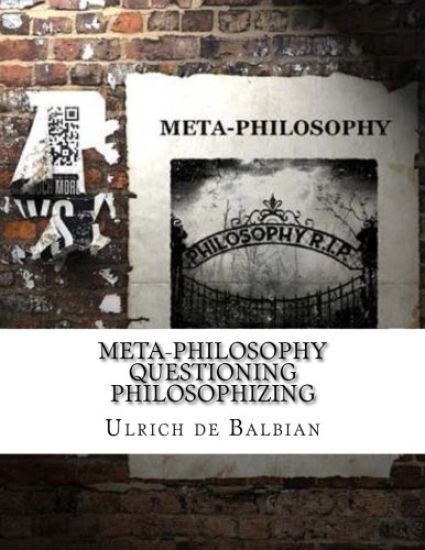
Meta-Philosophy questioning Philosophizing

Meta-Philosophy questioning Philosophizing

Ulrich de Balbian

Createspace Independent Publishing Platform
2018
nidottu
Traditional philosophy is no longer viable,‭ ‬relevant and acceptable.‭ ‬It might be possible to continue doing philosophizing in traditional ways.‭ ‬It is possible to continue fabricating fictional realities in the manner of the Pre-Socratics,‭ ‬Spinoza,‭ ‬Leibniz,‭ ‬Husserl,‭ ‬Hegel,‭ ‬Plato,‭ ‬et al.‭ ‬It is possible to devise pictures of realities and depictions of‭ ‬human consciousness and cognition like Descartes or in the Kantian manner. One of the major issues with traditional philosophy is its lack of self-awareness,‭ ‬the absence of meta-cognition.‭ ‬This lack of meta-cognition of traditional philosophers leads to the creation of all sorts of questionable phenomena and fake problems. Traditional philosophy,‭ ‬metaphysics,‭ ‬ontology,‭ ‬epistemology,‭ ‬ethics,‭ ‬philosophy of sciences,‭ ‬religion,‭ ‬arts,‭ ‬etc are little more than the possibilities,‭ ‬limits and restrictions enabled and allowed by the philosopher's methodology,‭ ‬techniques and tools.‭ It is most likely possible to envisage a project to devise a collection or synthesis of‭ ‬many alternative realities by means of the insights and theories of theoretical physics,‭ ‬mathematics,‭ ‬bio-chemistry,‭ ‬biology and other sciences,‭ ‬the depictions produced by the arts and pictures of realities presented by the humanities.‭ ‬If such a system of pictures of reality is philosophically relevant and meaningful is however another matter. The original,‭ ‬creative thinking philosopher constitutes alternative or new realities by his philosophizing.‭ ‬This philosophizing employs and resembles aspects and stages of the processes of theorizing. The real goal of philosophizing is to increase ever greater wisdom.‭ ‬Not merely wisdom in an abstract sense,‭ ‬but different kinds of practical and applied wisdom in all areas of human,‭ ‬everyday existence.‭ ‬In other words,‭ ‬like spirituality and mysticism philosophizing attempts to embody or incarnate wisdom.‭ ‬While mysticism or the mystical paths and aspects of religions aspire to unity experience,‭ ‬to become one with THE ONE,‭ ‬to become the ONE,‭ ‬REAL SELF,‭ ‬to realize the Buddha mind or to be united or‭ '‬married‭' ‬to the Beloved of Sufism.
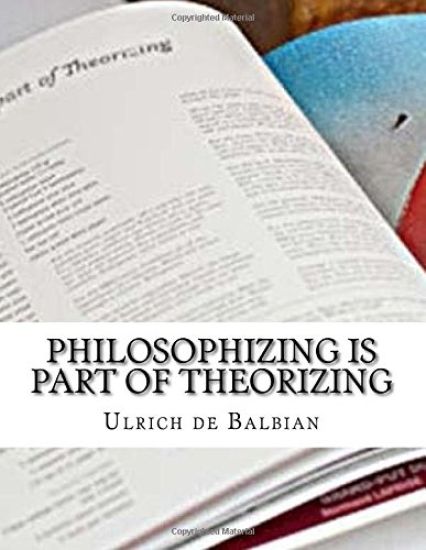
Philosophizing is part of Theorizing

Philosophizing is part of Theorizing

Ulrich de Balbian

Createspace Independent Publishing Platform
2018
nidottu
Philosophizing is part of the Process/es of TheorizingAbstract An illustration (by means of a number of articles, books, opinions, statements, hypotheses, theories, arguments, reasoning and comments) of doing philosophy or philosophizing and its methods, as aspects of the contexts, stages, steps and features of the process/es of theorizing. The methods and techniques of philosophizing is explored and the nature and purpose of theories are shown. It is indicated that and how the approaches and aims philosophizing form part of the stages and processes of theorizing. A number of implicit assumptions and tacit pre-suppositions of this socio-cultural practice and discourse, for example as they resemble that of everyday and religious perception (MNC, maturationally natural& perception, cognition, and action), are identified and revealed.
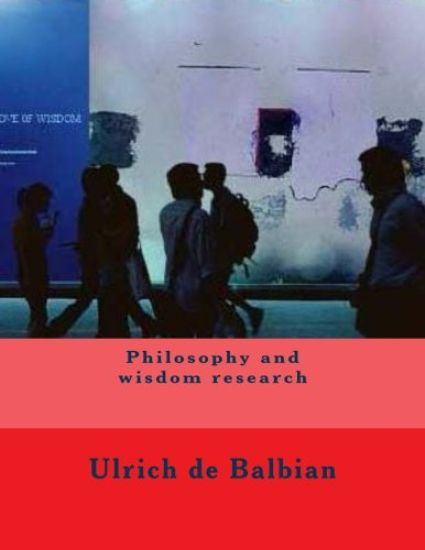
Philosophy and wisdom research

Philosophy and wisdom research

Ulrich de Balbian

Createspace Independent Publishing Platform
2018
pokkari
A conceptual exploration of the umbrella notion Wisdom, as well as dimensions, characteristics and components of the idea of wisdom as suggested by experimental philosophy, neurosciences and other studies and a comparison of the notion of wisdom with those of knowledge, truth, insight and understanding and in different cultures and periods.Contemporary research and discussions of wisdom on a wisdom list by researchers.Keywords: philosophy, knowledge, wisdom, truth, Gettier problem, insights, truth, understanding, knowledge, Experimental philosophy, neuroscience of wisdom
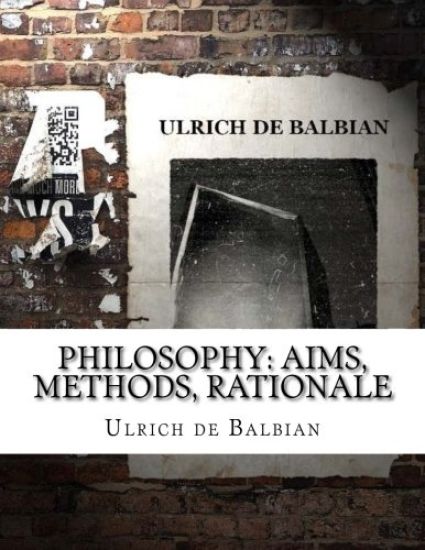
Philosophy: Aims, Methods, Rationale

Philosophy: Aims, Methods, Rationale

Ulrich de Balbian

Createspace Independent Publishing Platform
2018
nidottu
In this meta-philosophical study I commence with an investigation of Wisdom. I then continue with ane xploration of the institutionalization of the subject and the professionalization of those involved in it. Thien I show that philosophizing resembles and attempts to do theorizing. The 9 questions, etc of the Socratic Method and details of the Philosophical Toolkit occur throughout different stages of theorizing as one level and one dimension of it. Traditional philosophy is no longer viable, relevant and acceptable. It might be possible to continue doing philosophizing in traditional ways. It is possible to continue fabricating fictional realities in the manner of the Pre-Socratics, Spinoza, Leibniz, Husserl, Hegel, Plato, et al. It is possible to devise pictures of realities and depictions of human consciousness and cognition like Descartes or in the Kantian manner. One of the major issues with traditional philosophy is its lack of self-awareness, the absence of meta-cognition. This lack of meta-cognition of traditional philosophers leads to the creation of all sorts of questionable phenomena and fake problems. Traditional philosophy, metaphysics, ontology, epistemology, ethics, philosophy of sciences, religion, arts, etc are little more than the possibilities, limits and restrictions enabled and allowed by the philosopher's methodology, techniques and tools. It is most likely possible to envisage a project to devise a collection or synthesis of many alternative realities by means of the insights and theories of theoretical physics, mathematics, bio-chemistry, biology and other sciences, the depictions produced by the arts and pictures of realities presented by the humanities. If such a system of pictures of reality is philosophically relevant and meaningful is however another matter. It is possible to continue fabricating fictional realities in the manner of the Pre-Socratics, Spinoza, Leibniz, Husserl, Hegel, Plato, et al. It is possible to devise pictures of realities and depictions of human consciousness and cognition like Descartes or in the Kantian manner.
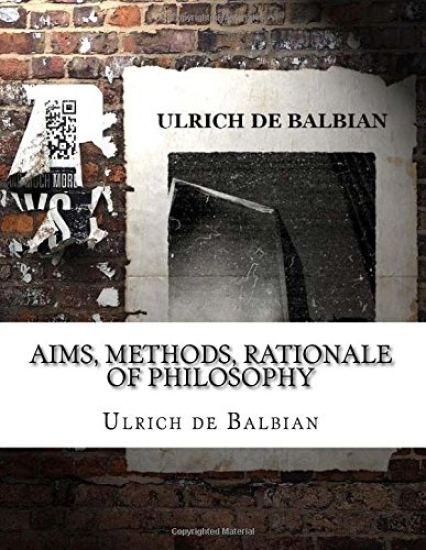
Aims, Methods, Rationale of Philosophy

Aims, Methods, Rationale of Philosophy

Ulrich de Balbian

Createspace Independent Publishing Platform
2018
nidottu
In this meta-philosophical study I commence with an investigation of Wisdom. I then continue with an exploration of the institutionalization of the subject and the professionalization of those involved in it. This I contrast with original and creative philosophizing. I then show that philosophizing resembles and attempts to do theorizing. The 9 questions, etc of the Socratic Method and details of the Philosophical Toolkit occur throughout different stages of theorizing as one level and one dimension of it. Traditional philosophy is no longer viable, relevant and acceptable. It might be possible to continue doing philosophizing in traditional ways. It is possible to continue fabricating fictional realities in the manner of the Pre-Socratics, Spinoza, Leibniz, Husserl, Hegel, Plato, et al. It is possible to devise pictures of realities and depictions of human consciousness and cognition like Descartes or in the Kantian manner. One of the major issues with traditional philosophy is its lack of self-awareness, the absence of meta-cognition. This lack of meta-cognition of traditional philosophers leads to the creation of all sorts of questionable phenomena and fake problems. Traditional philosophy, metaphysics, ontology, epistemology, ethics, philosophy of sciences, religion, arts, etc are little more than the possibilities, limits and restrictions enabled and allowed by the philosopher's methodology, techniques and tools.It is most likely possible to envisage a project to devise a collection or synthesis of many alternative realities by means of the insights and theories of theoretical physics, mathematics, bio-chemistry, biology and other sciences, the depictions produced by the arts and pictures of realities presented by the humanities. If such a system of pictures of reality is philosophically relevant and meaningful is however another matter.