Kirjojen hintavertailu. Mukana 11 699 587 kirjaa ja 12 kauppaa.

Kirjahaku

Etsi kirjoja tekijän nimen, kirjan nimen tai ISBN:n perusteella.

3 kirjaa tekijältä Ulrika Martensson

Rule of Law, ‘Natural Law’, and Social Contract in the Early ‘Abbasid Caliphate
The book analyses all extant works by Ibn Jarir al-Tabari (d. 224/839–310/923), referring to their individual methodologies; their legacy as al- madhhab al-jariri; and their scholarly and socio- political context. Through the study of al- Tabari’s works, the book addresses research debates over dating the legal and scholarly institutions and their disciplines; authorship and transmission of scholarly writings; political theory and administration; and ‘origins’ of the Qur’an and Islam. Al-Tabari defined the Qur’an in linguistic and legal terms. The linguistic terms refer to rhetoric and semiotics, and the legal to theories of social contract, ‘natural law’, and rule of law. Both sets of terms go into al-Tabari’s theory of prophecy and administration, including of ‘minorities’. By engaging current debates about the usefulness or not of the medieval Muslim scholars in research on the Qur’an and early Islam, this book argues that the – 2 – 20:59 contribution of each medieval scholar be assessed on an individual basis. Al-Tabari’s philosophical, ethical, historical, linguistic, and legal education produced analysis of the Qur’an and ‘origins’ of Islam that stands up to some fronts in contemporary research. The book thus adds to research on al-Tabari; early Islamic disciplines and institutions; and the Qur’an and early Islam.
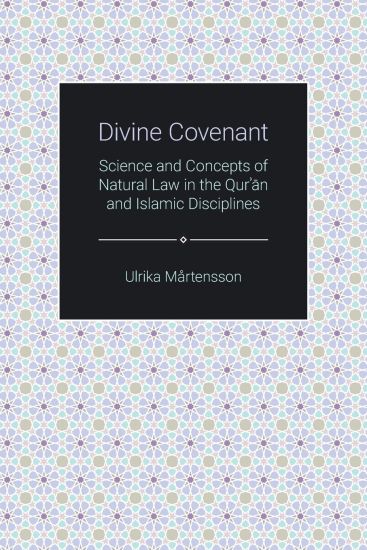
Divine Covenant

Divine Covenant

Ulrika Martensson

Equinox Publishing Ltd
2022
sidottu
Divine Covenant explores the Qur’anic concept of divine knowledge through scientific, theoretical paradigms – in particular natural law theory – and their relationship with seven Islamic scholarly disciplines: linguistics, hadith, politics, history, exegesis, jurisprudence, theology. By comparing scholarship within these disciplines with current state-of-the-art, the study shows how the Qur’anic concept of divine Covenant reflects natural law theory, relates to a range of other legal, political, and linguistic Qur’anic concepts, informs the canon’s entire literary structure, and has implications for a new, legal theory of ‘Islamic origins’. The book makes the case that the Islamic disciplines share political economy, institutional framework, and decisive theoretical topics with the Qur’an. The latter include the natural law-related issues of human rights, constitutional separation of powers, and social contract. The book surveys the scholarly deliberations of these topics within the parameters of each discipline and in changing contexts. In addition, consequences of the modern nation-state institutional order for early modern and contemporary Qur’anic studies are mapped. It is argued that the early and medieval Islamic disciplines offer scientifically valuable knowledge because they refer to the same institutional framework as the Qur’an. The disciplines are also important parts of European political history, where they have inspired social contract theory inclusive of diverse religious identities.
Divine Covenant

Divine Covenant

Ulrika Martensson

Equinox Publishing Ltd
2022
pokkari
Divine Covenant explores the Qur’anic concept of divine knowledge through scientific, theoretical paradigms – in particular natural law theory – and their relationship with seven Islamic scholarly disciplines: linguistics, hadith, politics, history, exegesis, jurisprudence, theology. By comparing scholarship within these disciplines with current state-of-the-art, the study shows how the Qur’anic concept of divine Covenant reflects natural law theory, relates to a range of other legal, political, and linguistic Qur’anic concepts, informs the canon’s entire literary structure, and has implications for a new, legal theory of ‘Islamic origins’. The book makes the case that the Islamic disciplines share political economy, institutional framework, and decisive theoretical topics with the Qur’an. The latter include the natural law-related issues of human rights, constitutional separation of powers, and social contract. The book surveys the scholarly deliberations of these topics within the parameters of each discipline and in changing contexts. In addition, consequences of the modern nation-state institutional order for early modern and contemporary Qur’anic studies are mapped. It is argued that the early and medieval Islamic disciplines offer scientifically valuable knowledge because they refer to the same institutional framework as the Qur’an. The disciplines are also important parts of European political history, where they have inspired social contract theory inclusive of diverse religious identities.