Kirjojen hintavertailu. Mukana 12 390 323 kirjaa ja 12 kauppaa.

Kirjahaku

Etsi kirjoja tekijän nimen, kirjan nimen tai ISBN:n perusteella.

8 kirjaa tekijältä Uwe Hassler

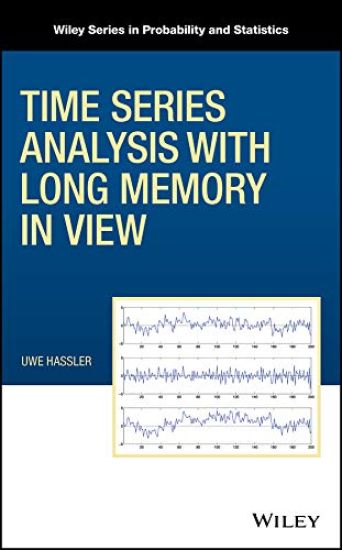
Time Series Analysis with Long Memory in View
Provides a simple exposition of the basic time series material, and insights into underlying technical aspects and methods of proof Long memory time series are characterized by a strong dependence between distant events. This book introduces readers to the theory and foundations of univariate time series analysis with a focus on long memory and fractional integration, which are embedded into the general framework. It presents the general theory of time series, including some issues that are not treated in other books on time series, such as ergodicity, persistence versus memory, asymptotic properties of the periodogram, and Whittle estimation. Further chapters address the general functional central limit theory, parametric and semiparametric estimation of the long memory parameter, and locally optimal tests. Intuitive and easy to read, Time Series Analysis with Long Memory in View offers chapters that cover: Stationary Processes; Moving Averages and Linear Processes; Frequency Domain Analysis; Differencing and Integration; Fractionally Integrated Processes; Sample Means; Parametric Estimators; Semiparametric Estimators; and Testing. It also discusses further topics. This book: Offers beginning-of-chapter examples as well as end-of-chapter technical arguments and proofsContains many new results on long memory processes which have not appeared in previous and existing textbooksTakes a basic mathematics (Calculus) approach to the topic of time series analysis with long memoryContains 25 illustrative figures as well as lists of notations and acronyms Time Series Analysis with Long Memory in View is an ideal text for first year PhD students, researchers, and practitioners in statistics, econometrics, and any application area that uses time series over a long period. It would also benefit researchers, undergraduates, and practitioners in those areas who require a rigorous introduction to time series analysis.
Stochastic Processes and Calculus

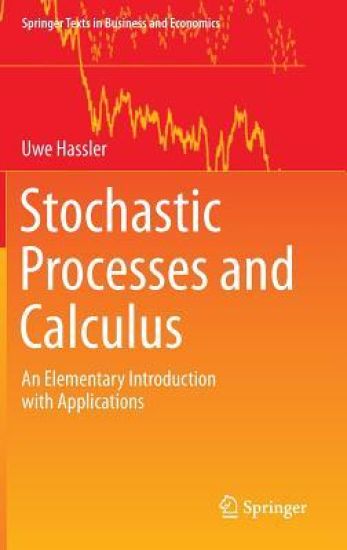
Stochastic Processes and Calculus

Uwe Hassler

Springer International Publishing AG
2015
sidottu
This textbook gives a comprehensive introduction to stochastic processes and calculus in the fields of finance and economics, more specifically mathematical finance and time series econometrics. Over the past decades stochastic calculus and processes have gained great importance, because they play a decisive role in the modeling of financial markets and as a basis for modern time series econometrics. Mathematical theory is applied to solve stochastic differential equations and to derive limiting results for statistical inference on nonstationary processes.This introduction is elementary and rigorous at the same time. On the one hand it gives a basic and illustrative presentation of the relevant topics without using many technical derivations. On the other hand many of the procedures are presented at a technically advanced level: for a thorough understanding, they are to be proven. In order to meet both requirements jointly, the present book is equipped with a lot of challenging problems at the end of each chapter as well as with the corresponding detailed solutions. Thus the virtual text - augmented with more than 60 basic examples and 40 illustrative figures - is rather easy to read while a part of the technical arguments is transferred to the exercise problems and their solutions.
Stochastic Processes and Calculus

Stochastic Processes and Calculus

Uwe Hassler

Springer International Publishing AG
2019
nidottu
This textbook gives a comprehensive introduction to stochastic processes and calculus in the fields of finance and economics, more specifically mathematical finance and time series econometrics. Over the past decades stochastic calculus and processes have gained great importance, because they play a decisive role in the modeling of financial markets and as a basis for modern time series econometrics. Mathematical theory is applied to solve stochastic differential equations and to derive limiting results for statistical inference on nonstationary processes.This introduction is elementary and rigorous at the same time. On the one hand it gives a basic and illustrative presentation of the relevant topics without using many technical derivations. On the other hand many of the procedures are presented at a technically advanced level: for a thorough understanding, they are to be proven. In order to meet both requirements jointly, the present book is equipped with a lot of challenging problems at the end of each chapter as well as with the corresponding detailed solutions. Thus the virtual text - augmented with more than 60 basic examples and 40 illustrative figures - is rather easy to read while a part of the technical arguments is transferred to the exercise problems and their solutions.
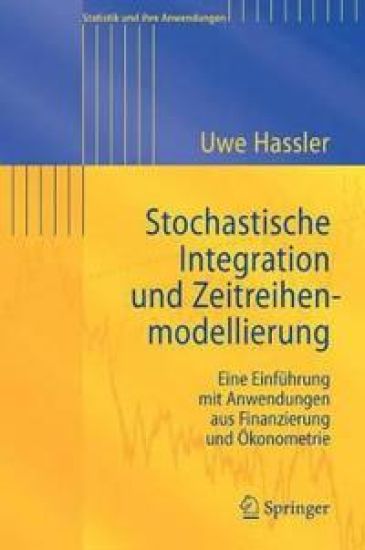
Stochastische Integration und Zeitreihenmodellierung

Stochastische Integration und Zeitreihenmodellierung

Uwe Hassler

Springer-Verlag Berlin and Heidelberg GmbH Co. K
2007
nidottu
Stochastische Integralrechnung und Zeitreihenmodellierung haben in den letzten Jahren große Bedeutung in der Wirtschaftswissenschaft erlangt. Zum einen spielen sie eine entscheidende Rolle bei der Modellierung von Finanzmärkten (Lösen stochastischer Differentialgleichungen), zum anderen basiert fast die gesamte statistische Inferenz instationärer Zeitreihen darauf (Kointegration). Der Leser erhält hier eine Einführung mit Hinblick auf beide Gebiete und lernt so die modernen Methoden der mathematischen Finanzierungstheorie sowie der Zeitreihenökonometrie kennen. Die Einführung ist elementar und rigoros zugleich. Der eigentliche Text enthält kaum mathematische Ableitungen, sondern stellt die Konzepte und Techniken eher anschaulich vor, illustriert anhand von Beispielen. Am Ende jeden Kapitels aber finden sich insgesamt über 100 Probleme und Übungsaufgaben samt kompletter Lösung, welche technische Details und Beweise enthalten und so ein hohes formales Niveau garantieren.
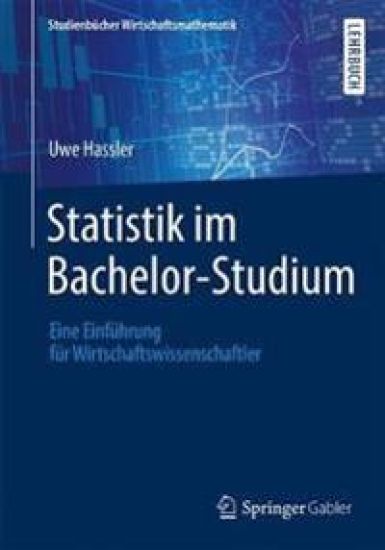
Statistik im Bachelor-Studium

Statistik im Bachelor-Studium

Uwe Hassler

Springer Gabler
2018
nidottu
Dieses Buch umfasst genau den Stoff, der typischerweise in Klausuren zu Einführungsvorlesungen "Statistik" an wirtschaftswissenschaftlichen Fachbereichen abgeprüft wird. Es enthält mehr als 100 ehemalige Klausuraufgaben mit Lösungen auf der Verlagsseite, die das Klausurtraining erleichtern sollen. Weiterhin finden sich über 60 vollständig durchgerechnete und ausformulierte Beispiele und Fallstudien.
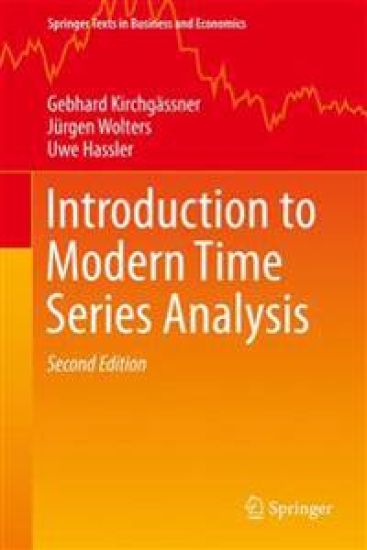
Introduction to Modern Time Series Analysis

Introduction to Modern Time Series Analysis

Gebhard Kirchgässner; Jürgen Wolters; Uwe Hassler

Springer-Verlag Berlin and Heidelberg GmbH Co. K
2012
sidottu
This book presents modern developments in time series econometrics that are applied to macroeconomic and financial time series, bridging the gap between methods and realistic applications. It presents the most important approaches to the analysis of time series, which may be stationary or nonstationary. Modelling and forecasting univariate time series is the starting point. For multiple stationary time series, Granger causality tests and vector autogressive models are presented. As the modelling of nonstationary uni- or multivariate time series is most important for real applied work, unit root and cointegration analysis as well as vector error correction models are a central topic. Tools for analysing nonstationary data are then transferred to the panel framework. Modelling the (multivariate) volatility of financial time series with autogressive conditional heteroskedastic models is also treated.
Introduction to Modern Time Series Analysis

Introduction to Modern Time Series Analysis

Gebhard Kirchgässner; Jürgen Wolters; Uwe Hassler

Springer-Verlag Berlin and Heidelberg GmbH Co. K
2014
nidottu
This book presents modern developments in time series econometrics that are applied to macroeconomic and financial time series, bridging the gap between methods and realistic applications. It presents the most important approaches to the analysis of time series, which may be stationary or nonstationary. Modelling and forecasting univariate time series is the starting point. For multiple stationary time series, Granger causality tests and vector autogressive models are presented. As the modelling of nonstationary uni- or multivariate time series is most important for real applied work, unit root and cointegration analysis as well as vector error correction models are a central topic. Tools for analysing nonstationary data are then transferred to the panel framework. Modelling the (multivariate) volatility of financial time series with autogressive conditional heteroskedastic models is also treated.