Kirjojen hintavertailu. Mukana 12 390 323 kirjaa ja 12 kauppaa.

Kirjahaku

Etsi kirjoja tekijän nimen, kirjan nimen tai ISBN:n perusteella.

5 kirjaa tekijältä Valérie Loichot

Water Graves

Water Graves

Valérie Loichot

University of Virginia Press
2020
sidottu
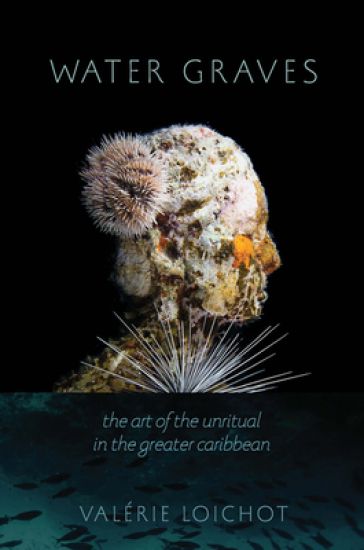
Water Graves considers representations of lives lost to water in contemporary poetry, fiction, theory, mixed media art, video production, and underwater sculptures. From sunken slave ships to the devastation of Hurricane Katrina, Valérie Loichot investigates the lack of official funeral rites in the Atlantic, the Caribbean Sea, and the Gulf of Mexico, waters that constitute both early and contemporary sites of loss for the enslaved, the migrant, the refugee, and the destitute. Unritual, or the privation of ritual, Loichot argues, is a state more absolute than desecration. Desecration implies a previous sacred observance--a temple, a grave, a ceremony. Unritual, by contrast, denies the sacred from the beginning.In coastal Louisiana, Mississippi, Georgia, Miami, Haiti, Martinique, Cancun, and Trinidad and Tobago, the artists and writers featured in Water Graves—an eclectic cast that includes Beyoncé, Radcliffe Bailey, Edwidge Danticat, Édouard Glissant, M. NourbeSe Philip, Jason deCaires Taylor, Édouard Duval-Carrié, Natasha Trethewey, and Kara Walker, among others—are an archipelago connected by a history of the slave trade and environmental vulnerability. In addition to figuring death by drowning in the unritual—whether in the context of the aftermath of slavery or of ecological and human-made catastrophes—their aesthetic creations serve as memorials, dirges, tombstones, and even material supports for the regrowth of life underwater.
Water Graves

Water Graves

Valérie Loichot

University of Virginia Press
2020
pokkari
Water Graves considers representations of lives lost to water in contemporary poetry, fiction, theory, mixed media art, video production, and underwater sculptures. From sunken slave ships to the devastation of Hurricane Katrina, Valerie Loichot investigates the lack of official funeral rites in the Atlantic, the Caribbean Sea, and the Gulf of Mexico, waters that constitute both early and contemporary sites of loss for the enslaved, the migrant, the refugee, and the destitute. Unritual, or the privation of ritual, Loichot argues, is a state more absolute than desecration. Desecration implies a previous sacred observance--a temple, a grave, a ceremony. Unritual, by contrast, denies the sacred from the beginning.In coastal Louisiana, Mississippi, Georgia, Miami, Haiti, Martinique, Cancun, and Trinidad and Tobago, the artists and writers featured in Water Graves—an eclectic cast that includes Beyoncé, Radcliffe Bailey, Edwidge Danticat, Édouard Glissant, M. NourbeSe Philip, Jason deCaires Taylor, Édouard Duval-Carrié, Natasha Trethewey, and Kara Walker, among others—are an archipelago connected by a history of the slave trade and environmental vulnerability. In addition to figuring death by drowning in the unritual—whether in the context of the aftermath of slavery or of ecological and human-made catastrophes—their aesthetic creations serve as memorials, dirges, tombstones, and even material supports for the regrowth of life underwater.
The Tropics Bite Back

The Tropics Bite Back

Valérie Loichot

University of Minnesota Press
2013
nidottu
The ubiquitous presence of food and hunger in Caribbean writing-from folktales, fiction, and poetry to political and historical treatises-signals the traumas that have marked the Caribbean from the Middle Passage to the present day. The Tropics Bite Back traces the evolution of the Caribbean response to the colonial gaze (or rather the colonial mouth) from the late nineteenth century to the twenty-first. Unlike previous scholars, ValÉrie Loichot does not read food simply as a cultural trope. Instead, she is interested in literary cannibalism, which she interprets in parallel with theories of relation and creolization. For Loichot, “the culinary” is an abstract mode of resistance and cultural production. The Francophone and Anglophone authors whose works she interrogates-including Patrick Chamoiseau, Suzanne CÉsaire, AimÉ CÉsaire, Maryse CondÉ, Edwidge Danticat, Édouard Glissant, Lafcadio Hearn, and Dany LaferriÈre-“bite back” at the controlling images of the cannibal, the starved and starving, the cunning cook, and the sexualized octoroon with the ultimate goal of constructing humanity through structural, literal, or allegorical acts of ingesting, cooking, and eating. The Tropics Bite Back employs cross-disciplinary methods to rethink notions of race and literary influence by providing a fresh perspective on forms of consumption both metaphorical and material.
Crusoe’s Footprint

Crusoe’s Footprint

Patrick Chamoiseau; Valérie Loichot

UNIVERSITY OF VIRGINIA PRESS
2022
sidottu
The discovery in Robinson Crusoe of the footprint of a fellow human on an abandoned island is a haunting and iconic moment in world literature. In the hands of Patrick Chamoiseau, one of the most innovative and lauded authors in the French language, this moment of shattered solitude becomes an occasion for Crusoe to reconsider his origins, existence, and humanity and for one of our most acclaimed novelists to craft a powerful meditation on race and history.Chamoiseau’s novel contrasts two intertwining narratives—the log entries of a slave ship’s captain and the story of a castaway who awakens on a beach and must rebuild his entire world alone. Chamoiseau creates a new perspective on the Crusoe myth, not only injecting the slave trade and Creole history into this previously ahistorical tale but conceiving an intensely original, freeform prose influenced by Creole cadence. This powerful work by a literary master is available in English for the first time in this eloquent and vivid translation.
Crusoe's Footprint

Crusoe's Footprint

Patrick Chamoiseau; Valérie Loichot

UNIVERSITY OF VIRGINIA PRESS
2022
pokkari
The discovery in Robinson Crusoe of the footprint of a fellow human on an abandoned island is a haunting and iconic moment in world literature. In the hands of Patrick Chamoiseau, one of the most innovative and lauded authors in the French language, this moment of shattered solitude becomes an occasion for Crusoe to reconsider his origins, existence, and humanity and for one of our most acclaimed novelists to craft a powerful meditation on race and history.Chamoiseau’s novel contrasts two intertwining narratives—the log entries of a slave ship’s captain and the story of a castaway who awakens on a beach and must rebuild his entire world alone. Chamoiseau creates a new perspective on the Crusoe myth, not only injecting the slave trade and Creole history into this previously ahistorical tale but conceiving an intensely original, freeform prose influenced by Creole cadence. This powerful work by a literary master is available in English for the first time in this eloquent and vivid translation.