Kirjojen hintavertailu. Mukana 11 372 381 kirjaa ja 12 kauppaa.

Kirjahaku

Etsi kirjoja tekijän nimen, kirjan nimen tai ISBN:n perusteella.

8 kirjaa tekijältä Vincent G. Potter

John Pecham

John Pecham

Vincent G. Potter

Fordham University Press
1993
sidottu
This dual-language book is a translation of John Pecham's De aeternitate mundi (On the Eternity of the World), written probably in 1270. Pecham was born in England around 1230. He pursued studies in Paris, where he may have been a student of Roger Bacon's, and at Oxford. He returned to Paris some time between 1257 and 1259 to study theology and in 1269-1270 became magister theologiae. It was at this time that he presumably wrote the essay translated here, and presented it as part of his inception, the equivalent of a doctrinal defense, in 1271, when he sought to become a magister regens, a member of the theological faculty. While Pecham was studying in Paris, two controversial theological "innovations" were being debated. The first issue involved the founding of the mendicant orders (Franciscans and Dominicans) in the first decade of the thirteenth century. Their active moving about, preaching and teaching, represented a departure from the established Rule of St. Benedict in which Orders were largely confined to monasteries. The second debate was over the introduction of the "new" philosophy of Aristotle. The Dominicans and Franciscans found themselves allied against the Latin Averroists (or Radical Aristotelians) on such issues as the unicity of the intellect and the assertion of the world's eternity in the sense that is was not created. The two Orders disagreed, however, on the truth of other Aristotelian theses such as the unicity of substantial form and the demonstrability of the world's having a beginning in time. On another front, having to do with the legitimacy of the Dominicans and Franciscans interpretation of religious life, the two Orders united under attacks from the secular clergy. Pecham, a Franciscan, witnessed his Order allied with the Dominicans against Averroists and secular clergy, and at odds with them over Aristotelianism in orthodox theology. During this tumultuous time Pecham met, and probably discussed his inception with Thomas, and his position on the eternity of the world can be compared to the treatment of the topic found in the writings of St. Thomas Aquinas and St. Bonaventure. In 1279, Pecham was named the Archbishop of Canterbury by Pope Nicolas III, in this position it was expected that he carry out reforms mandated by the Council of Lyons. The ruling of that council included the eradication of the Averroists radical departures from theological philosophy and some of the theses held by the Thomists. Pecham died in 1291, no doubt in disappointment that the reforms for which he had strived never came to pass.
Readings in Epistemology

Readings in Epistemology

Vincent G. Potter

Fordham University Press
1993
pokkari
Available in a new digital edition with reflowable text suitable for e-readers A companion volume to On Understanding Understanding, this second edition incorporates corrections to the previous text and includes new readings. The works collected in this volume are mainly from the British Empiricists. The breadth of the selection is not so diverse that the pieces cannot be readily understood by a newcomer to Epistemology, they have a logical progression of development (from Locke to Berkeley to Hume), and all of the philosophers whose work is represented have had great influence on contemporary Anglo-American philosophy. In the Introduction, Potter sets the selections in their historical context and urges the readers to form their own viewpoint in terms of the period's contribution to the advancement of culture, politics, and society. He gives a concise summary of the Enlightenment period, demonstrating how and why Rationalism and Empiricism came about, and challenges the reader not to simply note the points of disparity between the two schools, but to notice the similarities of their common assumptions – both substantive and methodological. Readings in Epistemology, Second Edition is an excellent classroom tool. A biographical note on the philosopher, and list of suggested books for further study, heads each of the readings. Study Questions which stimulate discussion, are at the end of each piece.
Readings in Epistemology

Readings in Epistemology

Vincent G. Potter

Fordham University Press
1993
sidottu
Available in a new digital edition with reflowable text suitable for e-readers A companion volume to On Understanding Understanding, this second edition incorporates corrections to the previous text and includes new readings. The works collected in this volume are mainly from the British Empiricists. The breadth of the selection is not so diverse that the pieces cannot be readily understood by a newcomer to Epistemology, they have a logical progression of development (from Locke to Berkeley to Hume), and all of the philosophers whose work is represented have had great influence on contemporary Anglo-American philosophy. In the Introduction, Potter sets the selections in their historical context and urges the readers to form their own viewpoint in terms of the period's contribution to the advancement of culture, politics, and society. He gives a concise summary of the Enlightenment period, demonstrating how and why Rationalism and Empiricism came about, and challenges the reader not to simply note the points of disparity between the two schools, but to notice the similarities of their common assumptions – both substantive and methodological. Readings in Epistemology, Second Edition is an excellent classroom tool. A biographical note on the philosopher, and list of suggested books for further study, heads each of the readings. Study Questions which stimulate discussion, are at the end of each piece.
Charles S. Peirce

Charles S. Peirce

Vincent G. Potter

Fordham University Press
1996
sidottu
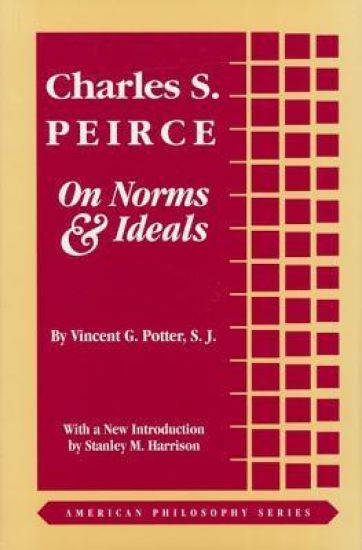
In recent years, Charles Sanders Peirce has emerged, in the eyes of philosophers both in America and abroad, as one of America's major philosophical thinkers. His work has forced us back to philosophical reflection about those basic issues that inevitably confront us as human beings, especially in an age of science. Peirce's concern for experience, for what is actually encountered, means that his philosophy, even in its most technical aspects, forms a reflective commentary on actual life and on the world in which it is lived. In Charles S. Peirce: On Norms and Ideals, Potter argues that Peirce's doctrine of the normative sciences is essential to his pragmatism. No part of Peirce's philosophy is bolder than his attempt to establish esthetics, ethics, and logic as the three normative sciences and to argue for the priority of esthetics among the trio. Logic, Potter cites, is normative because it governs thought and aims at truth; ethics is normative because it analyzes the ends to which thought should be directed; esthetics is normative and fundamental because it considers what it means to be an end of something good in itself. This study shows that pierce took seriously the trinity of normative sciences and demonstrates that these categories apply both to the conduct of man and to the workings of the cosmos. Professor Potter combines sympathetic and informed exposition with straightforward criticism and he deals in a sensible manner with the gaps and inconsistencies in Peirce's thought. His study shows that Peirce was above all a cosmological and ontological thinker, one who combined science both as a method and as result with a conception of reasonable actions to form a comprehensive theory of reality. Peirce's pragmatism, although it has to do with "action and the achievement of results, is not a glorification of action but rather a theory of the dynamic nature of things in which the "ideal" dimension of reality – laws, nature of things, tendencies, and ends – has genuine power for directing the cosmic order, including man, toward reasonable goals. Charles S. Peirce: On Norms and Ideals is available from the publisher on an open-access basis.
Charles S. Peirce

Charles S. Peirce

Vincent G. Potter

Fordham University Press
1996
pokkari
In recent years, Charles Sanders Peirce has emerged, in the eyes of philosophers both in America and abroad, as one of America’s major philosophical thinkers. His work has forced us back to philosophical reflection about those basic issues that inevitably confront us as human beings, especially in an age of science. Peirce’s concern for experience, for what is actually encountered, means that his philosophy, even in its most technical aspects, forms a reflective commentary on actual life and on the world in which it is lived. In Charles S. Peirce: On Norms and Ideals, Potter argues that Peirce’s doctrine of the normative sciences is essential to his pragmatism. No part of Peirce’s philosophy is bolder than his attempt to establish esthetics, ethics, and logic as the three normative sciences and to argue for the priority of esthetics among the trio. Logic, Potter cites, is normative because it governs thought and aims at truth; ethics is normative because it analyzes the ends to which thought should be directed; esthetics is normative and fundamental because it considers what it means to be an end of something good in itself. This study shows that pierce took seriously the trinity of normative sciences and demonstrates that these categories apply both to the conduct of man and to the workings of the cosmos. Professor Potter combines sympathetic and informed exposition with straightforward criticism and he deals in a sensible manner with the gaps and inconsistencies in Peirce’s thought. His study shows that Peirce was above all a cosmological and ontological thinker, one who combined science both as a method and as result with a conception of reasonable actions to form a comprehensive theory of reality. Peirce’s pragmatism, although it has to do with "action and the achievement of results, is not a glorification of action but rather a theory of the dynamic nature of things in which the "ideal" dimension of reality – laws, nature of things, tendencies, and ends – has genuine power for directing the cosmic order, including man, toward reasonable goals. Charles S. Peirce: On Norms and Ideals is available from the publisher on an open-access basis.