
Kirjahaku
Etsi kirjoja tekijän nimen, kirjan nimen tai ISBN:n perusteella.
8 kirjaa tekijältä Vivek Verma


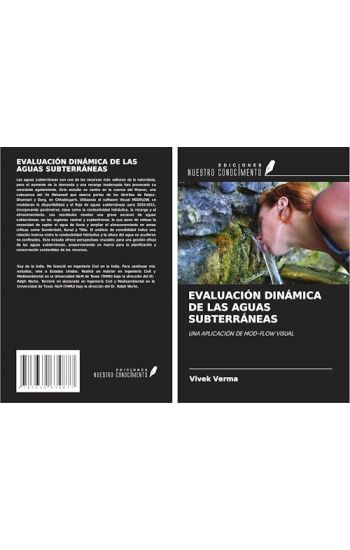
EVALUACIÓN DINÁMICA DE LAS AGUAS SUBTERRÁNEAS
Vivek Verma
Ediciones Nuestro Conocimiento
2025
nidottu
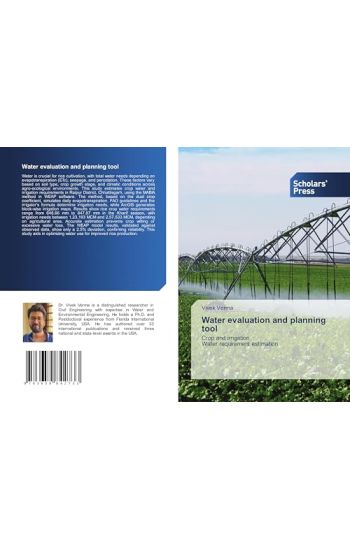
Water is crucial for rice cultivation, with total water needs depending on evapotranspiration (ETc), seepage, and percolation. These factors vary based on soil type, crop growth stage, and climatic conditions across agro-ecological environments. This study estimates crop water and irrigation requirements in Raipur District, Chhattisgarh, using the MABIA method in WEAP software. The method, based on the dual crop coefficient, simulates daily evapotranspiration. FAO guidelines and the irrigator's formula determine irrigation needs, while ArcGIS generates block-wise irrigation maps. Results show rice crop water requirements range from 648.66 mm to 847.87 mm in the Kharif season, with irrigation needs between 1,23,193 MCM and 2,57,533 MCM, depending on agricultural area. Accurate estimation prevents crop wilting or excessive water loss. The WEAP model results, validated against observed data, show only a 2.5% deviation, confirming reliability. This study aids in optimizing water use for improved rice production.
Groundwater is one of nature's most valuable resources, yet increasing demand and inadequate recharge have led to its steady depletion. This study focuses on the Kharun Basin, a sub-basin of the Mahanadi River, covering parts of Raipur, Dhamtari, and Durg districts in Chhattisgarh. Using Visual MODFLOW software, groundwater availability and flow were modeled for 2010-2011, incorporating key parameters such as hydraulic conductivity, recharge, and storage. Results reveal severe groundwater scarcity in the middle and northern regions, highlighting the need for rainwater harvesting and storage expansion in critical areas like Gunderdehi, Kurud, and Tilda. Sensitivity analysis indicates an inverse relationship between hydraulic conductivity and water head in unconfined aquifers. This study offers crucial insights for effective groundwater management, providing a framework for sustainable resource planning and conservation.
Demystifies non-contact warfare, and explores the labyrinth of development post-World War II. Disruption, denial, distortion, disempowerment, destabilisation and destruction are a few themes that the world is likely to witness as the dominance strategy using non-contact warfare unfolds.