Kirjojen hintavertailu. Mukana 11 627 469 kirjaa ja 12 kauppaa.

Kirjahaku

Etsi kirjoja tekijän nimen, kirjan nimen tai ISBN:n perusteella.

4 kirjaa tekijältä Vladimir Brovkin

Vladimir Brovkin: Velikaja Oktjabrskaja katastrofa 1917-1921
Eta kniga - o tom, kak russkaja revoljutsija 1917 goda pererosla v Grazhdanskuju vojn u 1917-1922 godov, okhvativshuju vse sloi naselenija. Izuchajutsja i analizirujutsja prichiny i posledstvija Oktjabrskogo perevorota 1917 goda. Po-novomu osmysljaetsja borba politicheskikh partij v 1917 godu, slabost novoj vlasti i skatyvanie ee metodov upravlenija ot khaosa k terroru. Grazhdanskaja vojn a rassmatrivaetsja i kak vzlet i padenie belogo dvizhenija, i kak voj na bolshevikov protiv krestjanskikh povstantsev - "zelenykh", privedshikh k Kronshtadtskomu i Tambovskomu vosstanijam. Osvescheno bolshoe kolichestvo faktov, iskazhennykh ili zabytykh blagodarja usilijam Lenina i ego partii, s tsitatami i ssylkami na neizvestnye dokumenty iz arkhivov mnogikh stran. Kniga pokazyvaet, pochemu Oktjabr 1917 goda sleduet otsenivat kak velikuju katastrofu dlja rossijskogo obschestva.
Russia After Lenin

Russia After Lenin

Vladimir Brovkin

Routledge
1998
sidottu
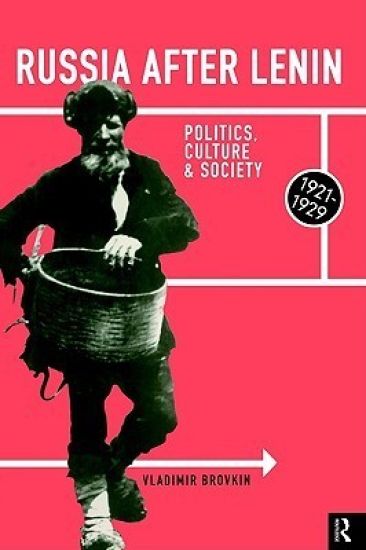
Following the Russian Revolution, the cultural and political landscape of Russia was strewn with contradictions. The dictatorship, censorship and repression of the Communist party existed alongside private enterprise, the black market and open debates on Socialism. In Russian Society and politics 1921-1929 Vladimir Brovkin offers a comprehensive cultural, political, economic and social history of developments in Russia in the 1920's. By examining the contrast between Bolshevik propaganda claims and social reality, the author explains how Communist representations were variously received and resisted by workers, peasants, students, women, teachers and party officials. He presents a picture of cultural diversity and rejection of Communist constraints through many means including unauthorised protest, religion, jazz music and poetry. In Russian Society and Politics 1921-1929 Vladimir Brovkin argues that these trends, if left unchecked, endangered the Communist Party's monopoly on political power. The Stalinist revolution can thus be seen as a pre-emptive strike against this independent and vibrant society as well as a product of Stalin's personality and communist ideology.
Russia After Lenin

Russia After Lenin

Vladimir Brovkin

Routledge
1998
nidottu
Following the Russian Revolution, the cultural and political landscape of Russia was strewn with contradictions. The dictatorship, censorship and repression of the Communist party existed alongside private enterprise, the black market and open debates on Socialism. In Russian Society and politics 1921-1929 Vladimir Brovkin offers a comprehensive cultural, political, economic and social history of developments in Russia in the 1920's. By examining the contrast between Bolshevik propaganda claims and social reality, the author explains how Communist representations were variously received and resisted by workers, peasants, students, women, teachers and party officials. He presents a picture of cultural diversity and rejection of Communist constraints through many means including unauthorised protest, religion, jazz music and poetry. In Russian Society and Politics 1921-1929 Vladimir Brovkin argues that these trends, if left unchecked, endangered the Communist Party's monopoly on political power. The Stalinist revolution can thus be seen as a pre-emptive strike against this independent and vibrant society as well as a product of Stalin's personality and communist ideology.
The Mensheviks After October

The Mensheviks After October

Vladimir Brovkin

Cornell University Press
1991
pokkari
In this major contribution to our understanding of the Russian Revolution, Vladimir Brovkin provides the fullest account to date of the Menshevik party during the first year of Soviet rule. Focusing on the period from October 1917 through October 1918—months when the Soviet political system still permitted a degree of electoral competition among political parties—he explores the moderate socialists' opposition to the Bolsheviks. Why, he asks, did the competition between the Bolsheviks and their socialist opponents lead to a violent confrontation? And how did their struggle shape the increasingly repressive political system that emerged during this period? Brovkin examines several major aspects of Menshevik party history in an effort to discover the organization's place in the revolutionary upheavals that rocked Russian society. He analyzes the debates within the party over the best policy for opposing the Bolsheviks and describes the Mensheviks' attempt to undermine their rivals by winning the support of the working class. He depicts too the struggle for party leadership and the changing composition of the membership. Finally, Brovkin explores the Mensheviks' interactions with their sometime ally the Socialist Revolutionary (SR) party and other opposition groups and traces the increasingly confrontational competition between the moderate socialists and the Bolsheviks, concluding his account with the onslaught of the Red Terror and the first stage of the civil war. Drawing on an impressive array of primary sources, Brovkin convincingly shows that as the political struggle progressed, the Mensheviks, together with the SRs, were seen as a serious challenge to the Bolsheviks. He argues, further, that the Bolsheviks' determination to counter this perceived threat led them to undertake the repressive actions that both crushed their opposition and transformed the Soviet government into a dictatorship.