Kirjojen hintavertailu. Mukana 11 699 587 kirjaa ja 12 kauppaa.

Kirjahaku

Etsi kirjoja tekijän nimen, kirjan nimen tai ISBN:n perusteella.

3 kirjaa tekijältä Vladimir Lepetic

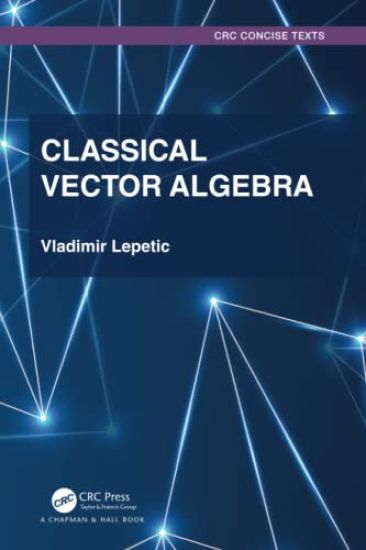
Classical Vector Algebra

Classical Vector Algebra

Vladimir Lepetic

TAYLOR FRANCIS LTD
2022
nidottu
Every physicist, engineer, and certainly a mathematician, would undoubtedly agree that vector algebra is a part of basic mathematical instruments packed in their toolbox.Classical Vector Algebra should be viewed as a prerequisite, an introduction, for other mathematical courses dealing with vectors, following typical form and appropriate rigor of more advanced mathematics texts. Vector algebra discussed in this book briefly addresses vectors in general 3-dimensional Euclidian space, and then, in more detail, looks at vectors in Cartesian ??3 space. These vectors are easier to visualize and their operational techniques are relatively simple, but they are necessary for the study of Vector Analysis. In addition, this book could also serve as a good way to build up intuitive knowledge for more abstract structures of ??-dimensional vector spaces.Definitions, theorems, proofs, corollaries, examples, and so on are not useless formalism, even in an introductory treatise -- they are the way mathematical thinking has to be structured. In other words, "introduction" and "rigor" are not mutually exclusive. The material in this book is neither difficult nor easy. The text is a serious exposition of a part of mathematics students need to master in order to be proficient in their field. In addition to the detailed outline of the theory, the book contains literally hundreds of corresponding examples/exercises.
Classical Vector Algebra

Classical Vector Algebra

Vladimir Lepetic

TAYLOR FRANCIS LTD
2022
sidottu
Every physicist, engineer, and certainly a mathematician, would undoubtedly agree that vector algebra is a part of basic mathematical instruments packed in their toolbox.Classical Vector Algebra should be viewed as a prerequisite, an introduction, for other mathematical courses dealing with vectors, following typical form and appropriate rigor of more advanced mathematics texts. Vector algebra discussed in this book briefly addresses vectors in general 3-dimensional Euclidian space, and then, in more detail, looks at vectors in Cartesian ??3 space. These vectors are easier to visualize and their operational techniques are relatively simple, but they are necessary for the study of Vector Analysis. In addition, this book could also serve as a good way to build up intuitive knowledge for more abstract structures of ??-dimensional vector spaces.Definitions, theorems, proofs, corollaries, examples, and so on are not useless formalism, even in an introductory treatise -- they are the way mathematical thinking has to be structured. In other words, "introduction" and "rigor" are not mutually exclusive. The material in this book is neither difficult nor easy. The text is a serious exposition of a part of mathematics students need to master in order to be proficient in their field. In addition to the detailed outline of the theory, the book contains literally hundreds of corresponding examples/exercises.
Principles of Mathematics

Principles of Mathematics

Vladimir Lepetic

Wiley-Blackwell
2016
sidottu
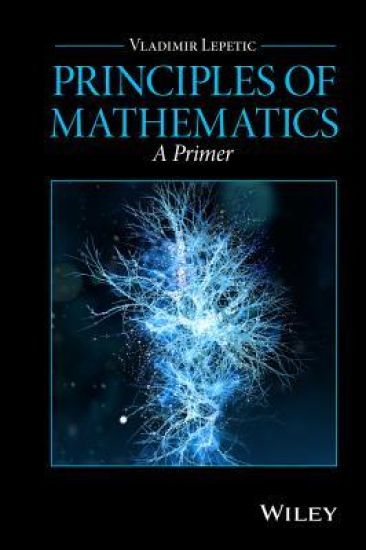
Presents a uniquely balanced approach that bridges introductory and advanced topics in modern mathematics An accessible treatment of the fundamentals of modern mathematics, Principles of Mathematics: A Primer provides a unique approach to introductory andadvanced mathematical topics. The book features six main subjects, whichcan be studied independently or in conjunction with each other including: settheory; mathematical logic; proof theory; group theory; theory of functions; andlinear algebra. The author begins with comprehensive coverage of the necessary building blocks in mathematics and emphasizes the need to think abstractly and develop an appreciation for mathematical thinking. Maintaining a useful balance of introductory coverage and mathematical rigor, Principles of Mathematics: A Primer features: Detailed explanations of important theorems and their applicationsHundreds of completely solved problems throughout each chapterNumerous exercises at the end of each chapter to encourage further explorationDiscussions of interesting and provocative issues that spark readers’ curiosity and facilitate a better understanding and appreciation of the field of mathematics Principles of Mathematics: A Primer is an ideal textbook for upper-undergraduate courses in the foundations of mathematics and mathematical logic as well as for graduate-level courses related to physics, engineering, and computer science. The book is also a useful reference for readers interested in pursuing careers in mathematics and the sciences.